The Western confrontation with fundamentalist Islam has in some ways come to resemble the great ideological battle of the twentieth century, that between Marxism-Leninism and liberal democracy. Not only do Americans frame the discussion about Iran and Algeria much as they did the earlier one about the Soviet Union and China, but they also differ among themselves on the question of fundamentalist Islam roughly along the same lines as they did on the Cold War. Liberals say co-opt the radicals. Conservatives say confront them. As usual, the conservatives are right.
At first glance, how to deal with fundamentalist Islam appears to be a discussion unrelated to anything that's come before. Islam is a religion, not an ideology, so how can the U.S. government formulate a policy toward it? A closer look reveals that while Islam is indeed a faith, its fundamentalist variant is a form of political ideology. Fundamentalists may be defined, most simply, as those Muslims who agree with the slogan that "Islam is the solution." When it comes to politics in particular, they said that Islam has all the answers. The Malaysian leader Anwar Ibrahim spoke for fundamentalist Muslims everywhere when he asserted some years ago that "We are not socialist, we are not capitalist, we are Islamic." For the fundamentalists, Islam is primarily an "-ism," a belief system about ordering power and wealth.
 Much distinguishes fundamentalism from Islam as it was traditionally practiced, including this emphasis on public life (rather than faith and personal piety); its leadership by schoolteachers and engineers (not religious scholars); and its Westernized quality (for example, whereas Muslims traditionally did not consider Friday to be a Sabbath, fundamentalists have turned it into precisely that, imitating the Jewish Saturday and Christian Sunday). In brief, fundamentalism represents a thoroughly modern effort to come to terms with the challenges of modernization.
The great majority of Muslims disagree with the premises of fundamentalist Islam, and a small number do so vocally. A few, like Salman Rushdie and Taslima Nasrin, have acquired global reputations, but most toil more obscurely. When a newly elected deputy to the Jordanian parliament last fall called fundamentalist Islam "one of the greatest dangers facing our society" and compared it to "a cancer" that "has to be surgically removed," she spoke for many Muslims.
As an ideology, fundamentalist Islam can claim none of the sanctity that Islam the religion enjoys. While remaining respectful of the Islamic faith, Americans can in good conscience criticize fundamentalism.
Battle Lines
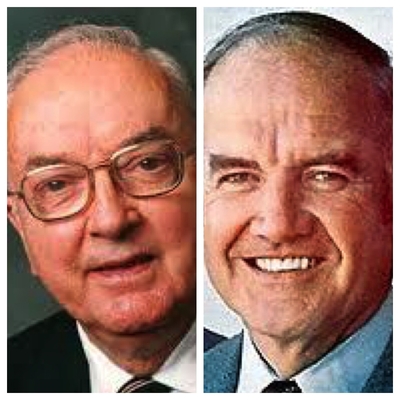 Jesse Helms (L) and George McGovern. |
- Causes: The Left, in keeping with its materialist outlook, sees communist or fundamentalist Islamic ideology as a cover for some other motivation, probably an economic one. The Russian Revolution expressed deep-seated class grievances; fundamentalist violence in Algeria, the State Department tells us, expresses "frustration arising from political exclusion and economic misery." In contrast, the Right sees radical utopian ideology as a powerful force in itself, and not just as an expression for socio-economic woes. Ideas and ambitions count at least as much as the price of wheat: visions of a new order go far to account for the revolutions of 1917 and 1979.
- Solutions: If misery causes radicalism, as the Left argues, then the antidote lies in economic growth and social equity. The West can help in these areas through aid, trade, and open lines of communication. But if, as the Right believes, ambitious intellectuals are the problem, then they must be battled and defeated. In both cases, liberals look to cooperation, conservatives to confrontation.
- The West's responsibility: The Left sees Western hostility as a leading cause for things having gone wrong. According to one journalist, the West "made its own sizable contribution" to causing the current crisis in Algeria. It's the old liberal "blame America first" attitude: just as Americans were responsible for every Soviet trespass from Stalin to the arms race, so they are now answerable for the appearance of Ayatollah Khomeini (due to U.S. support for the shah) and for the many Arab fundamentalist movements (due to U.S. support for Israel). The Right adamantly denies Western culpability in both cases, for that would absolve tyrants of their crimes. We made mistakes, to be sure, but that's because we find it hard to contend with radical utopian movements. Along these lines, Arnold Beichman argues that "We are at the beginning of what promises to be a long war in which new moral complexities... will present themselves as once they did in the days of Soviet communism."
- A single source: When the State Department disclaims "monolithic international control being exercised over the various Islamic movements," it uses almost the same words as it once used to speak of Marxism-Leninism. For decades, American "progressives" insisted that communist organizations around the world had indigenous sources and did not owe anything to Moscow (a claim easier to make so long as Moscow's archives remained closed). To which conservatives have long replied: Of course, there's no "monolithic international control," but there is an awful lot of funding and influence. Tehran administers a network akin to an Islamist Comintern, making its role today not that different from Moscow's then.
- The antis: For many decades, the Left saw those Russians, Chinese, and Cubans whose first-hand experience turned them into anti-communists as marginal elements. In similar fashion, the Left today looks at anti-fundamentalist Muslims as unauthentic or sellouts. Churches are among the worst offenders here. For example, in one recent analysis, a German priest presented the extremist element as the Muslim community per se. The Right wholeheartedly celebrates both types of antis as brave individuals bringing advance word of the terrors that result from efforts radically to remake society.
- Do moderates exist? The Left distinguishes between those ideologues willing to work within the system (deemed acceptable) and those who rely on violence and sabotage (deemed unacceptable). The Right acknowledges differences in tactics but perceives no major difference in goals. Accordingly, it tends to lump pretty much all communists or fundamentalists together.
- Motives: When the other side strikes out in an aggressive way, the Left often excuses its acts by explaining how they are defensive in nature. Invasions by Napoleon and Hitler explain the Soviet presence in Angola; a legacy of colonial oppression accounts for the depths of fundamentalist rage. The Right concludes from events like the downing of a Korean Airlines flight or the World Trade Center bombing that the other side has offensive intentions, and listens to no excuses.
- Fighting words: The two sides draw contrary conclusions from aggressive speech. Liberals dismiss the barrage of threats against the West (a Muslim prisoner in a French court: "We Muslims should kill every last one of you [Westerners]") as mere rhetoric. Conservatives listen carefully and conclude that the West needs to protect itself (France's Interior Minister Charles Pasqua: fundamentalist groups "represent a threat to us").
- Threat to the West: If they are only approached with respect, Marxist-Leninists and fundamentalist Muslims will leave us alone, says the Left. Don't treat them as enemies and they won't hurt us. The Right disagrees, holding that all revolutionaries, no matter what their particular outlook (communist, fascist, fundamentalist), are deeply anti-Western and invariably target the West. Their weaponry ranges from Soviet ICBMs to truck bombs, but their purpose is the same: to challenge the predominance of modern, Western civilization. And if truck bombs threaten less than missiles, it needs to be noted that fundamentalists challenge the West more profoundly than do communists. The latter disagree with our politics but not our whole way of life (how could they, even as they pay homage to Dead White Males like Marx and Engels?). In contrast, fundamentalist Muslims despise our whole way of life, including the way we dress, mate, and pray. To appease communists, we would need to change the political and economic spheres; to appease fundamentalists means women taking up the veil, scuttling nearly every form of diversion, and overhauling the judicial system.
- Future prospects: In the 1950s, the Left portrayed Marxism-Leninism as the wave of the future; today, it ascribes the same brilliant prospect to fundamentalist Islam. In other words, these radical ideologies are an unstoppable force; stand in their way and you'll not only get run over but you might even spur them on. But conservatives see utopianism enjoying an only temporary surge. The effort to remake mankind, they say, cannot work; like communism, fundamentalism has to end up in the dustbin of history.
Conciliation or Confrontation?
 Summing up, the Left is more sanguine than the Right about both communism and fundamentalist Islam. It's hard to imagine a conservative calling the Ayatollah Khomeini "some kind of saint," as did Jimmy Carter's ambassador to the United Nations, Andrew Young. It's about as unlikely to hear a liberal warning, along with France's Defense Minister François Leotard, that "Islamic nationalism in its terrorist version is as dangerous today as National Socialism was in the past." On the scholarly level, a liberal Democrat like John Esposito publishes a book titled The Islamic Threat: Myth or Reality? and concludes that the threat is but a myth. In complete contrast, Walter McDougall, the Pulitzer-prize-winning historian and sometime assistant to Richard Nixon, sees Russia helping the West in "holding the frontier of Christendom against its common enemy," the Muslim world.
These contrary analyses lead, naturally, to very different prescriptions for U.S. policy. The Left believes that dialogue with the other side, communist or fundamentalist Muslim, has several advantages: it helps us understand their legitimate concerns, signal them that we mean them no harm, and reduce mutual hostility. Beyond dialogue, the West can show good will by reducing or even eliminating its military capabilities. Roughly speaking, this is the Clinton Administration position. In Algeria, for instance, it hopes to defuse a potential explosion by urging the regime to bring in fundamentalist leaders who reject terrorism, thereby isolating the violent extremists.
The Right has little use for dialogue and unilateral disarmament. Communists and fundamentalists being invariably hostile to our way of life, we should show not empathy but resolve; not good will but will power. And what better way to display these intentions than with armed strength? Now as then, conservatives think in terms of containment and rollback. For conservatives, Algeria fits into the tradition of friendly tyrants-states where the rulers treat their own population badly but who help the United States fend off a radical ideology. It makes sense to stand by Algiers (or Cairo) just as it earlier made sense to stick by Saigon or Pinochet in Chile.
Of course, the schema presented here does not align perfectly. In its confusion, the Reagan Administration searched for "moderates" in Iran (an effort led by none other than Oliver North). The Bush Administration enunciated a soft policy toward fundamentalism. And the Clinton Administration has pursued a more resolute policy toward Iran than either of its predecessors. Interests sometimes seem to count more than ideology. The liberal Clinton Administration speaks out against a crackdown on fundamentalists in Algeria, where the stakes are low for Americans, but accepts tough measures in Egypt, where the United States has substantial interests. The conservative French government bemoans the crackdown in Egypt (not so important for it) but encourages tough measures in Algeria (very important).
 Still, the basic pattern is clear. And as the lines of debate sort themselves out, the two sides are likely to stick more consistently to their characteristic positions. This suggests that while Marxism-Leninism and fundamentalist Islam are very different phenomena, Westerners respond in similar ways to ideological challenges.
They do so owing to a profound divide in outlook. American liberals believe in the peaceful and cooperative nature of mankind; when confronted with aggression and violence, they tend to assume it is motivated by a just cause, such as socio-economic deprivation or exploitation by foreigners. Anger cannot be false, especially if accompanied by the high-minded goals of communists or fundamentalists. Less innocently, conservatives know the evil that lurks in the men's hearts. They understand the sometimes important roles of fanaticism and hatred. Just because an ideology has utopian aims does not mean that its adherents have lofty motives or generous ambitions.
Few readers of the National Review will be surprised to learn that the Left's soft approach to fundamentalist Islam predominates in Washington, in the universities, the churches, and the media. Indeed, to recall one of the Left's favorite phrases, it has become the hegemonic discourse in the United States. On the other side stand nothing but a handful of scholars, some commentators and politicians, and the great common sense of the American people. Americans know an opponent when they see him, and are not fooled by the Left's fancy arguments. That common sense prevailed in the Cold War and no doubt will suffice yet again to wrestle down the follies of the New Class.


