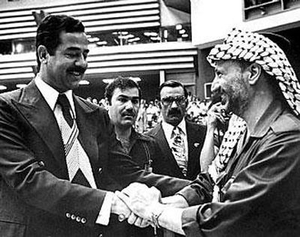
 Saddam Hussein (L) and Yasir Arafat in better times. |
To make matters worse, Kuwait was the Palestinians' El Dorado, and their wealth in that country was almost completely lost. The numbers involved are large, even if they don't reach the wild estimates proffered by PLO officials: $8 billion according to Muhammad Milham of the PLO Executive Committee; somewhere between $8.5 billion and $12.6 billion according to Yasir Arafat; and $13 billion according to Salim az-Za'nun, the PLO's representative in Kuwait. (These obviously hyperbolic numbers have been picked up by reputable media; Jonathan C. Randal reports the $10 billion figure with a straight face in The Washington Post.) In addition, Palestinians in the territories occupied by Israel lost, again according to Yasir Arafat, $1.4 billion.
Alienating contributors and losing capital has serious consequences for the PLO. Its income appears to be about half of what it was before Aug. 2 and expenditures have fallen by 30 percent. According to a report in The Jerusalem Post, the organization's revenue fell by as much as 90 percent. PLO employees, armed and not, have already experienced pay cuts and more reductions lie ahead. A reduction of pay to Palestinian fighters in early 1991 provoked a mutiny in Fatah in Lebanon; Fatah responded by summarily executing the malcontents, apparently hoping this would prevent a collapse in the chain of command.
Although it would be unwise ever to discount the PLO, an organization that regularly rebounds from adversity, this blow can be expected severely to crimp its activities and its ambition to remain the dominant Palestinian organization.
Sources of Money
During the PLO's heyday in Lebanon, 1970-82, when it ran a state-within-a-state, revenues derived mostly from a wide array of legal and illegal commercial activities. The result was a formidable war chest. Abu Musa, a one-time ally of Arafat's, has stated that in 1982 the PLO had $1 billion in Lebanese banks alone.
On the legal side, the PLO got involved in some surprising ventures. The Popular Front for the Liberation of Palestine, for example, ran the Modern Mechanical Establishment, an iron and steel company south of Sidon. The company made money by paying no taxes, using coercive sales methods, and engaging in predatory pricing. Then, after forcing the competition to go out of business, it raised prices.
Lebanon's anarchy offered unbounded opportunities for illegal activities: drug trafficking, protection rackets, robberies, hijackings, and the training of foreign terrorists. Drug trafficking was by far the steadiest and most lucrative racket during the Lebanon years; during the late 1970s, when the PLO ruled substantial portions of Lebanon, drug-trafficking is said to have brought the PLO $300 million a year. Other activities also brought spectacular returns. The December 1975 capture of OPEC oil ministers reportedly netted the PLO $20 million. A few months later, the PLO participated in what the Guinness Book of World Records calls the largest bank heist of all time; robbing the Beirut branch of the British Bank of the Middle East brought the PLO one-third the loot, between $16 and $33 million.
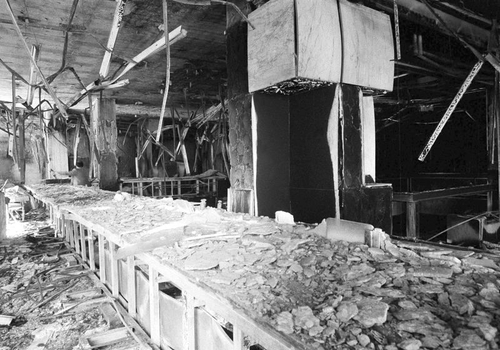 The counter of the British Bank of the Middle East seen about a week after the heist, its insides gutted by fire, explosions and looters. (Harry Koundakjian/AP) |
Also, while Soviet-bloc aid used to amount to the equivalent of tens of millions of dollars annually, provided in cash, arms, training, and intelligence, Eastern Europe's liberation and the ravages of perestroika have caused this once-reliable source virtually to dry up.
Deprived of these sources, the PLO has in recent years become heavily dependent on handouts from Arab presidents, kings, and emirs - a demeaning return to pre-1970 circumstances. Gone are those heady days when Arafat had the leeway to act independently of his state sponsors. The PLO has steadily received at least $100 million a year from the Arab states since 1973, but the amount has recently edged toward $250-300 million a year. Arab states agreed to take up this slack in PLO funding primarily for offensive reasons (to gain influence) or defensive ones (to avoid retribution); in some cases they may even have done so out of conviction.
Nearly all of this income came from Kuwait, Saudi Arabia, and the other states that have just cut the PLO off. According to PLO records made public in 1988, the Saudi authorities over the previous decade had donated $855 million. Salim az-Za'nun, the PLO's representative in Kuwait, announced that the Kuwaitis had provided his organization with $2 billion over 26 years. In fact, the total contribution was much more, for both governments funneled massive amounts to Yasir Arafat personally. Abu Musa, indirectly confirmed this point in 1983: "Saudi Arabia gives him tens, hundreds of millions, to corrupt not to develop the revolution. It does not appear in the books. It is much more than the official contributions."
Not all the money came from government coffers. Palestinians living in Arab countries are supposed to pay 3 to 7.5 percent of their salaries by way of tax to the PLO. While it is unclear when and where these funds were actually collected and transmitted to the PLO, it appears that Kuwait, Saudi Arabia, and the UAE were the only states to do so on a regular basis; Samir Khalaf estimated that Palestinians in Kuwait alone sent $150 million a year to the West Bank and Gaza before the Iraqi invasion. All this has come to an end since Aug. 2, 1991.
Individual Palestinians make contributions, especially at times of crisis, ranging from the very small (the purchase of "Arab Liberation Stamps") to the very large. Some contributions are voluntary, others extracted by threats.
Money Troubles
The PLO's operations and political prominence depend heavily on money, and so the sudden disappearance of half the organization's budget is causing many problems.
Money gives Yasir Arafat control over some twenty thousand gunmen, consisting of both conventional and irregular forces. It permits diplomacy on a grand scale; the PLO has two more "embassies" than Israel and 'Arafat sometimes visits three or four capitals in his own plane on a single day. It furthers the PLO's terrorist and military efforts. There's nothing like buying a small airline to penetrate the world of civil aviation, and this is what the PLO has done, through one George Khallaq, when it bought part equity in Transportes Aeros de Guinea-Bissau. On a smaller scale, the PLO has shown a marked interest in leasing commercial space at airports.
Money permits him to influence states by moving around liquid assets. Some $700 million was moved out of Jordan in 1986 to protest King Hussein's policies; $200 million was once transferred into Tunisia as a reward. Nor are all investments apolitical. Funds are on occasion loaned to allies in need, such as $12 million to the Nicaraguan government in 1981 and $100 million to Iraq in 1986. "Friendship" projects have included factories and farms in places like Syria, Guinea, the Maldives, and Poland. Arafat also has the means to do the odd favor. In 1985, he is said to have won the release of three Soviet hostages held in Beirut by paying $15 million to fundamentalist Muslims.
Money sways public opinion by allowing the PLO to subsidize the media. In February 1986, for example, a payment of some $150,000 to the pro-Jordanian Al-Quds newspaper of Jerusalem rapidly turned around that paper's editorial stance.
Money reduces the chances that a rival Palestinian organization will challenge Arafat's leadership. Half a year after the intifada erupted, the PLO responded by offering $50 million to its leadership - a clear attempt to bring an unruly upstart under company control. Hamas, the fundamentalist Muslim group that has emerged as the PLO's only serious rival, hopes to join the PLO to tap its funds.
Money makes it possible to provision social, welfare, economic, cultural, and educational services which win Palestinian allegiance to the PLO. When traveling in poor countries, Arafat dispenses money freely.
Finally, not to be overlooked is the opulent way of life - elegant villas in Tunisia, first-class travel, and the other perquisites of power - that money bestows on the PLO pashas. Zuhayr Muhsin, for example, acquired a pronounced taste for gambling on the Côte d'Azur. Others put aside impressive nest eggs. Wadi Haddad, the PLO's explosive expert killed in 1978, is said by his comrades-in-arms to have left his sister a bequest of $140 million.
Notwithstanding the talk of Arafat's abstemious ways, he too enjoys what one newspaper account terms "a billionaire's life," including private planes, government guest houses, and the like. Those in the know also point to the fortune he has put aside. The Saudi press noted that Arafat "helps himself to the aid supplied to the PLO and the Palestinians." Mustafa Tallas, the Syrian defense minister, claims that Yasir 'Arafat owns $12 billion in his own name and is "one of the world's ten richest men." Tallas further claims 'Arafat stole £1.7 billion from Ar-Rafidayn Bank in Beirut, which he deposited in his own name, not that of the PLO." While this is obviously hyperbole, Arafat himself does not deny possessing "a great deal of money." He alleges, however, that it comes entirely from the money he made as an engineer in the 1950s in Kuwait; from the PLO, he claims to take not so much as a salary.
To maintain close control over PLO finances, Arafat personally makes deposits and signs large checks. While this highly centralized control leads to resentments and gross inefficiencies, it also makes 'Arafat indispensable. As one Jordanian official put it, "They have to keep Arafat because if he goes, no one will know where the money is."
Wealth has become so central to the PLO's presence and influence, it sometimes looms larger than military considerations. "Money is [Arafat's] only weapon at present," Abu Musa declared already in 1983. Thus, when the PLO evacuated Beirut in 1982, James Adams explains, its leaders "feared the Israeli seizure of their assets more than they did a military defeat." (Not without reason; that exodus is estimated to have cost them $400 million.) Confirming this attitude, a White House official recollects, "We got these messages from the PLO containing lists of BMWs and Mercedes' that they wanted to get on to the ships. They were very concerned to get their fleets of cars on as well as their families." Heavy dependence on large amounts of money has taken its toll; as an unnamed Jordanian official once put it, "The PLO isn't a revolution. It's a corporation."
Declining Fortunes
The size and sophistication of the PLO financial apparatus makes it a key power center of the organization. One can go further: while foiling attacks and capturing foot soldiers remains important, the only way to hobble and finally put an end to PLO terrorist operations is to hit it where it counts most - in the wallet.
Every attempt until now to count out the PLO has proven wrong; no one can predict its demise with confidence. (A bit prematurely, Zbigniew Brzezinski waved "Bye bye, PLO" in 1977.) But the current situation, described by Foreign Report as a "financial catastrophe," is likely to translate into a severe decline in the popularity of Yasir 'Arafat and the authority of the PLO.
Some may find this development unfortunate because it obstructs resolution of Palestinian-Israeli issues. But that grants the PLO too much. It is actually today's representative of that radical Palestinian tradition that, as Abba Eban put it, has never missed an opportunity to miss an opportunity. Far from serving as a force for peace, the PLO has bludgeoned and suppressed more moderate elements willing to coexist with Israel. For this reason, its financial predicament offers not just the likelihood of less violence in the Middle East but also a rare opportunity for alternative Palestinian voices to make themselves heard. Let us hope that they take advantage of the moment.


