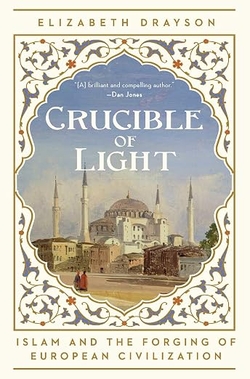
 Drayson of Cambridge University asserts that "conventional histories" of Christian-Muslim relations "tend to chart the legacy of a centuries-long mutual antagonism and violent conflict between the Muslims and Christians of Europe." In contrast, she writes of "a new, alternative kind of history ... bringing to light the suppressed cultural and religious elements that have contributed to the creation of modern Europe."
This cheery outlook, which Drayson declares "overlooked, unappreciated or [simply] unknown," concerns "the tolerance and exchange that catalysed Europe's cultural illumination and gave rise to its associated and immeasurable debt to Islamic civilization." Or, as the subtitle announces, Muslims had a key role in "the forging of European civilization." She grandly proclaims "the profound influence of Muslim life on a continent that has been moulded as much by Islamic civilization as by Latin Christendom" and calls the result "a hybrid."
This outlandish thesis prompts three main objections. First, Drayson did not discover "tolerance and exchange." Major studies boasting titles like The Legacy of Islam (1931) and Islam and the West: The Making of an Image (1958) appeared many decades ago and hardly confine themselves to antagonism and conflict but rather responsibly reflect the complex relations between these two sides. In particular, nearly everyone who researches this topic contrasts the more hostile relations pre-1700 with the less hostile ones that followed.
Second, while positive relations did exist at certain times and places over the centuries, it distorts history to give these precedence over the more common negative views and hostile actions. Yes, the Muslim impact can be seen, as Drayson writes, in "architecture, music, art, writing, intellectual history, or it can inhere in the landscape, in territory, spaces and structures, in everyday life," but these arenas pale next to those of antagonism and war. As historian Raymond Ibrahim accurately sums it up, the "West and Islam have been mortal enemies since the latter's birth some fourteen centuries ago."
Third, giving Muslims a central role in the development of Western civilization exaggerates what was never more than a peripheral influence. Of course, such stimuli existed, but they tugged and pulled on the West without fundamentally altering it, just as massive Western influence since 1800 has not "forged" contemporary Islamic civilization. Drayson has devoted nearly 600 pages to pulling off an intellectual fraud.


