Inoltre: The U.S.-Israeli attack Iran has led to a double blockade of the Straits of Hormuz. How do you see this test of endurance ending?
Daniel Pipes: I see it ending badly for the U.S.-Israeli side because the Islamic Republic of Iran can outlast the U.S. government. Several reasons explain this: (1) Dictatorships can impose hardships on their populations far more than can democracies. (2) This is an existential issue for Tehran, but not for Washington. (3) International pressure falls far more on Donald Trump than whoever is making decisions in Iran. If my analysis is correct, Trump will have to settle for an agreement very inferior to his initial aspiration of regime change and removal of fissionable materials.
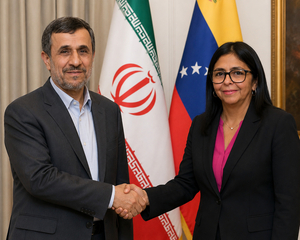 Mahmoud Ahmadinejad and Delcy Rodriguez shake hands, as imagined by ChatGPT. |
DP: The above analysis suggests they cannot be achieved. As I have argued at length, the U.S. attack on the Islamic Republic assumed that the Venezuela model could be applied to Iran. A report that the U.S. and Israeli governments saw Mahmoud Ahmedinejad as a Delcy Rodriguez-style figure confirms this point.
Inoltre: Does the Trump Administration share strategic goals in international politics or does a deep divide separate individuals and ideological camps?
DP: American conservatives always had their differences on foreign policy but generally agreed on taking pride in country, standing by allies, and a readiness to use military force against enemies. The emergence of the movement now known as MAGA disagrees with all of these precepts. As its name (Make American Great Again) implies, its adherents view the contemporary United States as failing, they look at allies in a transactional way (What can you do for me?), and they want to focus on internal issues, not foreign ones. This divide is real and it is deep.
Inoltre: What about the Democrats?
DP: As elsewhere in the world, a nearly linear right-left spectrum has emerged in the past quarter-century, with Republicans with time more supporting Israel and opposing Islamism and Democrats moving in the opposite direction. When Democrats take control of Washington, Middle East policy will undergo a radical shift, away from Israel and in favor of Türkiye, Qatar, and Iran.
Inoltre: Should Washington reach an agreement with Tehran that Jerusalem rejects, do you expect Israel to continue a separate war on the Islamic Republic of Iran?
DP: I do not. Through words and deeds, Prime Minister Benjamin Netanyahu has shown that he prioritizes excellent relations with Trump over almost any policy issue. As a result, Israel has lost control over those policies. Were I Israel's prime minister, I would likely follow the same approach, however distasteful I found it.
Inoltre: The Trump Administration claims that its actions have cut off Iran's axis of terror from Tehran's control and funding; do you agree?
DP: I believe it too early to judge. The war undoubtedly devastated Tehran's finances but does that necessary mean it ended all funding to its foreign allies and proxies? Let's wait and see.
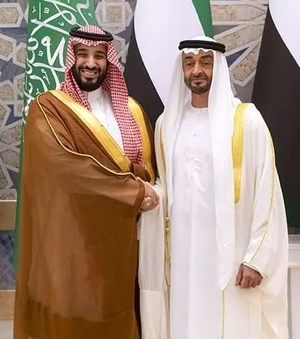 Mohammed bin Salman and Mohamed bin Zayed shook hands in 2021. |
DP: This results to some extent from the personal relationship and rivalry between the leaders of the UAE and Saudi Arabia, Mohamed bin Zayed and Mohammed bin Salman. Ir also reflects two Emirati frustrations: an old one about not exporting more than a fraction of its potential oil and gas production, plus a new one about being heavily targeted by Iran but receiving no meaningful help from its fellow Arabian states – only from Israel.
Inoltre: What does that redefinition mean for the UAE, Saudi Arabia, and Israel?
DP: It marks the UAE as the only Middle Eastern state other than Israel willing to enter fully into the American camp. It deepens and extends the rivalry with Saudi Arabia. And it marks only the second time (Türkiye thirty years ago being the first) that Israel has a true ally in the neighborhood.
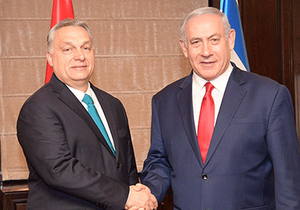 Viktor Orbán and Benjamin Netanyahu shook hands in 2019. |
DP: Their careers are strikingly parallel, coming both initially to office as young reformers, spending years in the political wilderness, and returning as angry senior figures burdened with much baggage and spurring widespread hostility. But Orbán lost the favor of his base in a way that Netanyahu has not, so I do not foresee him suffering a massive repudiation as Orbán did in elections later in 2026. If Netanyahu loses, the margin will likely be narrow.


