Il Riformista: Did Trump's decision to join Israel in attacking the Islamic Republic of Iran surprise you?
Daniel Pipes: Yes. Trump constantly surprises everyone, not just me. He despises intellectual frameworks, takes pride in making decisions on instinct, and always proclaims his actions an astounding success. No president has ever acted in this way, probably none other ever will again. In choosing him, conservatives opted for a wild ride. I sometimes imagine that we Americans live in medieval times, under a king who arbitrarily decides our fate.
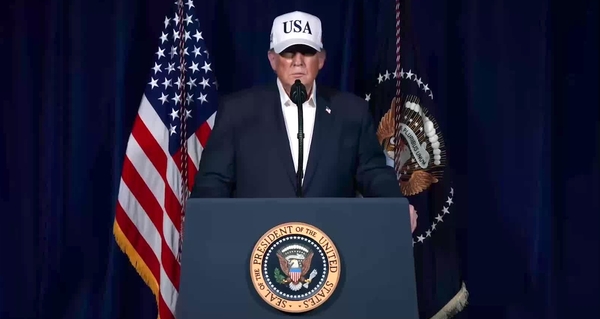 Trump announced the U.S.-Israeli war on Iran in a dark prerecorded video. |
IR: What are the main factors determining the war's result?
DP: Three topics, all concerning public responses – Iranian, American, and Arabian – are key to whether the war turns out as a victory or defeat for the Western allies.
Will the Iranian populace rise up to overthrow its oppressors? This ranks as the most crucial question of the entire conflict. From what we know, this was not dealt with in advance of the first attack on Feb. 28 but is a matter for "hope and prayer" for the U.S.-Israeli coalition.
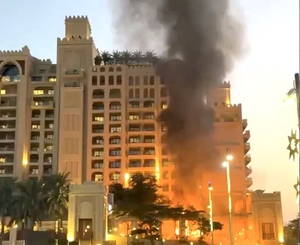 Iranian attacks on Arabian Peninsula states – as this one on Fairmont the Palm Hotel in Dubai – have shocked local populations. |
Will GCC states, whose way of life and business model are deeply disrupted by Iranian missiles and drones, draw closer to the United States and Israel or will they help Iran by lobbying for an end to the conflict? So far, it appears the governments are moving toward the alliance even as many of their subjects move toward appeasing Iran.
IR: You have called a conflict llike the U.S.-Israeli campaign a "special police operation." What do you mean by that?
DP: In contrast to Russia's attack on Ukraine, which is a real war in the sense that we do not know the battlefield outcome, the U.S.-Israeli attack on Iran is a foregone conclusion, as when the police surround a criminal compound. As in a police operation, the question is not who will prevail but how it will be accomplished: have laws been broken, how much collateral damage inflicted, what political consequences follow, and so on. The same applies to Israel's current war on Hezbollah as well as its prior wars on Hamas.
 In a police shootout, everyone knows the eventual outcome; this places an emphasis on the details. The same applies to the U.S.-Israeli attack on Iran. |
IR: What do you think the most likely outcome of the military campaign?
DP: The key question concerns the Iranian regime's survival or not. It is very hard to predict this so long as the regime's many enemies stay home. Will they later rise up? Will government thugs manage to suppress them? My inclination is to predict regime survival.
IR: Is a domestic uprising necessary to bring down the ayatollahs' regime?
DP: Yes, unless Kurdish forces prove stronger than expected or foreign forces occupy the country, neither of which appear likely.
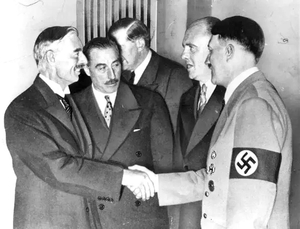 Neville Chamberlain's 1938 "peace for our time" agreement with Hitler in Munich initiated a tradition of appeasing dictators. |
DP: Yes. Diplomatic accords with totalitarian regimes – Munich, détente, Oslo, the Sunshine Policy, the JCPOA – almost always end up helping them and harming democracies.
IR: Why then did the U.S. government engage in diplomacy with Tehran?
DP: Because brute force does not come naturally to democracies. We prefer to talk things through, work them out. My father, who worked as an advisor on the Soviet Union for Ronald Reagan, complained that the State Department knew how to write fishing treaties with Ottawa, not how to confront Moscow.
IR: How much would the collapse of the Iranian regime reshape the Middle East?
DP: As I wrote in a recent article, "Terminating the Islamic Republic of Iran promises nearly 100 million Iranians the possibility of freedom and prosperity. It offers 500 million Middle Easterners a reduction in sabotage and violence. And it substantially releases 2 billion Muslims from the poison of today's most vibrant totalitarian ideology, Islamism."
IR: Should the regime collapse, will Iran remain a unified country?
DP: That is an intriguing topic because native Persian speakers make up only half of Iran's population. Put differently, like Russia, China, and Ethiopia, Iran is a land empire that includes many subjugated peoples, such as the Azerbaijanis, Gilakis and Mazandaranis, Kurds, Arabs, Lur, Baloch, and Turkmen. Many of these peoples want autonomy or independence. I disagree with the consensus that Iran's territorial integrity must be preserved. Why condemn the British, French, and other sea empires as imperialism but accept the permanence of land empires? They too need to be broken up.
IR: What repercussions will the IRI's collapse have on Hamas?
DP: It deprives Hamas of arms, money, diplomatic support, and ideological backing. But, given how diminished Tehran's power already is, Hamas will be deprived of its support, even if the regime hobbles on.


