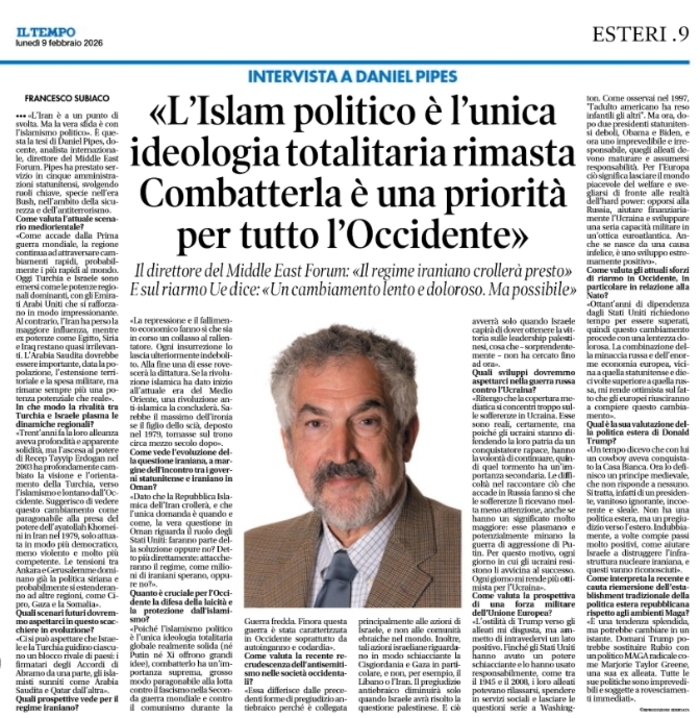
Il Tempo: How do you assess the current balance of power and strategic alignment in the Middle East?
Daniel Pipes: As has been the case since World War I, the region continues to go through rapid changes, probably the world's most rapid. Today, Türkiye and Israel have emerged as the dominant regional powers, with the United Arab Emirates strengthening impressively. In contrast, Iran has lost the most influence while former powers such as Egypt, Syria, and Iraq remain nearly inconsequential. Saudi Arabia should be important, given its population size, land area, and military spending, but ever remains more a potential power than an actual one.
Il Tempo: How does the rivalry between Türkiye and Israel shape the region's dynamics?
DP: Thirty years ago, their alliance had depth and apparent durability, but the coming to power of Recep Tayyip Erdoğan in 2003 profoundly changed Türkiye's outlook and orientation, toward Islamism and away from the West. I suggest seeing that shift as comparable to the 1979 seizure of power by Ayatollah Khomeini in Iran, only done more democratically, less violently, and far more competently. Tensions between Ankara and Jerusalem already dominate Syrian politics and will likely spread to other regions, such as Cyprus, Gaza, and Somalia.
Il Tempo: What future scenarios should we anticipate in this evolving geopolitical chessboard?
DP: Look for each of Israel and Türkiye to head a rival bloc of countries – the Abraham Accords signatories vs. Sunni Islamists such as Saudi Arabia and Qatar.
Il Tempo: What prospects do you see for the Iranian regime?
DP: Its repression and economic failure mean it is in process of a slow-motion collapse. Each insurgency leaves it further weakened. Finally, one will overthrow the dictatorship. If the Islamic revolution began the Middle East's current era, an anti-Islamic revolution will end it. It would be the height of irony if the son of the shah, who was ousted in 1979, returned to the throne about a half-century later.
Il Tempo: How do you see the Iranian question evolving, even as the U.S. and Iranian governments meet in Oman?
DP: Given that the Islamic Republic of Iran will collapse, and the only question is when and how, the key issue in Oman concerns the U.S. role: will it be part of the solution or not? Put more directly, will it attack the regime, as millions of Iranians are hoping, or will it not?
Il Tempo: How crucial for the West is the defense of secularism and protecting against Islamism?
DP: Islamism being the only robust global totalitarian ideology (neither Putin nor Xi offer ideas), combatting it has supreme importance, roughly analogous to fighting fascism in World War II and communism in the Cold War. So far, that war has mostly been characterized in the West by self-delusion and cowardice.
Il Tempo: How do you assess the recent resurgence of antisemitism in Western societies?
DP: It differs from prior forms anti-Jewish bias in being primarily connected to actions by Israel, and not to Jewish communities around the world. Further, those Israeli actions overwhelmingly concern the West Bank and Gaza in particular – and not, for example, Lebanon or Iran. Anti-Jewish bias will subside only when Israel has solved its Palestinian problem. And that will only happen when Israel understands it needs to seek victory over the Palestinians, something that it – surprisingly – has not aspired to until now.
Il Tempo: What developments should we expect in the Russian war on Ukraine?
DP: Media coverage focuses too much on suffering in Ukraine. It is real, to be sure, but because Ukrainians are defending their homeland from a rapacious conqueror, they have the will to continue, so that torment has secondary importance. The challenge of reporting from Russia means that suffering there tends to get much less attention, even though it has far greater significance: it shapes and potentially undermines Putin's war of aggression. For this reason, each day the Ukrainians hold out brings them closer to success. Each day makes me more optimistic for Ukraine.
Il Tempo: How do you evaluate the prospect of a European Union military force?
DP: Trump's hostility toward allies appalls me but I admit to finding a silver lining in it. So long as the United States had overwhelming power and used it responsibly, as was the case between 1945 and 2008, its allies could relax, spend on social services, and leave the serious business to Washington. As I noted in 1997, "The American adult rendered others child-like." But now, after two weak U.S. presidents, Obama and Biden, and now an unpredictable and irresponsible one, those allies must mature and take responsibility. For Europe, this means leaving the pleasant world of welfare and waking to the realities of hard power: standing up to Russia, helping Ukraine financially, and developing a serious military capability. Even if resulting from an unfortunate reason, this is a highly welcome development.
Il Tempo: How do you assess current rearmament efforts in the West, particularly in relation to NATO?
DP: Eighty years of dependence on the United States takes time to repair, so this shift moves with aching torpitude. The combination of Russian threat plus the huge European economy, near that of the United States and ten times that of Russia, makes me optimistic that Europeans will successfully make this change.
Il Tempo: What is your assessment of Donald Trump's foreign policy?
DP: I have called him on X "a vain, distracted, petulant, money-hungry president with the intelligence of a middling 10th-grader [a 15-year-old]." I could have added that he is ignorant, inconsistent, and disloyal. Such a person does not have a foreign policy but a foreign prejudice. Undeniably, he sometimes takes very good steps, such as helping Israel to destroy Iran's nuclear weapons infrastructure, and these need to be acknowledged. I used to say a cowboy has seized the White House. Now, I call him a medieval prince, accountable to no one.
Il Tempo: How do you interpret the recent, cautious, re-emergence of the traditional Republican foreign policy establishment – particularly figures such as Marco Rubio – in contrast to a MAGA movement that appears, at least in part, to be losing momentum?
DP: This is a wonderful trend, but it could change in an instant. Tomorrow, Trump might replace Rubio with a radical MAGA politician like Marjorie Taylor Greene, a former ally of his. All his policies are unpredictable and subject to instant reversal.