
I announced today my opposition to the Khalil Gibran International Academy, an Arabic-language focused New York City public school. This entry explains why I did so. In brief, Arabic instruction at that school fits a pattern of pan-Arab nationalist and radical Islamic content.
For one powerful first-hand example of this problem at the collegiate level, see "Middlebury's Arabic Morass" by Franck Salameh. He explains:
even as students leave Middlebury with better Arabic, they also leave indoctrinated with a tendentious Arab nationalist reading of Middle Eastern history. Permeating lectures and carefully-designed grammatical drills, Middlebury instructors push the idea that Arab identity trumps local identities and that respect for minority ethnic and sectarian communities betrays Arabism.
For another specific case, see Shukri B. Abed, Focus on Contemporary Arabic: Conversations with Native Speakers (New Haven: Yale University Press, 2007); YUP conveniently has posted the table of contents (if backwards), where one chapter deals with "The Question of Palestine." The chapter contains eleven readings. To give an example of their flavor, the fifth of them states that the "Palestinian problem" is at base an issue of justice in which the Palestinians are the victims of a double standard.
For the heavy Islamic freight that Arabic instruction carries, see "Does Learning Arabic Prevent Moral Decay?" where one learns that some Muslims believe "Knowledge of Arabic can then help the Western countries recover from the present moral decay." (This is not as surprising as it sounds, for Muslims commonly assume that a non-Muslim who learns Arabic is en route to conversion to Islam; I experienced this many times when living in Cairo.)
Evidence from Algeria also points to the impact of Arabic instruction, as documented in James Coffman's breakthrough 1995 article "Does the Arabic Language Encourage Radical Islam? He compared Algerian students taught in French versus those taught in Arabic and found that
Arabized students show decidedly greater support for the Islamist movement and greater mistrust of the West. Arabized students tend to repeat the same simplistic stories and rumors that abound in the Arabic-language press, particularly Al-Munqidh, the newspaper of the Islamic Salvation Front. They tell about sightings of the word "Allah" written in the afternoon sky, the infiltration into Algeria of Israeli women spies infected with AIDS, the "disproving" of Christianity on a local religious program, and the mass conversion to Islam by millions of Americans. I was not the only one to notice this distinction. When asked if the new, Arabized students differed from the other students, many students and faculty answered an emphatic yes.
Coffman also found a similar trend in other Arabic-speaking countries:
because Arabs draw so close a connection between classical Arabic and the faith of Islam, Arabization invariably leads to an identification with the (supranational) Islamic religious tradition. Even the most secular Arab nationalists (such as the Ba'thist variants in Syria and Iraq) must appeal to Islamic symbolism to bolster sagging legitimacy and to mobilize the masses (as Saddam Husayn did in his wars against Iran and the U.S.-led coalition). Hence, Arab nationalism has, however inadvertently, contributed to the rise of Islamism. Indeed, today's Islamist surge is the natural, perhaps inevitable consequence of the Arab nationalist policies of thirty years ago.
(March 7, 2007)
Jan. 8, 2008 update: A reader, Alex, writes in a comment on this website that he is using a first-year Arabic textbook by Mahdi Alosh, associate professor of Arabic at The Ohio State University, Ahlan wa Sahlan: Functional Modern Standard Arabic for Beginners (Yale University Press, 2000), and that it mentions Bilad al-Sham repeatedly, but never Israel.
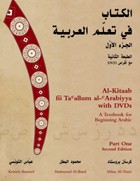
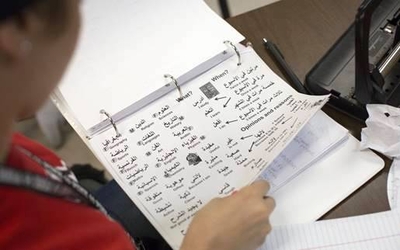
July 5, 2008 update: "Learning Arabic should not include lessons in political propaganda." So writes Joel B. Pollak, a student at Harvard Law School, in the Washington Post, criticizing his Arabic language class at Harvard this past academic year. The basic problem concerns the textbook. Titled Al-Kitaab fii Tacallum al-cArabiyya, by Kristen Brustad, Mahmoud Al-Batal, and Abbas Al-Tonsi. Published by Georgetown University Press, it received financial assistance from the National Endowment for the Humanities.
Pollak calls it "suffused with the stale prejudices and preoccupations of the pre-Sept. 11 Middle East" and gives details:
Most maps of the Middle East in Al-Kitaab do not include Israel, though a substantial minority of Israelis, both Jews and Arabs, are native Arabic speakers. Alongside simple Arabic poems, students read about anti-Western heroes such as Gamal Abdel Nasser.
"Al-Kitaab fii Ta'allum al-'Arabiyya" by Kristen Brustad, Mahmoud Al-Batal, and Abbas Al-Tonsi (Georgetown University Press).
The DVD that comes with Al-Kitaab includes footage of Nasser's mass rallies in Cairo—including slogans in Arabic and French such as "Brother Nations in Struggle, We Are By Your Side." These scenes of totalitarian rage are fondly described by the narrator as "dreams of his youth."
The accompanying lesson describes the highlights of Nasser's career, including the nationalization of the Suez Canal and the formation of the United Arab Republic. No mention is made of Egypt's defeat in the Six-Day War or of Nasser's brutal, repressive rule. In my class, we were asked to recite a passage about Nasser to practice our vocalization. (I refused.)
The last lesson in the book features a woman wistfully recalling her childhood in Palestine: "My childhood was taken from me!" Over mournful music on the DVD, Pollak notes, "she talks about returning to Jerusalem, as if she were a refugee, but the images suggest that she left voluntarily after the Six-Day War, when Israel offered citizenship to the Arab residents of East Jerusalem. The fact that Israel also claims Jerusalem as its capital is ignored."
Non-textbook instruction at Harvard also has a pan-Arabist tenor. For example, his class watched three movies this past semester, all with political themes. Two of them bear noting:
One was West Beirut, which cast Christians as the prime bad guys in Lebanon's civil war (though, to be fair, there was plenty of hatred all around). Another was The Tale of Three Jewels, an allegorical film about Palestinian nationalism that portrayed Israeli soldiers as bloodthirsty child-killers.
Pollack concludes: "Most introductory language classes avoid controversial political subjects. In fact, they often highlight the brighter side of different cultures. Particularly with the growing importance of Arabic, can't we do better?" He rightly suggests a need to look "into the content of the federally funded materials used in Arabic programs at our own universities."
Aug. 11, 2008 update: The Washington Jewish Week has a follow-up piece on Pollak's account, "Plumbing the Pages: Arabic textbook stirs controversy," by Richard Greenberg.
A Georgetown University Press spokesperson told Greenberg that "tens of thousands" of copies of Al-Kitaab have been distributed to U.S. government agencies, undergraduate colleges, and some high schools.
GUP's director, Richard Brown, disputed Pollak's contention that Al-Kitaab has an anti-Western and anti-Israel agenda: "We do not traffic in materials that support totalitarian rage," insisting that the press implements rigorous internal and external review to ensure accuracy and absence of political bias. "I stand by the work and Georgetown University Press stands by the work." But Brown did concede that Pollak is not the first student to complain about Al-Kitaab's geography. "On occasion," students have objected to maps in the book that do not include Israel.
The National Endowment for the Humanities, a federal agency, contributed $131,000 to prepare Al-Kitaab. A NEH spokesperson indicated that, In keeping with procedures, it did not examine the content of the textbook for bias.
Pollak reports that his essay has led to his being branded a "neo-con" and "anti-Muslim," labels he termed "ridiculous."
Gabe Scheinmann, another student who used the book at Harvard, said he was "pretty annoyed" by the map of the Middle East without Israel "and several other students agreed. But I didn't bring it up to my instructor." After further reviewing the map, however, Scheinmann said that he did not find it overtly objectionable.
"All three co-authors have made public statements critical of Israel, according to the Washington, D.C., office of the Anti-Defamation League, but the textbook itself 'does not contain anti-Israel, anti-Semitic or anti-U.S. rhetoric, as some have suggested'." Greenberg then quotes these statements.
In response to a query from Greenberg, co-author Al-Tonsi rejected Al-Kitaab being characterized as political. He argued that "many Arabs believe in the co-existence of Israel & Palestine." Regarding Pollak's criticism, he wrote: "It seems now that some people in USA consider any ... criticism to Israel policy is anti-Israel, or even anti-Semitism. There is a tendency to reject any different views in controversial issues. That is to say frankly a new McCarthy Era."
Pollak said his Arabic instructors were "not overtly political." And one of them, Nicola Carpentieri, wrote Greenberg: "I have not felt any material contained in Al-Kitaab to be biased against Israel or the West."
Aug. 29, 2008 update: Emily McGinnis also takes a look at Al-Kitaab in the Georgetown University student paper, the Hoya. She reports in "Widely Used Arabic Textbook Called Anti-Western" that Ahmad Dallal, chair of the university's Arabic department, defends it. "I can't possibly imagine what anyone would object to in this book. It is not a book about politics, and from the perspective of language pedagogy — it is by far the best book in the field."
Gail Grella, associate director and acquisitions editor for languages and linguistics at the Georgetown University Press, adds that Al-Kitaab underwent extensive, formal evaluations at Georgetown and reviewed at various other universities before publication. She called Al-Kitaab a respectable text that is the most widely used textbook in the country. "By the sheer fact of how it's been embraced by the language teaching community, I think it's clear that it's a high quality textbook. Our authors are very careful not to politicize their books when writing. A very important part of language texts is culture, and there are elements of any culture that people will disagree with."
Apr. 28, 2009 update: The Mosque Foundation of Bridgeview, Illiinois, a leading Islamist organization, includes a message from Zaher Sahloul, its president, "Introducing Arabic Language to Public Schools." (Note the accompanying graphic.) Excerpts:
In a recent Candidate Forum organized by the Mosque Foundation, [candidates running for school board] pledged to support the introduction of Arabic language to the curriculum in their public schools. This is a landmark moment in the Mosque Foundation initiative to introduce Arabic Language to our Public Schools. ...
On May 21st, the Council of Islamic Organizations of Greater Chicago is organizing a lobby day in Springfield to address several important issues concerning our communities. More than 500 Muslim leaders, activists and students are expected to flock to Springfield to meet and lobby their State representatives for several initiatives including the introduction of Arabic language in Public schools, Education Reforms and opposition of online Gambling.
 May 7, 2009 update: The Council of Islamic Organizations of Greater Chicago argues in "The importance of Arabic" that Muslims believe if would be "a great benefit if their children get an opportunity to become conversant in Arabic through the public school system." The presentation gives various reasons for teaching Arabicin public schools and concludes with: "A basic knowledge of the Arabic language and culture can improve understanding and acceptance of Arab Americans and other Muslims."
May 18, 2009 update: Mastering Arabic 2 by Jane Wightwick and Mahmoud Gaafar (Palgrave Macmillan, 2009), published today, contains a page about "Arabic in Jordan and Palestine" that not only pretends there are no Arabic-speakers in Israel (in fact, they number well over a million) but creates a polity called "Israel and Palestine" where simply "Israel" should exist. That's a fine dose of ideology with one's lughat ad-dad.
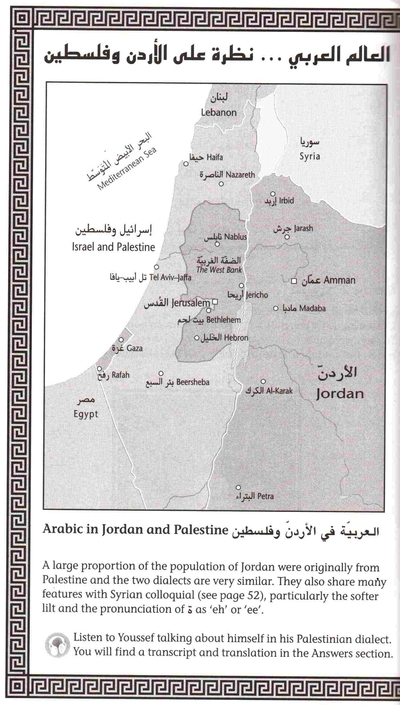 Page 214 of "Mastering Arabic 2" |
The book contains another map, this one of the Middle East. Students are asked to "Look at this map of the Middle East and then listen to the names of the countries." In Arabic, Wightwick and Gaafar then list "Libya, Egypt, Sudan, Jordan, Lebanon, Syria, Iraq, Saudia, Oman, and Yemen." Notice any country missing?
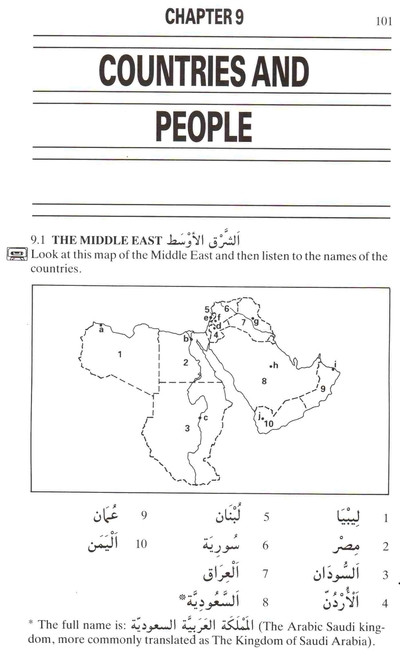 First page of Ch. 9 of "Mastering Arabic 2" |
May 21, 2009 update: The CIOGC-sponsored "first annual Muslim ACTION! Day" took place today in the state capital, Springfield, Illinois, and included, as noted in the Apr., 28, 2009 entry above, lobbying to have Arabic taught in the public schools. One insight into the connection between Arabic instruction and Islam was signaled in the description of a "Leadership Breakfast with Legislators":
Among the legislators to attend the breakfast was Rep. Paul Froehlich (D) from the 56th District (which is the greater Schaumburg area). Rep. Froehlich is a co-sponsor of the Arabic language instruction in public schools resolution introduced by Senator Jacqueline Collins (D). Like Senator Collins, Rep. Froehlich is a strong supporter of American Muslims.

June 18, 2009 update: In an article at PipeLineNews.com on the CIOGC initiative, "Terror-Linked Bridgeview Mosque Behind Push For Arabic Language Instruction In Illinois' Public Schools," William Mayer and Beila Rabinowitz conclude that
This proposal, which Rep. Paul Froehlich and Senator Jacqueline Collins and other political figures are blindly pushing, will have a very deleterious effect on the educative process in a city [Chicago] already infamous for broken schools. The idea itself did not arise out of a perception that it might help bolster a failing public education system. Far from it, this idea is being promulgated by a hard-line coalition of Muslim activists (allied with a reprehensible Hamas-linked mosque) who fully understand and support its stealth jihad overtones. As a result we believe that this now very limited program should be discontinued immediately. It's disingenuous, bad public policy, deadly from a national security perspective and ultimately violative of the First Amendment's "establishment" clause.
Oct. 29, 2009 update: The title of an IslamOnline.net article makes my point for me: "Arabic Introduces Islam to Ukrainians." Shadi Shawer, the Arabic schools supervisor, explains: "Arabic, the language of the Qur'an, has become a window for many Ukrainians to know Islam. ... The schools have become one of our tools to promote Islam and show its true image."
Apr. 26, 2010 update: Bassam K. Frangieh, professor of Arabic at Claremont McKenna, author of a forthcoming Arabic language instruction book (and translator of a book of Arabian love poems), also is a political extremist who lauds the "heroic operations" against Israel of Hizbullah, a designated terrorist organization, while calling for "American and European governments to halt their military and material maintenance of the Zionist killing machine."
Jan. 26, 2013 update: Flush with funds from its vast gas fields, the Qatari government, which has emerged as the leading backer of Islamist forces in the Middle East, has created the Qatar Foundation and its U.S. branch, Qatar Foundation International (QFI), one of whose missions is to spread the instruction of Arabic language via its "Anchor School Programs." Too clever to mention promotion of religious or political goals, QFI nonetheless freights the study of Arabic language as a way to do battle versus what it calls the "many deep misconceptions and barriers that lie between the United States and Arab peoples and cultures." Toward this end, its goal is "to introduce Arabic language and culture into mainstream education." To sweeten the deal, "QFI has facilitated visits to Qatari schools" for its students.
July 3, 2013 update: For a case study of how the Qatar Foundation International money is being used, see the Tucson Unified School District, which wants permission to accept its funds to implement "innovative curricula and teaching materials to be used in any Arabic language classroom."
Sep. 9, 2013 update: StandWithUs.com sent out an Action Alert today with news from San Diego State University:
Two weeks ago, at the second class session of Elementary Arabic 1 at SDSU (a State school) students received a map of Middle Eastern countries from Dr. Ghassan Zakaria which not only fails to label "Israel" as a legitimate country, it falsely portrays the entire territory of Israel as "Palestine."
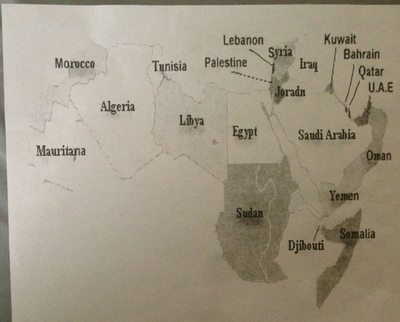 The map handed out in Arabic class at San Diego State University. |
SWU urges activists to complain to Dr. Ghada Osman, Department Chair & Arabic Program Director: 619-594-1910, gosman@mail.sdsu.edu.
Sep. 17, 2013 update: A student, Sheli Grumet, reports in the San Diego Jewish World the unusually swift and happy resolution of this problem in the aftermath of the Action Alert:
A flood of concerned letters were sent to the SDSU administration and the head of the department from individuals and even from professors at other California universities. SDSU's Aztecs for Israel strongly condemned the use of this falsified academic material and demanded a public apology from Zakaria and from the administration. SDSU's ABC affiliate, News10 broke the story that evening.
Thankfully, the university took immediate action. Ghada Osman, chairman of the Linguistics and Asian/Middle Eastern Languages department at SDSU wrote that Zakaria would replace the map, stating:
"Prof. Zakaria explained [to me] that the reason that he utilized the label 'Palestine' was because this map was supposed to reflect the view of Arabic-speakers in the region. After assigning the map, his aim was then to have students get into groups and research the political developments of each area on the map, with the assumption that this would lead to a discussion of the Israeli-Palestinian conflict and the history of the state of Israel. After our conversation, Prof. Zakaria agreed that it would be more appropriate to discuss the context of the assignment at the outset. He will therefore explain the context and distribute a map that includes labels for members of the Arab League as well as Israel."
On the new map, "Israel" is hand written. He apologized to his class.
StandWithUs lauded this unusually rapid resolution. Further:
SDSU's administration took the situation one step further. President Elliot Hirschman and Andrea Rollins, Chief of Staff, Office of the President created two programs: the StandWithUs -San Diego State Jewish Studies Scholarship and the StandWithUs – San Diego State Israel Study Abroad Scholarship. This is the first time that any university has set up scholarship funds in partnership with StandWithUs.
Oct. 2, 2013 update: Parents in Daphne, Alabama, have picked up, if in a somewhat crude way, on the message in this blog about the baggage of Arabic language instruction, as shown by some of the quotes in a long story at AL.com concerning the hire of Sanaa El-Khattabi to teach Arabic at Daphne High School, where she has three classes of 25-30 students each:
"When you teach Arabic, you have to teach the culture along with it," said Chuck Pyritz, whose two sons, Isaiah, 17, and Isaac, 14, attend Daphne High. "The culture is intertwined with Islam." Pyritz cited the case of jihadist Omar Hammami, who grew up in Daphne, as a compelling reason that school systems should not offer courses in Arabic. "That's another red flag for us," he said. Hammami, who attended Daphne High, but did not graduate, is believed to have been killed a few weeks ago by members of his former Somali Islamist militant group, al-Shabab. ... "They're trying to indoctrinate our children with this culture that has failed," he said. "...Why should we want to teach our kids a failed culture when we have a culture that has been successful? All we have to do is follow our Christian culture, which has brought this nation to the pinnacle of success. ... I don't see why they would want to teach this."
"while I understand the alleged premise of offering Arabic at our high school, I don't agree with it," said Michael Rife, who lives in Daphne. "It is not just another language; it is a language of a religion of hate. I'm concerned about our taxpayer dollars going to fund such a program, because I don't believe it has a lot of foundational value. It just concerns me that we're headed down a path of further eroding our society to a Muslim-based society, or Sharia law (the moral code of Islam), and I'm not willing to let that happen without ... something to say about it."
Donna Rife, a Daphne resident who has two grandchildren in Daphne schools, questioned the fairness of teaching Arabic when public school systems often discourage any expression of religion. "If they want to speak their language, that is their privilege in this country," she said. "But don't silence another voice, such as Christianity. ... We are not a Muslim nation, and yet they're trying to bring this kind of nonsense into [schools]. I am absolutely against it." Rife was also disturbed, she said, about the possibility of her grandchildren studying Islam. "It's a great concern to me, because they're being indoctrinated with this," she said. "Arabic leads right into the Muslim teaching, and that is where the danger is and that is what I am absolutely against," she said. "Let them teach that in their mosques—but keep it out of our schools."
Sep. 13, 2014 update: Jermaine W. served as chairman of the Educatief Instituut Arabische Taal en Cultuur (Educational Institute for Arabic Language and Culture) in Huizen, The Netherlands; despite its name, much of the institute's work concerns learning the Koran and about Islam. W. recently left Europe with his family to join the terror group Islamic State in Iraq and Syria (ISIS).
Feb. 8, 2015 update: Montreal's Rosemont College has rented space to the L'école de la langue arabe El Forkane de Montréal (El Forkane Montreal School of the Arabic Language). On being apprised that the school's website contained Islamist materials (such as "Beware of the enemies of Islam; they will always want trouble, they set traps, the largest of which is their schools"), it has suspended its contract with El Forkane.

Comment: Even after cleansing, the homepage still contains highly political content unsuited for small children. The Arabic on the left is a religious statement about one God. The Arabic on the right is the Rabi'a sign of the Egyptian Muslim Brotherhood. Above: "Giving up is treason." Below: "We are all Rabi'a."
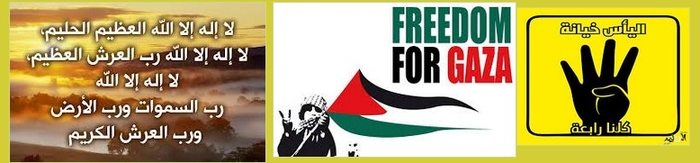 Political statements on El Forkane's homepage. |
Feb. 27, 2015 update: More from Montreal, now concerning Moroccan immigrant Adil Charkaoui and the charge that he radicalized four male and two female students, who over the past two months left to Turkey and then to Syria, all of whom studied Arabic with him. Both schools have suspended his classes; one is the Collège de Maisonneuve, the other has not been named.
The Canadian government arrested Charkaoui in 2003 on the grounds that he had trained at an Al-Qaeda camp in Afghanistan, then kept him in prisoned or under surveillance until 2009, finally withdrawing its case against Charkaoui so as not to compromise sources. He won Canadian citizenship in 2014.
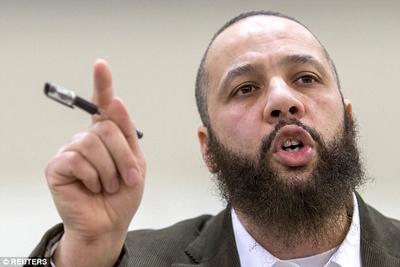 Adil Charkaoui, accused of radicalizing six Montrealers who then went to Syria. |
Apr. 6, 2015 update: Brian T. Edwards, a professor of Middle East studies at Northwestern University, sees the study of Arabic as a way to achieve peace:
We should aspire to teach our children second languages as a national priority. In particular, we should dramatically increase the number of students learning Arabic in U.S. public schools. We should do so both for their own futures and for the cause of peace at home and abroad. ... Further, massive numbers of American students learning Arabic will help advance peace.
July 12, 2015 update: Look at Saleh Patel, one of the few Arabic teachers working full-time in a British primary school, in this case Horton Park Primary School in Bradford, England. He is also deputy principal at a supplementary school offering Arabic language classes to 900 students.
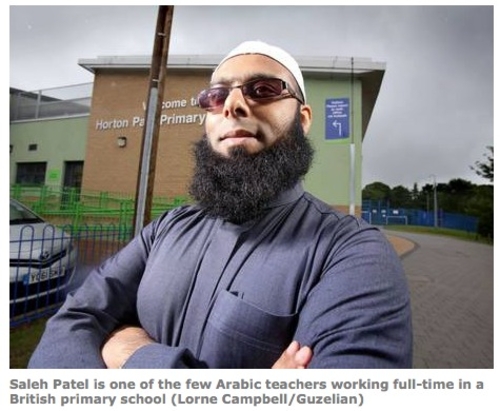
I just wonder whether he might be an Islamist. Any guesses?
Sep. 2, 2015 update: San Francisco's Unified School District has approved a resolution, Creating Arabic and Vietnamese Pathways, for "K-12 Arabic and Vietnamese language and culture classes beginning in the 2017-18 school year." As usual, there is a political dimension to the Arabic instruction, as Cinnamon Stillwell of Campus Watch explains:
to create "culturally appropriate professional development opportunities for school faculty," the district plans to work with the Arab Resource and Organizing Center (AROC), a fiercely anti-Israel, pro-BDS (boycott, divestment, and sanctions) local organization whose website blames global "repression" on "U.S. imperialism and Zionism."
Lara Kiswani, AROC's executive director and cofounder of the UC Davis chapter of Students for Justice in Palestine, is notorious for having declared at a 2014 UC Berkeley BDS panel discussion, "Bringing down Israel will really benefit everyone in the world" and, to a Jewish graduate student's concerns about anti-Semitism, responding, "As long as you continue to be on that side [of Zionism] I'm going to continue to hate you."
Oppositions to this politicization has prompted the school board to issue an apology and to reconsider "whether to retain or drop AROC." School board president Emily Murase stated about the Arabic language and teaching program, "Clearly we want to make sure it does not contain political agendas." Let's see if that can be resisted.
Sep. 18, 2015 update: Yacine Boudhane explains at "Arabic in Algeria: Identity Tainted by Politics" how the debate in Algeria noted above continues.
Sep. 30, 2015 update: Madeleine Chang writes in the Stanford Daily, a student paper, about "The politicization of learning Arabic." Whereas
most first-year language classes begin with simple interaction phrases such as "my favorite TV show is" and basic cultural information, ... Chapter one of Stanford's Arabic textbook al-Kitaab teaches students the phrase "Who wants to work at the United Nations?" In chapter two, students learn "translator, employee" and how to write the names of academic institutes like "Australian National University, Centre for Arab and Islamic Studies." Chapter three's vocabulary list contains "army" and "officer." Chapter seven: "Who would like to work for the State Department? Why?" Colors didn't make it in the book. The verb "to think" doesn't appear until the final chapter.
This political emphasis of Arabic instruction is hardly unique to Stanford: "Nearly every university in the English-speaking world uses the aforementioned textbook, al-Kitaab."
Aug. 25, 2017 update: The Qatar Foundation – a subsidiary of the Qatar government that is so radical that even the Saudis oppose it – has given $30.6 million over the past eight years to American public schools for Arabic language instruction in public K-12 schools. It paid for teacher training, materials and salaries. Tawnell D. Hobbs explains the unusual nature of this funding:
Benefactors from foreign governments, including other Arab nations, have long made donations to American higher education, but the Qatar Foundation's appears to be one of the few foreign organizations targeting K-12 public schools with lofty grants.
 A student shows her work in an intermediate Arabic class at Cholla High School in Tucson, Ariz., on Aug. 9. (Photo: Caitlin O'Hara/WSJ) |
Two years ago, Sam Herrera, a Houston activist against illegal immigration, coordinated a protest in the city over the opening of a public Arabic immersion school that received funding from the foundation. "They hide under school districts wantonly taking the money," he said. "They're not going to overtly come out and tell you what they're doing."
A hint of the political agenda peeks through even Hobbs' benign account:
As part of the program, students learn about the Arabic language and culture, and take cultural trips, including visiting the Qatari embassy in D.C. ... foundation officials are involved in the school, providing professional development and visiting classrooms.
The article also includes a starting assertion:
After Spanish, Arabic is the language most spoken by students learning English as a second language at U.S. public schools, and the percentage of speakers is growing at a faster rate than other top languages, according to a review of data from the National Center for Education Statistics.
Oct. 24, 2018 update: There's a debate underway in France over the propriety of teaching Arabic in public schools, reports the Wall Street Journal. Then comes this different perspective:
"Arabic courses have become for Islamists the best means of attracting youth in their mosques and schools," Hakim El Karoui writes in "The Islamist Factory," a study published in September by the Institut Montaigne think tank. Radical preachers wield their seeming knowledge of Arabic to impress younger generations, Mr. El Karoui writes. His writings resonate in the government, where he has been advising the education minister to train a corps of Arabic teachers imbued with republican values as a counterweight.
Jan. 11, 2019 update: Oren Litwin of the Middle East Forum takes a look at the Qatar Foundation International (QFI), which "presents itself as a friendly advocate for learning the Arabic language" but has a hidden agenda:
influencing American politics is the mission of QFI. Spreading Arabic-language instruction and training teachers across the country is meant to create a large pool of talented young Americans with favorable feelings toward Qatar, and the Islamic world more generally. Even better, QFI's advanced learning programs allow it to groom a cadre of motivated activists, who can be harnessed to Qatar's larger goals.
QFI does not merely assist in teaching Arabic, but evangelizes for it. Its affiliated website I Speak Arabic features an "Arabic Advocacy Kit," which includes not just resources for teaching Arabic and even founding new Arabic-language programs but an impassioned section about the many benefits of doing so. Explicitly stated among these is that learning Arabic will improve Americans' attitudes toward Arabs and Muslims, in addition to deepening their appreciation of Arabic culture. ...
along with the useful resources for teachers comes a heaping helping of Qatari propaganda. In the guise of educating teachers about the larger cultural context of the Arabic language, QFI presenters depict a version of Middle-East politics that is highly flattering to Qatar and critical of its enemies such as Saudi Arabia. Furthermore, QFI downplays the systematic support Qatar has provided to the Muslim Brotherhood, including funding actual terror operations.


