
Just as there are especially insightful statements (a few of them collected by me at "Caught My Eye – Noteworthy Quotes"), so there are assertions that dazzle with their stupidity. Here is a sampling, in reverse chronological order:
Ebrahim Rasool, South Africa's ambassador to the United States:
what is Israel's endgame amidst other competing visions for the region? The endgame is one not of chess but of cheese. There are four competing visions for the region. Two of these are variations of a cheddar cheese – a single Palestinian state from the river to the sea. ... The third contending vision is the two-state one of a Colby Jack cheese, with fairly equitable streaks of yellow and cream, accompanying the 1948 establishment of Israel and modified at Oslo. ... Finally, Israel's cheese of choice for its endgame is the Swiss cheese: A single, undivided, apartheid, Zionist state with Palestinian holes or enclaves.
Kati Marton: "Just as Putin controls information, Orbán does too." (Moment, Spring 2022)
Alain Gabon: "Why 'political Islam' can be a gateway to democracy. Contrary to mainstream rhetoric, Islamist movements can promote civic engagement, defuse the temptations of extremism and aid the integration of Muslims in the West." (Middle East Eye, July 9, 2021)
Glenn Kessler: "The full name of Hitler's party was Nationalsozialistische Deutsche Arbeiterpartei. In English, that translates to National Socialist German Workers' Party. But it was not a socialist party; it was a right-wing, ultranationalist party." ("[Marjorie Taylor] Greene's ahistorical claim that the Nazis were socialists," Washington Post, May 29, 2021)
Sarah Cammarata: "Warnings about electromagnetic pulse attacks have long inspired eye-rolls or outright guffaws among national security experts." ("Is It Lights Out for Trump's EMP Push," Politico, November 18, 2019).
Donald Trump to Recep Tayyip Erdoğan: "You're doing a fantastic job for the people of Turkey." (November 13, 2019)
Jens Stoltenberg, NATO Secretary General: "One must acknowledge that Turkey is an important ally. ... In the fight against ISIL Turkey has made crucial contributions for physically destroying the so-called caliphate." (November 3, 2019)
Charles, the Prince of Wales, speaking at an ocean conservation conference, noted that Somali pirates have scared off fishing crews from the Indian Ocean: "As a result, there hasn't been any fishing there for the last 10 or 15 years. And from that, there has been a fantastic explosion of bigger and bigger fish." (October 6, 2017)
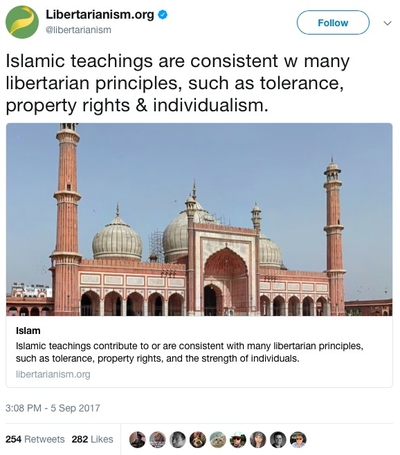
CATO Institute's Libertarianism.org website: "Islamic teachings are consistent w many libertarian principles, such as tolerance, property rights & individualism." (September 5, 2017)
James Mattis, U.S. secretary of defense: "Maniacs disguised in false religious garb thought, by hurting us, they could scare us [on Sep. 11, 2001]. But we Americans are not made of cotton candy. We are not seaweed drifting in the current. We are not intimidated by our enemies. And, Mr. President, your military does not scare."
Comments: (1) Dismissing Islamists as "maniacs disguised in false religious garb" ever-so slightly underestimates a great totalitarian threat. (2) The U.S. military, with 1,400,000 active frontline personnel are not scared of 19 jihadis? Oh, that's impressive. (3) Mattis seems mighty scared of the words "radical Islam" and "Islamist." (September 11, 2017)
Nawal Al-Saadawi, famed Egyptian feminist: "Post-modern religious fundamentalist movements are political movements that use God to justify glocal injustices: The Islamic State (IS) group, Al-Qaeda, Boko Haram, the Taliban and others work hand-in-hand with the capitalist nuclear super-powers." (May 18, 2017)
Antonio Guterres, UN secretary-general: "One of the things that fuel terrorism is the expression in some parts of the world of Islamophobic feelings and Islamophobic policies and Islamophobic hate speeches." (February 12, 2017)
John Kerry, U.S. secretary of state:
There will be no separate peace between Israel and the Arab world. I want to make that very clear to all of you. I've heard several prominent politicians in Israel sometimes saying, well, the Arab world's in a different place now, and we just have to reach out to them and we can work some things with the Arab world, and we'll deal with the Palestinians. No. No, no and no. ... There will be no advance and separate peace with the Arab world without the Palestinian process and Palestinian peace. Everybody needs to understand that. That is a hard reality.
(December 4, 2016)
Fareed Zakaria, journalist: "today's terrorists are not religious extremists who became radicals but rather radicals who became religious extremists." (The Washington Post, April 1, 2016)
Bernie Sanders, Democratic presidential candidate, on U.S. ties with Israel when he's in charge: "to the degree that [Israelis] want us to have a positive relationship, I think they're going to have to improve their relationship with the Palestinians." (April 4, 2016)
Ian Lustick, Bess W. Heyman Chair, Department of Political Science, University of Pennsylvania: "Is ISIS an Islamic Movement or is it a cross between the mafia and the Gestapo?" (explanation of a talk titled "How Much of the Middle East is a Terrorist Problem? under the auspices of the university's Middle East Center; March 23, 2016)
Jonathan Power, columnist: "Overwhelmingly, Muslims are a peaceful people, less prone to war than Christians and Jews." (March 9, 2016)
Karen Armstrong, writer about Islam, referring to the attack on Jan. 9 on the Hyper Cacher kosher store: "The supermarket attack in Paris was about Palestine, about ISIS. It had nothing to do with antisemitism; many of them are Semites themselves." (January 18, 2015)
Shimon Peres, former president of Israel: "To have a democratic and Jewish state, we need a Palestinian state as well." ("Shimon Peres Calls for Creation of a Palestinian State," Telesur TV, December 18, 2014)
Abdalmajid Katranji, a Michigan surgeon of Syrian origins, explaining the appeal of ISIS:
The Islamic State group literally approached civilians with lollipops, he said. "In the end, the victims of these conflicts are hungry. ... Some of them are forced to eat garbage, if they eat at all. When a person is hungry, they can become very frustrated ... weak ... vulnerable ... disenchanted ... disconnected. When a person is hungry, he can become fodder for the extremists of the Assad regime or the extremists of ISIS."
("Doctor: Food, training could quell extremism in Syria," USA Today, September 12, 2014)
Barack Obama, U.S. president, disapproves of Netanyahu's popularity after Israel's month-long fighting in Gaza: "If he doesn't feel some internal pressure, then it's hard to see him being able to make some very difficult compromises," such as making concessions to the Palestinian Authority. ("Netanyahu too strong, Abbas too weak for lasting peace, says Obama," The Jerusalem Post, August 9, 2014)
Life in Egypt:
The requirements for marriage are many and difficult to attain, and marrying without fulfilling them is a source of embarrassment and shame. If [the bride's] parents allow her to get married without her receiving a washing machine, a big-screen television and a five, preferably six-burner stove, they will not hear the end of it from neighbors and family members. Their lives will become a living psychological hell as [the bride's] appliance-free apartment was compared to the homes of cousins, chock-full with all the best equipment. [The groom] will feel inferior and live a life of guilt in a deficient marriage.
(Amina Kheiri, "Egypt's housing crisis makes marriage a luxury," translated from Al-Hayat, August 4, 2014)
Rowan Williams, former archbishop of Canterbury, as reported in the Independent: "Asked if he thought Islam was restoring British values, he said: 'Yes. I'm thinking of the way in which, for example, in Birmingham we have seen a local parish and a mosque combining together to provide family services and youth activities, both acting out of a very strong sense that this is what communities ought to do'." (Quoted in Lizzie Dearden, "'Islam is reviving British values', says former Archbishop of Canterbury Rowan Williams," August 2, 2014) Navi Pillay, the U.N. High commissioner for human rights.
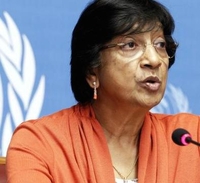
Navi Pillay, U.N. High Commissioner for Human Rights, critized the U.S. government for supporting Israel in its conflict with Hamas: It spent "almost $1 billion in providing the 'Iron Domes' to protect the Israelis from rocket attacks. But no such protection has been provided to Gazans against the shelling." (Quoted in Stephanie Nebehay, "World powers must hold Israel accountable: U.N. rights boss," July 31, 2014)
Trudy Rubin, columnist.
Trudy Rubin, columnist for the Philadelphia Inquirer: "One reason for the amazing extent of Hamas' underground tunnel network - which Israel is trying to destroy - is that digging tunnels is one of the few new sources of jobs." ("In Gaza, time to stop the blame and recognize the humanity," July 28, 2014)
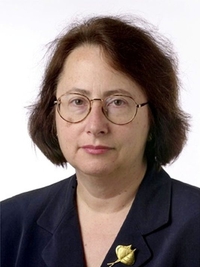
Nasser Judeh, Jordanian Minister of Foreign Affairs and Expatriate Affairs: "Failure to achieve the two-state solution, which should lead to an independent Palestinian state on the 1967 borders with East Jerusalem as its capital, is the main cause for regional instability and also threatens world peace and security." (Ma'an News, "FM meets US Congressional delegation," June 29, 2014)
Barack Obama, U.S. president, on Yemen offering a model to bring stability to Iraq. "You look at a country like Yemen -- a very impoverished country and one that has its own sectarian or ethnic divisions." ("Remarks by the President on the Situation in Iraq," June 19, 2014)
Barack Obama, U.S. president:
In the 2012 campaign, Obama spoke not only of killing Osama bin Laden; he also said that Al Qaeda had been "decimated." I pointed out that the flag of Al Qaeda is now flying in Falluja, in Iraq, and among various rebel factions in Syria; Al Qaeda has asserted a presence in parts of Africa, too. "The analogy we use around here sometimes, and I think is accurate, is if a jayvee team puts on Lakers uniforms that doesn't make them Kobe Bryant," Obama said, resorting to an uncharacteristically flip analogy.
Translation for non-Americans: If the junior varsity basketball team puts on the uniform of the Los Angeles Lakers professional team, this does not transform them into star basketball players such as Kobe Bryant is. (Quoted in David Remnick, "Going the Distance," January 27, 2014) Sep. 7, 2014 update: Obama now, in conversation with Chuck Todd of Meet the Press, denies what he plainly said:
TODD: Long way, long way from when you described them [ISIS] as a JV team.
OBAMA: Well, I–
TODD: Was that bad intelligence or your misjudgment?
OBAMA: Keep– keep– keep in mind I wasn't specifically referring to [ISIS]. I've said that, regionally, there were a whole series of organizations that were focused primarily locally. Weren't focused on homeland, because I think a lot of us, when we think about terrorism, the model is Osama bin Laden and 9/11.
As many have pointed out, this is not just spin but a falsehood.
Scott Alexander, associate professor of Islam: "Christians could begin thinking of Christmas as a time for renewing their commitment to the jihad for justice and peace." ("Muslim Perspectives on 'Remembering God' at Christmas," University of Chicago Divinity School, December 26, 2013)
Craig Considine: "Muhammad and Washington may seem like an unlikely connection, but in fact, they share strikingly similar biographies." ("An Unlikely Connection Between the Prophet Muhammad and George Washington," Huffington Post, January 10, 2013)
The Economist, discussing the nonsensical "Ergenekon" conspiracy theory promulgated by the AK party-dominated Turkish government: "No doubt coup-mongers are among them, yet there is widespread concern that some caught up in the trials are innocent people whose crime is to oppose AK." ("Erbakan's Legacy," March 5, 2011)
Time magazine: Andrew Lee Butters writes that, "unlike Egypt, and even Yemen and Jordan, demonstrations in Syria are unlikely to pick up anywhere near enough momentum to seriously threaten the regime of President Bashar al-Assad. The reason is simple: Syria, unlike Egypt, Yemen and Jordan, isn't allied with the United States." ("Why the Arab Democracy Wave is Unlikely to Reach Syria — Yet," February 4, 2011)
Barbara Lubin, co-founder of the Middle East Children's Alliance, a group in Berkeley that organizes aid missions to Gaza: "When you look at the Middle East, in one way or another it's all about what's happening in Palestine." (Quoted in Daniel Ming and Aaron Glantz, "A Jewish Group Makes Waves, Locally and Abroad," The New York Times, February 3, 2011)
Erik Akerlund, police chief of Rinkeby, a heavily immigrant suburb of Stockholm, responding the failed terrorist bombing in Stockholm: "The biggest worry isn't that the Muslim community will become radicalized but what this means for the view of Muslims in Sweden." (Karl Ritter, "Suicide bombing stirs Sweden's far-right," Associated Press, December 16, 2010)
Robert Mueller, director of the Federal Bureau of Investigation: "Most of the individuals who've been radicalized in the United States have been radicalized by influences outside the United States as opposed to being radicalized by influence in the United States." ("Nine Years After 9/11: Confronting the Terrorist Threat to the Homeland," testimony before the U.S. Senate Homeland Security and Governmental Affairs Committee, September 17, 2010)
Sheila Jackson Lee, Democratic member of the U.S. House from Texas: "Today, we have two Vietnams, side by side, North and South, exchanging and working. We may not agree with all that North Vietnam is doing, but they are living in peace. I would look for a better human rights record for North Vietnam, but they are living side by side." (Stephanie Condon, "Sheila Jackson Lee Catches Flack for Citing 'Two Vietnams'," CBS News, July 16, 2010)
Martin Indyk, director of the foreign policy program at the Brookings Institution, discussing Palestinian-Israel negotiations: "the negotiating environment is better suited to peacemaking today than it has been at any point in the last decade." ("For Once, Hope in the Middle East," The New York Times, August 26, 2010)
Barack Obama, U.S. president, replying to Yonit Levi of Israeli television noting that "there are people in Israel who are anxious about you and who ... feel like you don't have a special connection to Israel," to which Obama responds: "some of it may just be the fact that my middle name is Hussein, and that creates suspicion." ("Interview of the President by Yonit Levi, Israeli TV," July 7, 2010)
Hank Johnson (Democrat of Georgia): Discussing a planned military buildup on the Pacific island of Guam, he expressed concerns about to Adm. Robert Willard, head of the U.S. Pacific fleet: "My fear is that the whole island will become so overly populated that it will tip over and capsize." To which, Willard gently replied, "We don't anticipate that." (April 1, 2010)
The Royal Institute of International Affairs (Chatham House): "Abdullah Gül, President of Turkey, has been voted the winner of the Chatham House Prize 2010. This annual award is presented to the statesperson deemed by members of the Royal Institute of International Affairs at Chatham House to have made the most significant contribution to the improvement of international relations in the previous year." ("President Gül Named Chatham House Prize 2010 Winner," March 19, 2010)
Ghada Karmi, honorary fellow.
Ghada Karmi, honorary fellow af the Institute of Arab and Islamic Studies at the University of Exeter: "from the point of view of Arabs, the establishment of the State of Israel in their midst was an unmitigated disaster. There is actually nothing — repeat, nothing — positive about the existence of Israel, as far as the Arabs are concerned. You know, sometimes there are events, historical events, that happen against people's will. But, in time, they can find some positive aspect to something they didn't want to happen in the first place. This is not the case with Israel. On the contrary, as time has gone on, the existence of Israel has only increased the problems for the Arab region. It has increased the danger in the Arab world and is a threat not only to the security of the region, but the security of the whole world." ("Interview: Ghada Karmi, A Voice from Exile," Executive Intelligence Review, reprinted in Middle East Policy Journal, Spring 2010.)
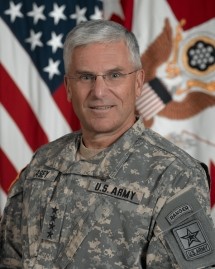
U.S. Army Chief of Staff George W. Casey Jr.
George W. Casey Jr., U.S. Army chief of staff, commenting on the just-occurred Ft. Hood massascre carried out by Maj. Nidal Hasan: "I believe it would be an even greater tragedy if our diversity becomes a casualty here." To which one replies in wonder: How many dead are a greater tragedy than the termination of "our diversity"? (Quoted in George Stephanopoulos, "Ft. Hood: Gen. Casey Doesn't Rule Out Terrorism," November 8, 2009; for the video, click here)
Daniel J. Wakin, reporter, looking at the question of four Muslim ex-cons arrested on the accusation of planning to attack two synagogues: "The authorities have made no overt claim that the four suspects — James Cromitie, Onta Williams, David Williams IV and Laguerre Payen — hatched a plot in jail or that their experiences behind bars led to their alleged acts. In fact, it is uncertain just how much of a role their faith played in their motivation." ("Imams Reject Talk That Islam Radicalizes Inmates," The New York Times, May 24, 2009.)
Vali Nasr, Council on Foreign Relations, arguing for the moderation of Turkey's AK Party (Adalet ve Kalkınma Partisi): "The AKP has expanded Turkey's defense pact with Israel, increased the volume of trade between the two countries, party leaders have visited Israel, and Erdogan has led mediation efforts between Israel and Syria. Fundamentalists do not seem to doubt the distance between themselves and the AKP." (Forces of Fortune, New York: Free Press, 2009, p. 241.)
James Howard Kunstler, novelist: I devote a whole weblog entry to his spectacularly wrong-headed ideas about "10 Ways to Prepare for a Post-oil Society" at "James Howard Kunstler's Reactionary Futurology." (December 1, 2008)
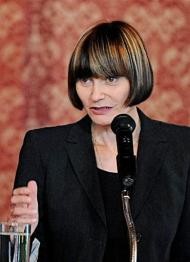
Micheline Calmy-Rey, foreign minister of Switzerland.
Micheline Calmy-Rey, foreign minister of Switzerland, arguing for "dialogue without discrimination," including possibly with Osama bin Laden: "The refusal of dialogue is always a sterile choice." For Switzerland, she said, "the only force we have ever had is that of words." (Quoted in "Switzerland does not rule out talking to bin Laden," August 25, 2008)
Richard Dawkins, author of The God Delusion: "It is possible to see Europe as a haven of civilisation, with the pincer movement of Islam on one side and the US on the other." (Quoted in Phil Miller, "Europe 'is haven of civilisation trapped between Islam and US'," August 12, 2008)
Daniel Gordis, senior vice president, the Shalem Center, Jerusalem: "The challenge facing Israel isn't to win the war against the Palestinians. The war can't be won. We can't eradicate them, and they won't accept our being here. The challenge that Israel faces is not to move towards peace." ("When Mistakes Are Worth Making," Dispatches from an Anxious State, July 18, 2008)
Antony T. Sullivan, director of Near East Support Services: "In the future, no one will be able to discuss U.S. foreign policy without reference to the Mearsheimer-Walt volume[, The Israel Lobby]." (review of the Mearsheimer-Walt book in Middle East Policy, Summer 2008)
Ehud Olmert, prime minister of Israel, arguing in favor of withdrawing from the Golan Heights: "we are facing a historic agreement with Syria, which may remove the northern threat." (Quoted in Hagai Einev, "Yishai, Mofaz promise to fight withdrawal from Golan," May 25, 2008)
Ehud Olmert, prime minister of Israel: "Peace is achieved through concessions. We all know that." (Speech commemorating Yitzhak Rabin's assassination, November 5, 2007)
William Odom.
William Odom, retired general and former director of the National Security Agency: Giuliani's anti-terrorism rhetoric is "the most delightful thing that al-Qaeda could want" and derides Giuliani's analogy of the war on terror to the cold war: "Jihadism is a mosquito bite compared to communism. Anybody who talks about terrorism this way is like a witch doctor." (Quoted in Amanda Ripley, "Behind Giuliani's Tough Talk," Time, August 22, 2007)
Shuli Dichter, co-director of Sikkuy, the Association for Advancing Civic Equality in Israel and a member of nearby Kibbutz Ma'anit: "I understand the Palestinians' reasons for wanting to stay [Israel citizens, on which see "'The Hell of Israel Is Better than the Paradise of Arafat'," D.P.], but it is because I am a Jew and a Zionist that I want them to stay. I live here in the region, and even if the Arabs wanted to leave, I would ask them not to. I believe in a Jewish majority, but not in total ethnic homogeneity. Having people who think differently than us enriches us." (Eetta Prince-Gibson, "Land (Swap) For Peace?" in The Jerusalem Report, November 26, 2007)
Condoleezza Rice, U.S. secretary of state, addressing the American Task Force on Palestine: "I believe that there could be no greater legacy for America than to help to bring into being a Palestinian state for a people who have suffered too long, who have been humiliated too long, who have not reached their potential for too long, and who have so much to give to the international community and to all of us. I promise you my personal commitment to that goal." ("Helping Palestinians Build a Better Future," October 11, 2006)
Jessica Stern
Jessica Stern, lecturer on terrorism at Harvard University, explaining the surge in Islamist violence: "Jihad has become a global fad, rather like gangsta rap." ("Jihad – a global fad," The Boston Globe, August 1, 2006)
Antony Whitehead, senior lecturer in criminology at the University of Huddersfield, explaining the motives behind the London transport bombings on 7/7: "The bombers have said that they are motivated by loyalty to Allah, which they may entirely believe. But if you are going to start to unpick their motivation, you need to consider their experience as young men as much as their adherence to Islam. It's a very understandable dynamic. Young Muslim men in the British culture experience a lot of internalised pressure to conform to the idea of manhood – the ideal of courage and standing up for yourself. How does that affect you if you are a Pakistani male living in a council estate with a BNP councillor and a guy with no hair shoving shit through your letterbox? Social disadvantage equals disadvantage in being a man as well. We are coming at this from the wrong angle. We are making the assumption that it's all about Islam. ... What I am saying is that suicide bombing in general is understandable in terms that are pretty ordinary." (Quoted in Liam McDougall, "Criminologists say London bombers were motivated more by masculinity than Islam," Sunday Herald (Scotland), July 9, 2006)
Aluf Benn
Aluf Benn, Israeli columnist, writing a week before Hasan Nasrallah, leader of Hizbullah initated a war with Israel: "Nasrallah hates Israel and Zionism no less than do the Hamas leaders, Shalit's kidnappers and the Qassam squads. But as opposed to them - he has authority and responsibility, and therefore his behavior is rational and reasonably predictable. Under the present conditions, that's the best possible situation. Hezbollah is doing a better job of maintaining quiet in the Galilee than did the pro-Israeli South Lebanese Army." ("We need a Nasrallah," Ha'aretz, July 6, 2006) July 20, 2006 update: In an almost unheard-of act, Benn has acknowledged and taken responsibility for his error in judgment: "I was mistaken. ... The mistake in my assessment stemmed, as always, from the idee fixe that what was is what will be." ("How I erred," Ha'aretz) Wise words, and this instance provides a good illustration of the need to avoid that too-tempting trap.
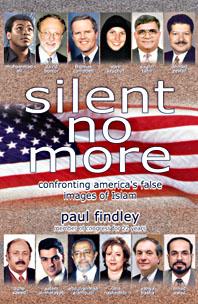
Cover of Paul Findley's "Silent No More" (2001)
Paul Findley, former U.S. congressman: "It is reasonable to credit Al-Arian with giving Bush a key to the White House." ("The Al-Arian Settlement Leaves Bush's Trophy Case Empty," Washington Report on Middle East Affairs, July 2006) Findley, it might be noted as an aside, is also the author who decided that a picture of Abdulrahman Alamoudi should be one of the heroic figures to grace the cover of his 2001 book, Silent No More.
Shimon Peres, vice premier of Israel, responding to a barrage of Qassam missiles on the Israeli town of Sderot: "This hysteria over the Qassams must end. We're just adding to the hysteria. What happened? Kiryat Shmona [in northern Israel] was shelled for years. ... We must tell the Palestinians, Qassams shmassams, we'll hold firm. We won't move from here." ("Peres: Enough with Qassam hysteria," Yedi'ot Aharonot, June 20, 2006)
Eli Moyal, the mayor of Sderot, a town near Gaza that is being hit by nearly three Kassam rockets a day: "We aren't even holding one inch of Palestinian land in the Gaza Strip, so I don't understand why they're shooting at Sderot." (Joshua Mitnick, "Sitting Ducks In Sderot," New York Jewish Week, June 16, 2006)
Hamid Dabashi
Hamid Dabashi, professor at Columbia University: ""The Iranian human-rights record is atrocious, as is the human-rights record of any country including the U.S." (Quoted in Kristin E. Holmes, "Concern rises over Baha'is in Iran," The Philadelphia Inquirer, May 6, 2006)
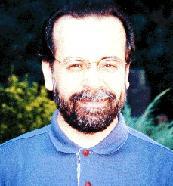
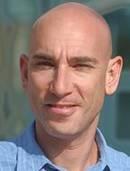
Paul M. Moskal, chief division counsel for Buffalo's FBI bureau
Paul M. Moskal, chief division counsel for Buffalo's FBI bureau, noting that he received phone calls and messages from people warning him not to work with the Council on American-Islamic Relations on a joint television program because CAIR has connections to terrorists: "I was very offended. I mean, what's the FBI's international reputation?" (Quoted in Sandra Tan, "Muslims, local FBI forging history," The Buffalo News, April 14, 2006)
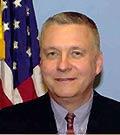
If there is someone more foolish coming out of the organized Jewish community than Henry Siegman, that person has yet to come to my attention. For a full analysis of his oeuvre, see the analysis by Daniel Mandel and Asaf Romirowsky, "The Council on Foreign Relations Does the Middle East." His most recent deep thinking in the New York Review of Books is summed up by its title: "Hamas: The Last Chance for Peace?" (April 27, 2006)
 Henry Siegman |
Ruth Walker, summing up a panel held at Harvard University with Elaine Pagels, Faisal Devji, and Jessica Stern: "If suicide terrorism is to be held in check, what's needed is an engaging, exciting 'counterperformance' - whatever that might be - that can be offered in place of the 'theater of violence' exemplified by the al-Qaida attacks of Sept. 11, 2001." ("Distinguished panel explores 'martyrdom': Martyrdom discussed, defined in context of various religious traditions," Harvard University Gazette, March 16, 2006)
Faisal Devji, assistant professor of history at the New School in New York, argues in a new book, Landscapes of the Jihad, that violence is less important to Al-Qaeda than ethics. In an interview with the Guardian, he suggests understanding it as a global movement, rather like environmentalism. In his words:
As I see it, al-Qaida's actions are typically "symbolic" - they can be seen as "effects" rather than political interventions. This is because they have no way of planning what they want to achieve. They have no blueprint for the future. This, of course, is also true of other global movements like environmentalism. They, too, have no coherent political programme.
Oh, and "violence is the least important thing about al-Qaida because the violence is ethical in origin and will quite likely flip into its opposite. The most important feature of al-Qaida is fragmentation and dispersal of Islamic thought globally." (October 17, 2005)
Harry Reid, Senate Democratic leader, discussing George W. Bush's choice of Harriet Miers for Supreme Court justice: "I have to say without any qualification that I'm very happy that we have someone like her [on the court. She is] very personable, very genuine, somebody that answers her phone calls immediately." (Quoted in Elisabeth Bumiller, "Bush Names Counsel as Choice for Supreme Court," The New York Times, Oct. 4, 2005) To this, David Kuo, a former special assistant to the president, adds another powerful endorsement:
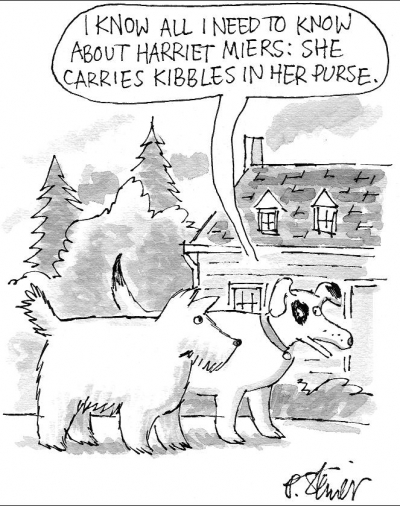 From The Weekly Standard, Oct. 17, 2005. |
|
Harriet used to keep a humidor full of M&Ms in her West Wing office. It wasn't a huge secret. She'd stash some boxes of the coveted red, white, and blue M&Ms in specially made boxes bearing George W. Bush's reprinted signature. Her door was always open and the M&Ms were always available. I dared ask one time why they were there. Her answer: "I like M&Ms and I like sharing."
("The Harriet Miers I Know," belief.net, undated)
That returning "phone calls immediately" and giving out candies should qualify a person for Supreme Court justice brings to mind the ditty of Sir Joseph Porter in Gilbert and Sullivan's H.M.S. Pinafore, the first stanza of which goes like this:
When I was a lad I served a term
As office boy to an Attorney's firm.
I cleaned the windows and I swept the floor,
And I polished up the handle of the big front door.
I polished up that handle so carefullee
That now I am the Ruler of the Queen's Navee!
Edina Lekovic, spokeswoman for the Los Angeles-based Muslim Public Affairs Council, commenting on local authorities in Lodi, California, rejecting an application of the Farooqia Islamic Center (whose leadership has been associated with terrorism): "If you replace the word 'mosque' with 'synagogue' or 'church,' would we see the same type of scrutiny and fear?" (Quoted in Neil Gonzales, "Islamic leader mystified by supervisors' decision," Stockton Record, Sep. 29, 2005)
Rachel Zoll, Associated Press religion reporter, in an article on the anticipated ban on homosexuals in the Catholic priesthood: "Several priests challenged [the argument that homosexuals face strong pressures in the priesthood's all-male atmosphere] and noted that heterosexual priests face their own temptations: The overwhelming majority of lay ministers who work side by side with clergy are women, yet no one has suggested banning heterosexuals from the priesthood." ("Expected Vatican Ban Roils American Church," Sep. 22, 2005)
Ali Hamka, 25, the son of Lebanese immigrants and a high school economics teacher in Rochester, a Detroit suburb, discussing the press focus on the London bombings of July 7, killing 52: "The media is always ready to point out that it's Muslims involved in terrorism. I don't think they get the message that, you know, we're a religion, about peace, not killing people." (Quoted in "Michigan Mosque Is Testament to Islam's Integration in American Society," RNS, Aug. 22, 2005)
Charles Strozier of John Jay College of Criminal Justice: "The Arab-American community in the United States and Muslim community in general is highly assimilated, very American, not radical. There's no reason to believe that it is from this community that you're going to find anyone who is likely to be a bomber." ("Hikind Stands By Call To Employ Racial Profiling In Subway Searches," August 2005.)
Ian Blair, Metropolitan Police Commissioner, London: there is "nothing wrong with being a fundamentalist Muslim. ... The key issue is the slide into extremism." (Sarah Blaskovich, "London Police Chief Reaches Out to Muslims," July 15, 2005)
Ehud Olmert, deputy prime minister of Israel: "We are tired of fighting, we are tired of being courageous, we are tired of winning, we are tired of defeating our enemies." (Speech to the Israel Policy Forum, June 9, 2005)
David Dickson, a specialist on Africa: "Political Islam, by definition, is neutral. It is any variant of Islam inspiring or serving as a vehicle for political mobilization or activity. Productive scholarship and policymaking must reject definitions that categorically treat political Islam as either a malevolent or benevolent force." ("Political Islam in Sub-Saharan Africa: The Need for a New Research and Diplomatic Agenda," U.S. Institute of Peace, May 2005)
Ehud Olmert, deputy prime minister of Israel, asked how he could trust the intentions of Mahmoud Abbas, head of the Palestinian Authority, when Abbas has allowed terrorists to arm themselves to the teeth. David Bedein described Olmert's reaction as "passionate. He pounded on the podium and exhorted people to examine 'Israel's withdrawal from Lebanon as a model which Israel would apply to Gaza and Samaria.' Olmert explained that Hizbullah terrorists now stationed in former Israeli army positions throughout Southern Lebanon had accumulated 15,000 missiles and mortars in Lebanon. Continuing to pound on the podium, Olmert that 'they have never, never, never used missiles against Israel on the northern border since Israel's withdrawal from Lebanon in May, 2000'." Bedein then documents the factual errors of this statement. ("All Quiet on the Northern Front," IsraelInsider.com, March 3, 2005)
Maria Margaronis: From London, "the most frightening thing about Bush's victory is the prospect of a world divided between warring fundamentalisms, with Europe in the middle struggling to hold on to its Enlightenment legacy." ("Fears of a World Divided," The Nation, Nov. 22, 2004)
Ariel Sharon speaking at the Herzliya Conference. (AP)
Ariel Sharon, prime minister of Israel, giving his ground-breaking "disengagement"-from-Gaza speech: "The purpose of the 'Disengagement Plan' is to reduce terror as much as possible, and grant Israeli citizens the maximum level of security. The process of disengagement will lead to an improvement in the quality of life, and will help strengthen the Israeli economy. ... These steps will increase security for the residents of Israel and relieve the pressure on the IDF and security forces in fulfilling the difficult tasks they are faced with. The 'Disengagement Plan' is meant to grant maximum security and minimize friction between Israelis and Palestinians." ("Prime Minister's speech at the Herzliya Conference," Dec. 20, 2003)
Patty Murray, Democratic senator from Washington State: "Why are people so supportive of [Osama bin Laden] in many countries? He has been in many countries that are riddled with poverty.... He's been out in these countries for decades building roads, building schools, building infrastructure, building day care facili ties, building health care facilities, and the people are extremely grateful. We [Americans] have not done that. We haven't been out in many of these countries helping them build infrastructure. How would they look at us today if we had been there helping them with some of that, rather than just being the people who are going to bomb in Iraq and go to Afghanistan?" (Spoken to high school students in Vancouver, Washington, December 18, 2002)
Joe Biden, U.S. senator (Democrat from Delaware) and chairman of the Senate Foreign Relations Committee, talking to committee staffers at a meandering meeting: "Seems to me this would be a good time to send, no strings attached, a check for $200 million to Iran." (Quoted in Michael Crowley, "Rhetorical Question" Oct. 22, 2001)
Larry C. Johnson, former State Department counterterrorism specialist (and note the date below before reading): "Judging from news reports and the portrayal of villains in our popular entertainment, Americans are bedeviled by fantasies about terrorism. They seem to believe that terrorism is the greatest threat to the United States and that it is becoming more widespread and lethal. They are likely to think that the United States is the most popular target of terrorists. And they almost certainly have the impression that extremist Islamic groups cause most terrorism.
"None of these beliefs are based in fact. ... when the threat of terrorism is used to justify everything from building a missile defense to violating constitutional rights (as in the case of some Arab-Americans imprisoned without charge), it is time to take a deep breath and reflect on why we are so fearful.
"Part of the blame can be assigned to 24-hour broadcast news operations too eager to find a dramatic story line in the events of the day and to pundits who repeat myths while ignoring clear empirical data. Politicians of both parties are also guilty. They warn constituents of dire threats and then appropriate money for redundant military installations and new government investigators and agents.
"Finally, there are bureaucracies in the military and in intelligence agencies that are desperate to find an enemy to justify budget growth. In the 1980's, when international terrorism was at its zenith, NATO and the United States European Command pooh-poohed the notion of preparing to fight terrorists. They were too busy preparing to fight the Soviets. With the evil empire gone, they 'discovered' terrorism as an important priority. ... terrorism is not the biggest security challenge confronting the United States, and it should not be portrayed that way." ("The Declining Terrorist Threat, The New York Times, July 10, 2001)
Ray Takeyh, Washington Institute for Near Eastern Policy: "today Islamism is everywhere on the retreat." (National Interest, Spring 2001, p. 97)
Zbigniew Brzezinksi, national security advisor to Jimmy Carter: "There isn't a global Islam. Look at Islam in a rational manner and without demagoguery or emotion. It is the leading religion of the world with 1.5 billion followers. But what is there in common among Saudi Arabian fundamentalism, moderate Morocco, Pakistan militarism, Egyptian pro-Western or Central Asian secularism? Nothing more than unites the Christian countries." (Interview in Le Nouvel Observateur, January 15, 1998)
Rafic Jouejati, a high-ranking Syrian diplomat: Syria will be "a regional power by 2010." ("Syria as a Regional Power by 2010," in Volker Perthes, ed., Scenarios for Syria: Socio-Economic and Political Choices, Baden-Baden: Nomos, 1998, p. 21.)
Norman Schwarzkopf, head of U.S. Central Command, was glad that European Command kept Israel within its area of responsibility because, he wrote later, "I'd have had difficulty impressing the Arabs with Central Command's grasp of geopolitical nuance if one of the stops on my itinerary had been Tel Aviv." (It Doesn't Take a Hero: The Autobiography of General Norman Schwarzkopf, New York: Random House, 1992, p. 318)
Richard Falk, Princeton University professor: "The depiction of [Khomeini] as fanatical, reactionary and the bearer of crude prejudices seems certainly and happily false. What is also encouraging is that his entourage of close advisers is uniformly composed of moderate, progressive individuals. ... they are widely respected in Iran butside religious circles, share a notable record of concern for human rights and seem eager to achieve economic development that results in a modern society oriented on satisfying the whole population's basic needs. ... Having created a new model of popular revolution based, for the most part, on nonviolent tactics, Iran may yet provide us with a desperately needed model of humane governance for a third-world country." ("Trusting Khomeini," New York Times, February 16, 1979)
Michel Foucault, French intellectual: "By 'Islamic government,' nobody in Iran means a political regime in which the clerics would have a role of supervision or control." ("What are the Iranians dreaming about?" Le Nouvel Observateur, Oct. 16-22, 1978)
Dwight Macdonald, American critic: "Europe has its Hitlers, but we have our Rotarians." (Quoted by Joseph Epstein, "Dwight Macdonald: sunburned by ideas," spoken probably in the 1930s)
William McDougall, the William James professor of psychology at Harvard University: "It was the ignoring of the importance of race and the overestimation of the moulding influence of culture and institutions ... that led England eighty years ago to set out on the task of endowing the millions of India with British culture and institutions. ... the best observers assure us that, were the task accomplished and the reins of a representative government left in native hands, it would be but a few years before the whole country would be reduced to a chaotic anarchic condition no better than that in which we found it. Others go further and assert with some plausibility that Eastern culture is positively injurious to the intellect and moral nature of Indians." (The Group Mind: A Sketch of the Principles of Collective Psychology with Some Attempt to Apply Them to the Interpretation of National Life and Character (New York: G. P. Putnam's Sons, 1920), p. 165.)
Ralph Waldo Emerson, American philosopher: "Fear always springs from ignorance." (Lecture to the Phi Beta Kappa chapter at Harvard, 1837)


