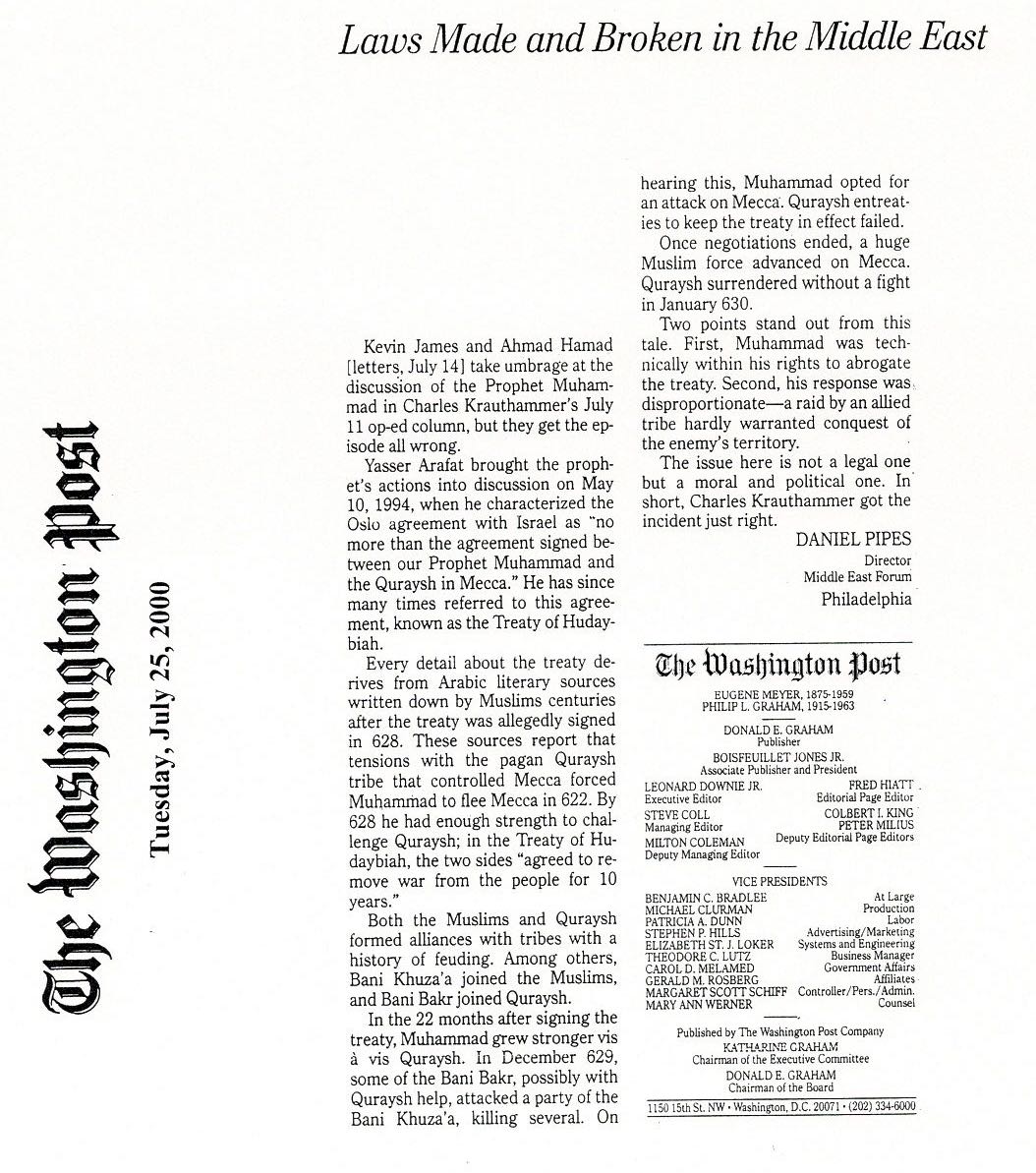
In response to this article (in which, contrary to other American commentators, I found that "Muhammad was technically within his rights to abrogate the treaty"), CAIR sent out a bulletin titled "Daniel Pipes Smears Prophet Muhammad" – fighting words for many Muslims – and called me a "hard-core Islamophobic ideologue." (September 10, 1999)
Nov. 1, 1999 update: I recount in an article in Commentary, "'How Dare You Defame Islam'," the unpleasant experiences of U.S. News & World Report and The New Republic:
Beginning in May 1995, Yasir Arafat, having entered into negotiations with Israel, took to defending himself before Arab audiences by alluding cryptically to the treaty of Hudaybiyah, signed by the Prophet Muhammad in 628 C.E. Dusting off their history books, American commentators mostly concluded that, in invoking an agreement signed but then subsequently broken by Muhammad when circumstances changed, Arafat was signaling that he, too, did not really mean to keep his pledge. Arafat's intentions aside, however, it was the suggestion that the Prophet Muhammad had gone back on his word that aroused CAIR's fury. So impassioned was the reaction when Mortimer B. Zuckerman, editor-in-chief of U.S. News & World Report, referred in a column to "the doctrine of the prophet Muhammad of making treaties with enemies while he is weak, violating them when he is strong," that the magazine ended up printing not one but two apologies.
A flavor of what CAIR and its network of letter writers were capable of producing on this occasion may be gleaned from the pages of the New Republic, where a similar statement had been made by Yehoshua Porath, an eminent professor of Middle East history at the Hebrew University of Jerusalem: "Muhammad broke the [Hudaybiya] agreement eighteen months after its conclusion." This view elicited, according to the magazine's editors, "hundreds of abusive phone calls, letters, and e-mail accusing us of defamation of the Prophet and worse." Among the letters published by the editors, all in their original grammar and spelling, one read:
You guys had better watch out, ok? Because this is not going to go on further anymore, ok? You'd better watch out that f*ing Jew . . . tell him where he is coming from, ok? Because you know mother-f*er bastard, mother - his mom is a bastard. ok? He can't talk about Muslim shit and you get your act together . . . all of you. We don't want to hear anymore about this problem, ok? You got that right?
Another was more threatening:
The jews from back in history were the ugly decievers and BLOOD SUCKERS. . . . It is importatn that an apology is issued to calm down the MUSLIM all over the world. WE DO NO WANT TO SEE ANOTHER 19 AMERICANS GO A WSAY IN THA LAND OF THE PROPHET ,,, DO WE ??????? !!!!!! I am saying this because the Muslims will never tolerate the actions of the jews agains their religion. And articels like these contribute in the future loss of life of Anmericans all over the Islamic world. . . . We are fed up of filthy jews robbing our lands, and defaming all HOLY concepts we have. Please, save the lives of few Americans by issuing your apology.
July 11, 2000 update: Charles Krauthammer wrote in the Washington Post today that "Arafat has explicitly analogized Oslo to the 10-year treaty Mohammed made with the Quraysh tribe. It too marked an interlude. Two years later, when the tactical necessity had passed, the treaty was broken and the Quraysh were attacked and defeated." The same day, CAIR replied with an alert proclaiming, "Pro-Israel Columnist Defames Prophet Muhammad."
July 25, 2000 update: Krauthammer's column prompted a rebuttal from Kevin James and Ahmad Hamad on July 14 that I answered today.
Aug. 3, 2001 update: Tom Lantos (Democrat of California) thus addressed the American Israel Public Affairs Committee:
Arafat walked away from a dream deal. Apparently, his approach to the peace process was based on the Treaty of 628 at Hudaibiyah, which was a treacherous treaty. Islamic forces made truce with non-Islamic elements, and they had no intention of keeping that agreement. They went on to attack, and destroyed those with whom they had made the treaty. Arafat's behavior suggests that this is the kind of peace he had in mind.
In response, American Islamist organizations lambasted Lantos in their press releases:
The Council on American-Islamic Relations called this a "demonstrably false smear" in a release titled "Muslims Demand Lantos Apologize for Smearing Prophet Muhammad."
The American Muslim Council decried the "slanderous comments" in a release titled "AMC Urges Muslims to Demand an Apology from Congressman Lantos for Slanderous Remarks Against Prophet Muhammad."
The Muslim Public Affairs Council termed them "offensive, superficial, ignorant and politically viscous" remarks in a release titled "Rep. Tom Lantos Bigoted Comments Against Islam."
Aug. 11, 2001 update: Lantos apologized for his comments:
Let me make very clear that I intended no offense to Muslim believers nor any defamation of the Prophet Muhammad... and I regret any pain caused, however inadvertently. I fully respect Islam as one of the world's great religions and civilizations and as a faith that provides spiritual comfort and uplift to hundreds of millions... Making a historical judgment on the events of 628-630 AD is well beyond my Congressional responsibilities. I had no desire to do so, and, to the extent that I allowed for such an understanding of my intent, I regret it.
But this did not satisfy CAIR. Nihad Awad responded:
Lantos apologized for hurting the feelings of Muslims. This is good, but not sufficient. He has to retract his false statement against the prophet. This is what prompted us to contact him, not because he hurt our feelings, but because he made a bold lie about the prophet. Even though he admits that he is not a historian, he still judges history. While Lantos says he had no intent to defame the Prophet Muhammad, he does not clearly retract his false allegation that the Prophet's actions were "treacherous."
Awad also criticized "representatives of the pro-Israel lobby" for continuing to promote "this slur against the Prophet Muhammad as an anti-Muslim 'talking point.'"
"It is known in history, even by Western historians, is that the prophet never broke any treaty, but that the other side broke the treaty. And once any treaty is broken, it is null and void," said Awad.
June 21, 2012 update: Anwer Mahmood Khan devotes his entire article, "Perception vs. Reality: Is Islam a Militant Religion? Response to Daniel Pipes' Accusations," to a critique of my article on Hudaybiya.
Sep. 13, 2018 update: Making 25 years since the Oslo Accords were signed, Palestinian Media Watch today collects a number of statements. One, broadcast by Mahmoud Al-Habbash, Abbas' advisor on religious and Islamic affairs, and Chairman of the Supreme Council for Shari'ah Justice on official PA television on July 19, 2013, concerns Hudaybiya:
The Palestinian leadership's sense of responsibility towards its nation made it take political steps [the Oslo Accords] about 20 years ago [1993] ... exactly like the Prophet [Muhammad] did in the Treaty of Hudaybiyyah. ... The Prophet said: 'I'm the Messenger of Allah and I will not disobey Him.' This is not disobedience, it is politics... In less than two years, the Prophet returned and based on this treaty, he conquered Mecca. This is the example, this is the model.