| Home | Articles | Blog | Reviews | Spoken | Books | Biographical | Middle East Forum | About this site | Mailing List |
Biographical Sketch of Daniel Pipes
(Click here for a short version of this résumé.)
(Click here for talking points to introduce Daniel Pipes at an event.)
(Click here for a list of the topics Mr. Pipes speaks on.)
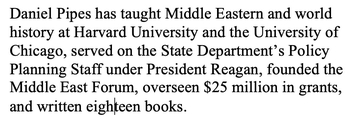
Daniel Pipes is founder of the Middle East Forum and a historian. A columnist for The Washington Times, his special interests include the public role of Islam, Turkey, the Arab-Israeli conflict, and the liberal-conservative divide. His most recent book, Israel Victory: How Zionists Win Acceptance and Palestinians Get Liberated, appeared in June 2024
 Bio, short version. |
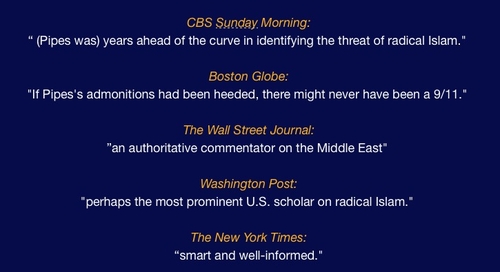
CBS Sunday Morning says Daniel Pipes was "years ahead of the curve in identifying the threat of radical Islam." "Unnoticed by most Westerners," he wrote, for example, in 1995, "war has been unilaterally declared on Europe and the United States." The Boston Globe states that "If Pipes's admonitions had been heeded, there might never have been a 9/11." The Wall Street Journal calls Mr. Pipes "an authoritative commentator on the Middle East" and the Washington Post deems him both "a prominent conservative intellectual" and "perhaps the most prominent U.S. scholar on radical Islam." The New York Times calls him "smart and well-informed."
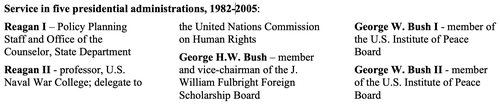
Mr. Pipes received his A.B. (1971) and Ph.D. (1978) from Harvard University, both in history, and spent six years studying abroad, including three years in Egypt. Mr. Pipes speaks French, and reads Arabic and German. He has taught at Harvard, Pepperdine, the U.S. Naval War College, and the University of Chicago. He was affiliated with Princeton in 1977-78 and a fellow at the Hoover Institution in 2008-12. He served in five presidential administrations between 1982 and 2005, including two presidentially-appointed positions, vice-chairman of the Fulbright Board of Foreign Scholarships and board member of the U.S. Institute of Peace. He was director of the Foreign Policy Research Institute, 1986-93. He headed the Middle East Forum 1994-2025.
Mr. Pipes discusses current issues on television on such U.S. programs as ABC World News, Crossfire, Good Morning America, Nightline, O'Reilly Factor, PBS NewsHour, and The Today Show. He has appeared on leading television networks around the globe, including the BBC and Al-Jazeera, and has lectured in 25 countries. He has publicly debated leading figures, including Noam Chomsky, Jeremy Corbyn, and Ken Livingstone.
More than 100 newspapers have carried his articles, including the Los Angeles Times, New York Times, Wall Street Journal, and Washington Post. He has been a columnist for the New York Post, the New York Sun, and The New York Times Syndicate. Mr. Pipes has published in such magazines as the Atlantic Monthly, Commentary, Economist, Foreign Affairs, Harper's, National Review, New Republic, Newsweek, and Time.
Mr. Pipes has written eighteen books:
Four deal with Islam: Face à l'islam radical (co-authored with Guy Millière, French: David Reinharc, 2012), The Rushdie Affair (Birch Lane, 1990), In the Path of God (Basic Books, 1983), and Slave Soldiers and Islam (Yale University Press, 1981).
Three books concern Syria: Syria Beyond the Peace Process (Washington Institute, 1996), Damascus Courts the West (Washington Institute, 1991), and Greater Syria (Oxford University Press, 1990).
Three deal with other Middle Eastern topics: Israel Victory (Wicked Son, 2024) explains how to end the Palestinian-Israeli conflict. The Hidden Hand (St. Martin's, 1996) analyzes conspiracy theories among Arabs and Iranians. An Arabist's Guide to Colloquial Egyptian (Foreign Service Institute, 1983) systematizes the grammar of Arabic as spoken in Egypt.
Conspiracy (Free Press 1997) establishes the importance of conspiracy theories in Europe and America.Seven volumes contain some of his best essays: Islamism vs. The West (Wicked Son, 2023), Nothing Abides (Transaction, 2015), Löwengrube (German: Critic, 2012), L'islam radical à la conquête du monde (French: Cheminements, 2008), Miniatures (Transaction, 2003), Militant Islam Reaches America (WW Norton, 2002), and The Long Shadow (Transaction, 1989).
In addition, Mr. Pipes has edited two collections of essays by multiple authors: Sandstorm (UPA, 1993) and Friendly Tyrants (St. Martin's, 1991). He has published 1,500 articles, 1,500 weblog entries, 700 book reviews, and 12,000 tweets. There are 17,600 translations of his writings into 39 languages, appearing in such publications as ABC (Spain), Corriere della Sera, Le Figaro, and Neue Zürcher Zeitung.
Mr. Pipes has edited two journals, Orbis (1986-90) and the Middle East Quarterly (1994-2001). He sits on several editorial boards, has testified before many congressional committees, and worked on six presidential campaigns. Universities in the United States and Switzerland have conferred honorary degrees on him.
Mr. Pipes takes pride in having been Borked by Edward Kennedy, called an "Orientalist" by Edward Said, insulted by Lyndon LaRouche, deemed the neo-conservative movement's "leading thinker" by Egypt's Al-Ahram newspaper, and publicly invited to convert by a top Al-Qaeda figure. He has also been recognized as one of Harvard University's 100 most influential living graduates and listed in Marquis Who's Who in the World.
Mr Pipes founded the Middle East Forum in 1994 as a traditional think tank focused on the region and influencing U.S. policy toward it through publications (including the Middle East Quarterly) and media appearances. With time, MEF morphed into a "think and activist tank": Campus Watch critiques Middle East studies, Islamist Watch combats non-violent jihadis, Focus on Western Islamism reports on what the mainstream media ignores, the Washington Project educates the administration and Congress; and the MEF Observer publishes policy-oriented op-eds. Campaigns include the Israel Victory Project, the Iran Freedom Project, and the Red Sea Security Project. The Forum, a non-profit, 501c3 organization, has a $4 million annual budget.
Updated February 2025
Biographical articles about Daniel Pipes
Items are listed in reverse order of date
| Title | Publication | Date |
| Assessing the Career of Daniel Pipes | ResearchGate | |
| The Intrepid Duo: Pipes, Father and Son | Gatestone Institute | |
| The Misguided Campaign against Daniel Pipes | Australia Broadcast Corporation (ABC) | |
| Once considered anti-Islam, senior scholar says he's now in the middle |
The Washington Post | |
| Recruiting Soldiers Against Radical Islam |
FrontPageMagazine.com | |
| Daniel Pipes fights the worldwide threat of Islamism - from Malibu |
Jewish Journal of Greater Los Angeles | |
| Radical Departure |
Philadelphia Magazine | |
| Militant about "Islamism" | Harvard Magazine | |
| [Flemming Rose interview:] The Threat of Islamism | Jyllands-Posten | |
| Pipes Objects to Fox in the Henhouse |
Insight Magazine | |
| Truth on Terror |
World Magazine | |
| Where's the Muslim Debate? |
Wall St. Journal | |
| Smearing Daniel Pipes | New York Post | |
| Muslims for Pipes |
New York Sun | |
| Terror's Nemesis | New York Post | |
| Daniel Pipes Visits Hamilton College |
Capitalism Magazine | |
| Pipes' London lecture surprisingly low key | London Free Press | |
| Writer Daniel Pipes is a Lightning Rod in the Post-9/11 World |
Newhouse News Service | |
| Islam's Battle with a Hostile World |
Financial Times Weekend | |
| Speech Down the Pipes | National Review Online | |
| Daniel (Pipes) in the Lions' Den | Where-What-When | |
| Pipes' Dreams |
Philadelphia City Paper | |
| Radical Islam vs. Academic Freedom | Midstream | |
| Radical Islam vs. Academic Freedom: One Example |
FrontPageMagazine.com | |
| Islam Expert in Demand |
Boston Phoenix | |
| Islam Expert Suddenly in the Spotlight |
Philadelphia Inquirer | |
| Yes Related No. 3: The Pipes, the Pipes Are Calling |
Slate.com | |
| Daniel Pipes: Prophet |
Lifestyles Magazine | |
| Son creates his own footsteps through Middle East Politics | The Canberra Times | |
| A Contract for "The Ayatollah, the Novelist and the West" is Canceled | New York Times |
Information about Daniel Pipes' recent talks at universities.
Click on the thumbnails below to see larger-sized
photos of Daniel Pipes, suitable for printing:


Photographs copyrighted © by Daniel Pipes

Latest Articles
Follow Daniel Pipes


All materials by Daniel Pipes on this site: © 1968-2026 Daniel Pipes. daniel.pipes@gmail.com and @DanielPipes
Support Daniel Pipes' work with a tax-deductible donation to the Middle East Forum.Daniel J. Pipes
(The MEF is a publicly supported, nonprofit organization under section 501(c)3 of the Internal Revenue Code.
Contributions are tax deductible to the full extent allowed by law. Tax-ID 23-774-9796, approved Apr. 27, 1998.
For more information, view our IRS letter of determination.)