For the first time in its exceedingly long history, Yemen now threatens the outside world. It does so in two principal ways.
First, even before the current political upheaval began there on January 15, violence emanating out of Yemen impinged on Westerners. As President Ali Abdullah Saleh's weak government controlled only a small part of the country, violence had emerged both near to Yemen (such as attacks on American and French ships) and distant from it (Anwar al-Awlaki's incitement to terrorism in Texas, Michigan, and New York). With Mr. Saleh's apparent abdication on June 4, when he traveled to Saudi Arabia for medical treatment, the central government's writ will further diminish, Yemen is set to become an even greater exporter of violence.
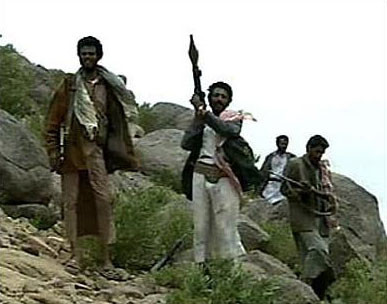 Houthi rebels in northern Yemen. |
The problem begins with an increasingly cataclysmic water shortfall. Gerhard Lichtenthāler, a specialist this topic, wrote in 2010 how, in many of the country's mountainous areas, "available drinking water, usually drawn from a spring or a cistern, is down to less than one quart per person per day. Its aquifers are being mined at such a rate that groundwater levels have been falling by 10 to 20 feet annually, threatening agriculture and leaving major cities without adequate safe drinking water. Sanaa could be the first capital city in the world to run dry."
And not just Sanaa: as a London Times headline put it, Yemen "could become first nation to run out of water." Nothing this extreme has happened in modern times, although similar patterns of drought have developed in Syria and Iraq.
Scarce food resources, columnist David Goldman points out, threaten to leave large numbers of Middle Easterners hungry and a third of Yemenis faced chronic hunger even before the unrest. That number is growing quickly.
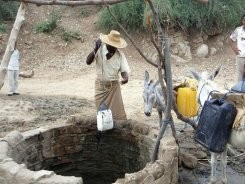 A Yemeni man draws water from a well in the north of the country. |
If water and food were not worrisome enough, Yemen has one of the highest birthrates in the world, exacerbating the resource problem. With an average of 6.5 children per woman, almost 1 in 6 women is pregnant at any given time. Today's population of 24 million is predicted to double in about 30 years.
Politics exacerbate the problem. Assuming Mr. Saleh's rule is history (the Saudis may not let him leave, too many domestic opponents have risen against him), his successor will have difficulty ruling even the meager portion of the country that he controlled.
Too many factions with contrary aims are competing for power – Mr. Saleh's forces, Houthi rebels in the north, secessionists in the south, Al-Qaeda-style forces, a youth movement, the military, leading tribes, and the Ahmar family – for them to coalesce into a neat binary conflict. In a country governed by a "tribal system masquerading as a military autocracy," anarchy along Somali or Afghan lines looks more probable than civil war.
Yemeni Islamists range from members of the Islah Party, which competes in parliamentary elections, to the Houthi rebels fighting Saudi forces, to Al-Qaeda in the Arabian Peninsula. Their growing power boosts the Iranian-backed "resistance bloc" of states and organizations. If Shi'ites prevail over Sunnis in Yemen, Tehran will gain all the more.
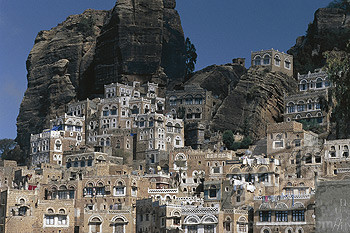 Al-Tawilah village, an example of Yemeni architecture. |
On a personal note: I was fascinated by Yemen on a visit as a student in 1972. A land so difficult of access that colonial powers only lapped at its edges, it managed to keep its customs, including a spectacular style of architecture and a distinctive culture of dagger-wearing men and most adults chewing qat.
Can the outside world prevent catastrophe? No. Yemen's terrain, culture, and politics all render a military intervention untenable; and, at this time of Western deficits and Saudi dread, no one will take responsibility for its collapsing economy. Nor will states volunteer to take in millions of needy refugees.
In this darkest hour, Yemenis are on their own.
Mr. Pipes is president of the Middle East Forum and Taube distinguished visiting fellow at the Hoover Institution of Stanford University.
July 11, 2012 update: Hunger is growing in Yemen, reports Eva Sohlman from Sana for the New York Times.
Hunger in Yemen — the poorest country in the Middle East — has doubled since 2009, according to the World Food Program. The ability of families to feed their children has deteriorated significantly in the last year as food and fuel prices have soared amid the political turmoil and economic activity has ground to a near halt.
About 10 million Yemenis, or 44 percent of the population, no longer have enough to eat, and 5 million are in need of urgent emergency aid, according to a report from the World Food Program in May. Over a quarter of a million children are so malnourished that they risk dying, and nearly half of all children under 5 years old are chronically malnourished, putting their physical and mental development at risk, the report said.
Some 90 percent of Yemenis have been affected by higher food and fuel prices, the report said, and the situation is expected to stay difficult because the country depends on international food markets, where prices remain high. Other contributing factors include a lack of clean drinking water, high unemployment and poverty. Nearly half the population lives below the poverty line of $2 a day.
While there is still food in the markets, there are signs that supplies are shrinking, the World Food Program said. The country's agricultural potential is limited by water shortages and the cultivation and consumption of qat, a water-intensive plant producing the mild narcotic leaf that Yemenis like to chew. For households in urban areas, the breakdown in law and order has made it harder to get food.
Comment: Horrible as this sounds, it's just the beginning of Yemen's woes. There seems to be no way out of the dismal fate that awaits the country.
May 7, 2013 update: Thomas L. Friedman has actually done some useful reporting, about water scarcity, from the city of Taiz in Yemen:
I am in the Yemen International Hospital in Taiz, the Yemeni city in the central highlands that is suffering from such an acute water shortage that people get to run their taps for only 36 hours every 30 days or so. They have to fill up as much as they can and then rely on water trucks that come through neighborhoods and sell water like a precious commodity.
I am visiting Mohamed Qaid, a 25-year-old laborer from the nearby village of Qaradh who was struck the night before in the hand and chest by three bullets fired by a sniper from Marzouh, the village next door. The two villages have been fighting over the rapidly dwindling water supply from their shared mountain springs. Six people have been killed and many more wounded in clashes since 2000 that have heated up of late. One was killed a night ago. ...
Yemen, a country of breathtaking beauty, with wonderful people, is a human development disaster. You see here what a half-century of political mismanagement, coupled with natural resource mismanagement, oil distortions and a population explosion has led to.
Apr. 9, 2015 update: The emptying of Yemen has begun, in an admittedly small way, with the arrival of more than 300 Yemenis in Djibouti across the Red Sea.
May 22, 2015 update: In the space of a month, those hundreds of Yemeni refugees in Djibouti have already turned into thousands.
Nov. 3, 2016 update: Two pieces of catastrophic news from Yemen, as reflected by headlines: "Worst forecasts become reality as Yemen starves" and "Cholera threatens millions in Yemen."
Dec. 12, 2016 update: Al-Jazeera reports that
hunger among children has reached an "all-time high," with at least 462,000 suffering from severe acute malnutrition - a drastic increase of about 200 percent since 2014. In a report published on Monday, UNICEF said at least one child dies every 10 minutes because of malnutrition, diarrhea and respiratory-tract infections.
Feb. 21, 2017 update: Here's the dire current situation report on the food situation from the United Nations World Food Programme:
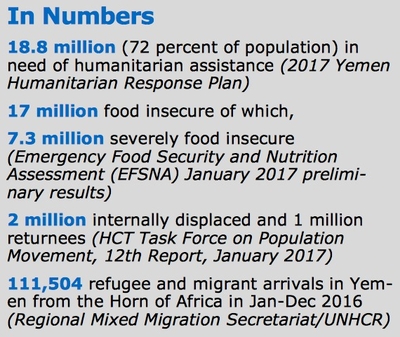
Feb. 22, 2017 update: UN Secretary-General Antonio Guterres: "Yemen is facing the largest food insecurity emergency in the world, with an estimated 7.3 million people needing help now."
May 30, 2017 update: Stephen O'Brien, United Nations undersecretary general for humanitarian affairs and emergency-relief coordinator, reports that out of a population of about 25 million, more than 17 million Yemenis are "food insecure" (i.e., they lack a reliable supply of nutrition) and 6.8 million are "one step away from famine."
June 2, 2017 update: The World Health Organisation (WHO) representative in Yemen Nevio Zagaria notes that cholera in Yemen is spreading at "an unprecedented rate" and predicts that the infected over the next six months could increase from the current 50,000 to 300,000. And of these, as many as 4-5 percent could die.
May 3, 2018 update: The Associated Press reports:
Around 2.9 million women and children are acutely malnourished; another 400,000 children are fighting for their lives, in the same condition as Mizrah. Nearly a third of Yemen's population — 8.4 million of its 29 million people — rely completely on food aid or else they would starve. That number grew by a quarter over the past year.


