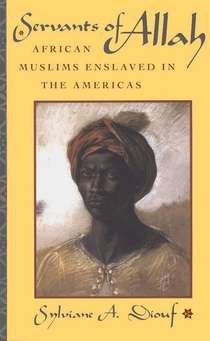
Slowly, out of the surprisingly full records of slavery, an important fact is coming to light: that Muslims constituted a significant percentage of the Africans brought to the Americas in servitude; and that, as the most educated and resistant of the captive peoples, they exerted a disproportionate influence on slave life in the Americas. Groundbreaking studies by Allan D. Austin and João José Reis showed what riches lie in store for those who study this topic; Sylviane Diouf, a Ph.D. from the University of Paris now resident in New York, has built on these and other studies, then done much research of her own, and the result is a fascinating account of the three main topics: the background within Africa, the "difficult and sometimes astonishing steps" of Muslims to maintain their faith and traditions, and the legacy of this nearly-forgotten episode.
I. African Background
 It is sobering to realize that next year, 2001, marks five centuries of "almost uninterrupted" Islamic practices by people of African origin in the Western Hemisphere. When the Spanish brought the very first Africans to the New World in 1501, however, they sought to ensure that these were not Muslims but ladinos - that is to say, captives who had spent some time in Spain where they had been forcibly converted to Christianity. As a royal Spanish order of 1543 explained, "in a new land like this one where [the Catholic] faith is only recently being sowed, it is necessary not to allow to spread there the sect of Mahomet or any other."
The Spanish had a particular dread of the native Indians converting; among other reasons for this was the fact that if Africans, who knew about horses, converted the Indians and then taught them equine skills, much of the Spaniards' military advantage would have been lost. That the Spanish authorities went on to issue five pieces of legislation to keep Muslims out of the New World in the first fifty years of colonization suggests this effort was less than completely successful. That the Northern Europeans, less concerned with Islam, did not even attempt to maintain this ban meant that Islam was the second monotheism (after Catholicism, before Protestantism) in the Americas.
2. Maintaining the Faith
The heart of Servants of Allah consists of a detailed reconstruction of Muslim slave efforts in the United States to maintain, as much as possible, an Islamic way of life: their reluctance to convert to Christianity, or their pseudo-conversions; praying, giving alms, and fasting; keeping Muslim names, dietary restrictions, and sexual taboos; wearing beards, turbans, and even veils; and keeping apart from non-Muslims. In all, the author finds, the experience of slavery, "far from making the Africans' religious fervor disappear, . . . deepened it."
Diouf finds that Muslim slaves included a disproportionate number of the intellectual elite in West Africa, men far better prepared than the average farmer to sustain their faith. Being Muslim helped them to do well in the horrifyingly difficult circumstances of American chattel slavery: "There is ample evidence that the Muslims actively used their cultural and social background and the formation they had received in Africa as tools to improve their condition in the Americas."
The signs of this success were easy to see, even if slightly contradictory. On the one hand, Muslims rose to the top of the slave hierarchy (in at least one case, the slave kept his master's plantation records in Arabic), were manumitted more often, and returned to Africa more frequently. On the other hand, Muslims had a disproportionately large role in establishing maroon communities and leading slave rebellions, sometimes (most especially the great Bahia rebellion of 1835 in Brazil) dominating their planning and leadership. "Islam was an excellent organizing force," Diouf notes. In addition to the communal solidarity it imbued in Muslims, knowledge of Arabic at times served as a common and secret language for those planning revolts.
Some of this prominence resulted from their sense of community and solidarity, which extended across linguistic boundaries to fellow Muslims in bondage and also back to Africa; some from their resistance to being dominated more than necessary by their Christian overlords; and much of it resulted from their education. On this final point, Diouf argues that "literacy became one of the most distinguishing marks of the Muslims." She even claims, somewhat implausibly, that the literacy rate among Muslim slaves was "in all probability" higher than among their masters. Islamic networks brought Arabic books produced in Africa to Brazil. Qur'anic instruction reached as distant an outpost as Lima, Peru.
3. The Legacy of Slave Islam
The legacy of the Muslim slaves is somewhat controversial. It is fashionable among African-American Muslims in the United States today to call themselves not converts but reverts, alluding both to the fact that Islam claims to be the natural and original religion of each person at birth, and so turning to it later in life is a return; and to the fact that some African slaves were Muslims, so they see themselves reverting to that original faith, not converting to a new one. In this view, Christianity was enforced upon the slaves in America, not a faith they ever truly accepted. According to Eric Lincoln, a scholar of the subject, "The memory of Islam, however, tenuous, was never completely lost." Some analysts explicitly attribute Islam's success among blacks in the twentieth-century to their "can be explained only in terms of the Islamic roots of many black Americans." Others go further and contend that "the religion of Islam is part of the genetic memory of African-Americans."
Diouf sharply rejects this romantic notion; instead, she flat-out declares that "Islam as brought by the African slaves has not survived." To be more precise: "in the Americas and the Caribbean, not one community currently practices Islam as passed on by preceding African generations." This discontinuity followed primarily from the Muslim slaves' inability to pass their religion on to their children, thanks to the gender disparities among slaves (far fewer women imported), disrupted family lives, the absence of proper schools, and the pressure to convert to Christianity. So remote had Islam become that some grandchildren of enslaved Muslims did not even know their grandparents had been Muslims but remembered them as worshippers of the sun and moon (a wildly ignorant interpretation of their praying at dawn and dusk). As a result, the last Muslims of slave background died in the 1920s, though the last semi-Muslim (a person who outwardly accepted Christianity) was alive in Brazil as late as 1959.
If slave Islam as a faith died out completely, it nonetheless left many vestiges behind, some of them quite unexpected. Diouf catalogues Islamic influence "found in certain religions, traditions, and artistic creations" among peoples of African descent in the Americas. Most notably, it can be seen in the syncretic black religions of the Americas such as Candomble in Brazil, Santeria in Cuba, Voodoo in Haiti, and other cults. In Voodoo temples, for example, when a deity appears, the priest greets it with Salam, Salam, then goes on his knees and raises his arms, much as Muslims do when praying. Even some Christian rites, for example among the "Shouters," Trinidadian Baptists, have practices reminiscent of Islam (they move about in a circle, perhaps an echo of the circumambulation of the Ka'ba in Mecca). African-style amulets are widespread.
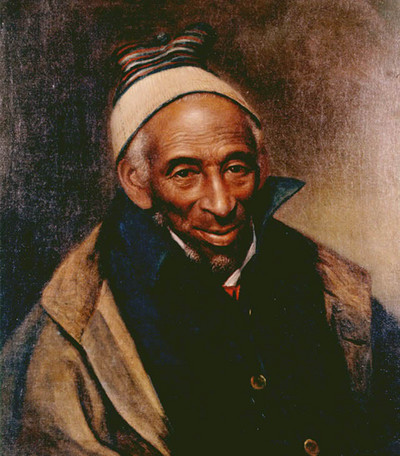 Charles Peale's remarkable 1819 portrait of the aged ex-slave called Mamout Yarrow. |
The very first of these movements, founded in 1913, called itself the Moorish Science Temple of America and prominently claimed that blacks are in fact "Moors," "Moorish-Americans," or "Asiatics." This tradition continued in the Nation of Islam, with its leader Elijah Muhammad again and again telling his followers, "You are members of the Asiatic Nation, from the Tribe of Shabazz. There is no such thing as a race of Negroes." NoI members have a history of taking this idea very literally. Filling out a questionnaire from his draft board in 1953, Malcolm X filled in the blank for the question, "I am a citizen of ____" with the word "Asia." The Five Percent Nation, an off-shoot of the Nation of Islam, calls its membership the "Asiatic Black Man."
Islamic traces can be found in several kinds of music, such as the Arabic words found in songs off the Georgian and Peruvian coasts, in Cuba and Trinidad. More unexpected is the thesis, seemingly sound, that the "high lonesome complaint" so characteristic of blues music derives ultimately from recitations of the Qur'an by unhappy (but educated) slaves. One musicologist, John Storm Roberts, finds that the "long, blending and swooping notes" of the blues are "similar to the Islam-influenced styles of much of West Africa." In some cases, whole songs (such as "Tangle Eyes") seem to have a Muslim African provenance.
Diouf speculates that the family name "Bailey" may in many cases derive from "Bilali," a common name for dark-skinned Muslims. She suggests that some leading African-Americans of the post-Emancipation era (Frederick Douglass, Harriet Tubman) had Muslim ancestors. She traces the common habit of black American males of wearing handkerchiefs, rags, and bandannas around their heads to their Muslim slave ancestors' always wearing a turban or skullcap.
Diouf goes a bit far in her lyrical praise of Islam under slave conditions, at times idealizing it in inappropriate and even anachronistic ways; thus, she calls Islam "democratic and progressive in a society that was despotic, repressive, tyrannical, and racist." This may be connected to the paucity of sources and therefore her having to rely heavily on just four written slave narratives, all of them presumably recounting the highly unusual experiences of their authors.
Despite this mild distortion, Diouf's account of Muslim life in the most horrific of circumstances is a truly moving one and at times an inspiring one: "The African Muslims may have been, in the Americas, the slaves of Christian masters, but their minds were free. They were the servants of Allah."
July 1, 2006 update: Sylviane Diouf further argues for the Islamic origins of American blues music in an article by Jonathan Curiel in Aramco World.
July 1, 2016 update: Aramco World published an article by Ramin Vellotti on the most renowed of Muslim African slaves in the United States, "Yarrow Mamout: Freedman," with a focus on his residence at 3324 Dent Place N.W. in Washington, D.C.


