President George W. Bush provided a good definition of sleepers and the problem they pose in his 2002 State of the Union address: "Thousands of dangerous killers, schooled in the methods of murder, often supported by outlaw regimes, are now spread throughout the world like ticking time bombs, set to go off without warning."[1] Sleepers—those seemingly law-abiding individuals who live quietly and inconspicuously near the scene of their future operations, waiting for orders to spring into action—make up one of the leading security problems facing the United States. Indeed, one day after that speech, FBI director Robert S. Mueller expressed his fear that "sleeper cells" exist within the United States and declared that they require the country to remain on extended high alert.[2]
It is important to understand that these sleepers are a vital part of Al-Qaeda's network, much of which exists outside Afghanistan. The author of a best-selling book on the Taliban, Ahmed Rashid, notes that Al-Qaeda "has always been divided into two halves. One is the half which is based in Afghanistan, fighting with the Taliban. And they will certainly be eliminated. But the tens of thousands of al Qaeda militants, usually well-educated, middle class people who have come into Afghanistan, trained and then left, and settled down in many foreign countries, these cells . . . are going to remain."[3] Others estimate that an even smaller proportion—perhaps 20 percent—of Al-Qaeda's assets were ever in Afghanistan. While being secretly recorded by Italian police, a member of Al-Qaeda's Milan cell boasted that his organization is "everywhere."[4] And indeed, according to intelligence sources, as many as seventy thousand agents trained in weapons and explosives remain at large in some fifty countries. What are they doing there?
Preparing for further acts of terrorism, of course. This requires a substantial infrastructure of individuals placed in mosques, Muslim institutions, financial institutions, law firms, government offices, and many other sensitive positions. But the key operatives are the sleepers. Documents found in Afghanistan point to larger numbers of sleepers trained at Al-Qaeda camps in that country than previously imagined. One estimate sees one thousand five hundred of them in North America and Europe.[5] In Los Angeles, for example, the authorities are watching up to thirty individuals.[6] Or this: in mid-September 2001, some 250 members of Al-Qaeda, thought to be sleeper agents, fled Afghanistan to an island in the Indian Ocean off the coast of Africa, from which point they dispersed to parts unknown.[7]
Nor is Al-Qaeda the only source of militant Islamic sleepers. Yonah Alexander of the Potomac Institute for Policy Studies notes that Hizbullah, the militant Islamic organization of Lebanon, "has sent entire families to settle in Latin America, South Africa and Europe. It's a long-term approach that follows the Soviet model to send sleepers."[8]
September 11 showed what damage sleepers can do. Catching them before they wake up is one of the most urgent and most difficult tasks in the war on terrorism.
Dealing with the Problem
U.S. Attorney General John Ashcroft understated the case when he observed in mid-October 2001 that it is "very unlikely" that all of those with a part in the suicide hijackings of September 11 and other "terrorism events" have been apprehended.[9] Indeed, the FBI has initiated at least 150 investigations of suspected sleepers (according to CNN), confirming just how much work remains to be done.[10]
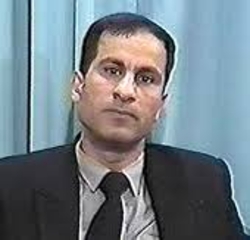 Ali Abdelsoud Mohamed. |
An officer in the Egyptian military, Mohamed rose to the rank of major in Egypt's special forces. At some point, he joined the militant Islamic terrorist group that in 1981 assassinated President Anwar Sadat. Under growing suspicion for extremist views, he was cashiered in 1984. A year later he moved to the United States and joined the U.S. military, rising to the rank of supply sergeant as well as lecturer on Middle East culture at the U.S. Army's special warfare school in Fort Bragg in 1986–89. He also began working for Osama bin Laden then. Mohamed taught his army skills to Al-Qaeda's recruits, translated military manuals from English into Arabic, and, as one of bin Laden's oldest and most trusted aides, helped plan operations. The most important of these was in Kenya, where he admits he "took pictures, drew diagrams, and wrote a report." Bin Laden later "looked at the picture of the American embassy and pointed to where a truck could go as a suicide bomber."[11] His colleagues blew up the embassy in August 1998. Mohamed's case points to a massive failure on the part of both the State Department, which issues visas to foreigners, and the U.S. Army.
More recently, the chance arrest in December 1999 of Ahmed Ressam, an Algerian member of Al-Qaeda, as he was crossing the Canada-U.S. border to bomb Los Angeles International Airport, opened a window into the substantial network of sleeper agents already within the United States. (Information he provided also led to the arrest of sleepers in four European countries.)[12]
How to tell who might be a sleeper? Don't ask the feds; Mohamed himself, when pleading guilty to his crimes, dismissed current profiles of sleepers as "invalid."[13] He was probably referring to the fact that the sixteen men convicted in the 1993 World Trade Center bombing and related conspiracy cases had a specific profile that reigned for many years afterwards: uneducated, "conspicuous hotheads, young immigrant men from the poorest and most radicalized Arab countries, clustered around a fire-breathing preacher at an established mosque," all of them working for a "state sponsor" of terrorism.[14] Other than being young immigrant men, the September 11 hijackers have none of these characteristics.
Nor are other governments better prepared: Hassan Butt, a twenty-two-year-old British Muslim, who claims to have helped recruit more than two hundred British volunteers to fight for the Taliban in Afghanistan, disdained the British ability to protect the society, maintaining that "The security forces and intelligence services within Britain are not competent to deal with sophisticated Mujahideen."[15] Magnus Ranstorp of the University of St. Andrews in Scotland criticizes Western intelligence in the 1990s for having "take[n] the eye off the ball" on the sleeper issue.[16]
For Washington to get serious about this problem requires some substantial changes. In particular, Congress should review current laws to protect the country from them. Here are four specifics that need changing:
The FBI and CIA face a barrage of regulations restricting their intelligence-collecting abilities actively to collect information on and penetrate hostile groups.
Immigration law does not consider membership in a terrorist organization, or advocacy of acts of terrorism, as grounds to exclude a foreigner.
The Department of Transportation instructs airlines "not to target or otherwise discriminate against passengers based on their race, color, national or ethnic origin, religion, or based on passengers' names or modes of dress,"[17] thereby prohibiting the intelligent use of passenger profiling.
A law dating from 1986 prohibits an employer from requiring specific documentation from would-be employees to prove their right to live and work in the United States. An employer must accept virtually any documents an applicant submits—school report cards, doctors' records, even day-care receipts. If the employer, even one with public safety responsibilities, asks to see a passport, green card, or birth certificate, he is liable to be sued by the Department of Justice and to be fined a hefty civil penalty.
Many other institutions besides the government also have a major role in protecting the country, something John Ashcroft recognized when he called for the establishment of a "national neighborhood watch."[18] Some local programs have sprung up, such as the New Jersey-based Community Anti-Terrorism Training, which deputizes community groups and citizens by training them to spot possible dangers by becoming more aware of their environment,[19] but the bulk of the responsibility falls on institutions, especially corporations. Recall how airport security operators, flight instruction companies, and airlines had their shortcomings brutally exposed on September 11. Manufacturers of weaponry and paramilitary equipment have been lax in controlling their sales. Banks have not cracked down on money laundering. Hi-tech firms have scoffed at the need for controls on their products. Educational institutions have taught anyone qualified the secrets of electrical engineering.
Proving that hardly any business is exempt, consider what happened to ABC News when it employed Tarik Hamdi of Herndon, Virginia, to help secure an interview with bin Laden in early 1998. The network transported Hamdi to Afghanistan, unaware of his real purpose in going there - to carry a replacement battery to bin Laden for the satellite telephone he would later use to order the embassy bombings in East Africa.[20]
 In some cases, private institutions have done a better job of discerning sleepers than has law enforcement. Most notable is the case of the Pan Am International Flight Academy in Minneapolis, where the flight instructor became immediately suspicious of his student, Zacarias Moussaoui, who showed no interest in basic aviation skills but wanted only to practice on an advanced commercial jet simulator. "Do you realize how serious this is?" the instructor asked an FBI agent. "This man wants training on a [Boeing] 747. A 747 fully loaded with fuel could be used as a weapon!" In this case, at least, the FBI did arrest Moussaoui. But when Pan Am's Phoenix branch called the Federal Aviation Administration (FAA) to report on Hani Hanjour, who later piloted the plane that crashed into the Pentagon, the FAA responded by sending an employee to observe Hanjour. The result? He discussed with Pan Am the issue of Hanjour's poor English and finding someone to help him with this obstacle to his becoming a pilot! "The school was clearly more alert than federal officials," observes Representative Martin Sabo of Minnesota.[21]
Ira A. Lipman of Guardsmark, a leading private security firm, warns that "sleepers are one of the most dangerous elements facing the United States in the years ahead" and argues that private organizations must be vigilant no less than public ones. In particular, he notes the need for comprehensive background investigations and proactive protective systems. Although it is hard to find anyone who will dispute these points post–September 2001, it is true that this good advice is only sometimes implemented in full.
Deception
Granting that sleepers can do terrible damage, how does one recognize them? While the great majority of sleepers to date have been young Middle Eastern Muslim men, this pattern must be used with caution. The fact is, militant Islam is an ideology open to all races, ethnicities, and nationalities. David Belfield, the Iranian agent who assassinated a man outside Washington, D.C., in 1980,[22] and Clement Rodney Hampton-El, a culprit in the first World Trade Center attack, are both African-Americans. A plot in 2001 against the U.S. Embassy in Paris depended in part on so-called white Moors, or French converts to Islam such as the two French brothers, David and Jerome Courtailler.[23] Richard Reid, the would-be shoe bomber, is half-English and half-Jamaican.
Nor does looking piously Islamic offer much of a clue. Most pious Muslims, of course, are not terrorists, a fact that came home when a state trooper on the Pennsylvania Turnpike in September 2001 stopped the car carrying Sheikh Muhammad Hisham Kabbani of the Islamic Supreme Council of America in order to check out what one person called "something fishy."[24] In fact, Kabbani - who wears a flowing robe and has a full beard and is a patriotic citizen - was driving home from a private prayer session with the president of the United States.
The problem, rather, has to do with a person's subscribing to militant Islam, the Islamic-flavored totalitarianism that fuels violent movements from Egypt to the Philippines, that has brought low Iran and Algeria, and has devastated Afghanistan and Sudan. Its adherents seek to bring this radical utopian program not just to majority-Muslim countries but even to Western Europe and North America. About one of every eight Muslims worldwide accepts militant Islam. These today are the prime threats to the United States and other Western countries. They have proven themselves to be ideologically dedicated, ruthless, and technically sophisticated. They will stop at nothing to harm or even destroy the countries they hate.
In normal circumstances, militants take pride in making themselves conspicuous through their appearance and clothing, their actions and statements. For obvious reasons, however, sleepers prefer to blend into the nonmilitant majority, so they take precautions to hide themselves. They "don't wear the traditional beards and they don't pray at the mosques,"[25] Mohamed testified. Al-Qaeda instructs its agents to wear Western clothes and (advised some poorly spelled English-language class notes found in a training house in Afghanistan), "Don't taike any thing wich belong to Islam."[26] A captured Al-Qaeda encyclopedia, Military Studies in the Jihad Against the Tyrants, instructs sleepers to "have a general appearance that does not indicate Islamic orientation," and specifically mentions the need for men not to wear a beard. The book also admonishes sleepers not to denounce the inequity in their midst, not to use common Islamic expressions such as "peace be on you," nor to frequent Islamic locations, such as mosques.[27]
Sleepers might be married to non-Muslims; indeed, they make a practice of using their families as cover. "They often avoid Muslim communities, living blameless lives, paying their taxes, holding down steady jobs," notes Simon Reeve, the biographer of Osama bin Laden.[28] And while the leaders live abstemiously and according to Islamic precepts, the lower ranks are more self-indulgent, with a taste for pornography, women, liquor, and drugs. The man accused of planning to ram an airplane into the fifty-five-story Rialto Towers, Australia's highest building, often turned up twice a week at the Main Course brothel in downtown Melbourne, where he became notorious "as a bit of a sneak, always trying to get more than he paid for."[29]
Such duplicity makes it much harder to discern who should be suspect. "It's like a ghost in front of you," commented a senior French official about the September 11 gang in general.[30] "They didn't do anything to raise eyebrows," said an acquaintance about two of its members in particular.[31] For sleepers, this deception also has the advantage of bringing the Muslim population as a whole under suspicion, which both provides cover and raises questions of bias (often proving an obstacle to effective law enforcement).
Recognizing Sleepers
Despite these difficulties, ways do exist to distinguish the likely sleepers from other Muslims. To begin with, all known sleepers until now have been young men. (The only women arrested for Al-Qaeda activities were two Algerians producing fake credit cards and passports in Leicester, England.) Perhaps the militant Islamic networks will one day go beyond this self-imposed limitation, but for now it appears to be one way of winnowing down the pool of potential suspects.
It is hard for sleepers to maintain a perfect cover. Connections to foreign countries offer one set of warning signals:
- Arrival from countries where violent militant Islamic groups (such as Al-Qaeda) are known to operate;
- Long, unexplained absences; or absences for vague purposes of religious education, charity work, or pilgrimage;
- Travel to hot spots where Muslims are fighting non-Muslims (Bosnia, Chechnya, Lebanon, Kashmir);
- Travel to countries where militant Islam rules (Sudan, Iran, Afghanistan).
Sleepers much prepare themselves for their operations, and this can leave telltale indications:
- Study of technical subjects (such as electrical engineering or computer sciences) that would help pull off an operation.
- Collecting information on subjects (e.g., crop-dusting planes) that could help in carrying out an operation.
- Working in an area (such as import/export) that serves as a cover for preparing for an operation.
- Engaging in para- or military training, perhaps under guise of preparing to do security work (e.g., serving as a bodyguard).
- Physical training.
- Possession of such artifacts as detonators and a protective suit against chemical and biological weapons.
- Purchase of chemicals and other dual-use materials.
- Scouting out military bases, government buildings, and other potential targets; practicing routines; and otherwise rehearsing for an operation.
- Possession of instructions for conducting of either a spiritual nature (how to prepare for one's suicide death) or a practical nature (how to smuggle detonators).
Some attitudes raise red flags:
- Support for militant Islamic groups and fronts.
- Outspoken support of Muslims in combat against non-Muslims.
- Excusing violence against Americans on the grounds that American actions provoked the problem.
- Disparagement of Western civilization in favor of Islamic civilization.
- Fury at the West, for reasons ranging from the personal (unemployment) to the global (policy toward Iraq).
- Bigoted statements against non-Muslims in general ("infidels") or specifically against Jews, Christians, or Hindus.
- Seeing moderate Muslims as apostates from Islam.
- Conspiracy theories about Westerners (e.g., the CIA arranged for the 2001 attack on the World Trade Center to boost its funding levels).
- Accusing the West of trying to destroy Islam.
- Hoping to apply Islamic law in the United States.
- Disregard for the U.S. legal system where it prohibits something permitted by Islamic societies (such as polygamy or the "honor" killing of women).
Problems having to do with identity are a further indication:
- Fraudulent personal identities, sometimes with inconsistencies. (Zacarias Moussaoui presented himself as French, but when spoken to in French not only could not reply but became belligerent.)
- A cover story that does not ring true. (A young Arab, recently arrived in Spain, wants to buy a watch repair shop and the owner agrees to sell, but something seems not right—"He had fat fingers, so how was he going to fix watches?")[32]
- Evasive about his background ("I'm from the Middle East" rather than giving a country name).[33]
- Losing passports or other documentation so as to get new ones.
- Acquisition of multiple identities and their careful use. ("The only time [the shoe-bomber, Richard] Reid appears to have used his real name is when flying.")[34]
Social activities can offer clues:
- Membership in militant Islamic groups or front organizations.
- Financial support for those groups or fronts.
- Active involvement at mosques known for their militant Islamic orientation.
- Close friendships or family ties with other suspects.
- Immersion in a purely Muslim environment.
- Avoiding contact with the larger society: "friendly but standoffish," in the words of a former assistant U.S. attorney. "Say 'hello' but don't talk. Let people see you, but don't bring attention to yourself," in the words of an Al-Qaeda advisory.[35]
Other miscellaneous pointers to look for include:
- Choosing to live in areas where many cultures are represented and an easygoing attitude toward different customs is evident (northern New Jersey, southern Florida, Leicester or Bradford in England, Hamburg in Germany).
- Sending or receiving large amounts of money.
- A preference for cash transactions.
- Criminal activity, especially reliance on counterfeited money and smuggling.
- A promising career that failed, descent into drugs and alcohol, then redemption through Islam.
- An offer to work for the enemy's intelligence services.
- Enrolling in university studies in the liberal arts, then switching to engineering or the sciences.
These are admittedly imprecise indicators; a Muslim who exercises and makes anti-Hindu statements cannot automatically be suspected of planning a suicide operation. Rather, the above signals must be seen in the context of a whole personality and a wider pattern of behavior. Precisely because the legitimate search for sleepers is open to abuse, it requires an unusual degree of common sense, sensitivity, and restraint.
Notes:
[1] White House, "The President's State of the Union Address," 29 January 2002.
[2] Associated Press, 31 January 2002.
[3] Wolf Blitzer Reports, Cable Network News, 14 December 2001.
[4] The Washington Post, 5 November 2001.
[5] Mail on Sunday (London), 14 October 2001.
[6] Sacramento Bee, 30 September 2001.
[7] Cable Network News, 12 January 2002.
[8] Middle East Newsline, 4 January 2002.
[9] NBC's Meet the Press, quoted in The New York Times, 15 October 2001.
[10] Cable Network News, 12 January 2002.
[11] Judge Leonard B. Sand, Federal District Court in Manhattan, 20 October 2000.
[12] Cable Network News, 12 January 2002.
[13] The New York Times, 22 December 2000.
[14] The Wall Street Journal, 26 November 2001.
[15] Reuters, 7 January 2002.
[16] Cable Network News, 12 January 2002.
[17] Department of Transportation press release, "USDOT Issues Caution on Airline Discrimination," 21 September 2001.
[18] NBC's Meet the Press, quoted in The New York Times, 15 October 2001.
[19] Bergen Record, 11 November 2001.
[20] Assistant U.S. Attorney Kenneth Karas in United States of America v Usama bin Ladin et al. trial in the Southern District of New York, transcripts available at http://cryptome.info/usa-v-ubl-dt.htm; Tampa Tribune, 10 June 2001; The Jerusalem Post, 20 June 2001.
[21] Star Tribune (Minneapolis), 21 December 2001.
[22] The Washington Post, 25 August 1996.
[23] Le Nouvel Observateur, 18 October 2001.
[24] Los Angeles Times, 20 September 2001.
[25] The New York Times, 22 December 2000. Military Studies in the Jihad Against the Tyrants permits everything except wine and fornication, The New York Times, 5 April 2001.
[26] The Washington Post, 9 December 2001.
[27] The New York Times, 28 October 2001.
[28] Mail on Sunday (London), 14 October 2001.
[29] Sydney Morning Herald, 10 December 2001.
[30] The Washington Post, 5 November 2001
[31] Hassam Abukar, a past president of the Islamic Center of San Diego, quoted in Associated Press, 14 October 2001
[32] The New York Times, 4 December 2001.
[33] Star Tribune, 21 December 2001.
[34] The Times (London), 29 December 2001.
[35] The Miami Herald, 16 September 2001.
Nov. 2, 2008 update: I report today at "How to Catch Sleepers - Confirmed" on a test of the above article by Daniel B. Kennedy, Robert J. Homant, and Erick Barnes, and note that their analysis "established that the items derived from Pipes constitute an internally consistent scale and that our insider judges adopt a consistent pattern in evaluating the items."
Jan. 18, 2012 update: The Obama administration, well-known for its counterterrorism brilliance, convened a conference at the White House for 46 senior federal, state and local law enforcement officials to (among other things) offer its analysis of signs that suggest a terrorist in the making. Some details ahead of time:
Analysts from the FBI, Homeland Security Department and National Counterterrorism Center reviewed 62 cases of homegrown violent extremists and found basic similarities. The cases included violent extremists who adhered to a mix of ideologies, including people who ascribed to white supremacist beliefs and people inspired by a violent interpretation of Islam. The analysis is not a psychological profile of a homegrown terrorist, but instead offers similarities among cases that could help local law enforcement better understand and detect threats.
In the 62 cases reviewed, the subjects increasingly spoke out against the government, blamed the government for perceived problems and did so in a way that caught the attention of other people in their communities, according to the senior counterterrorism official who spoke on condition of anonymity to discuss the private White House event. Subjects became active on the Internet to espouse extremist views. In some cases, the subjects purchased weapons, ammunition or explosive materials.
Of course, analysts found that "a person's origin, ethnic background and socioeconomic status are not good indicators for potential violent extremist activity."
June 28, 2012 update: The Interior Ministry in the German state of Lower Saxony has issued a brochure, Radikalisierungsprozesse im Bereich des islamistischen Extremismus und Terrorismus, that lists the indicators of Muslim radicalization. These include "an increasingly strict moral code," "rejection and aggression against all that is 'Western'," and "visiting Islamist websites and consuming films that promote violent jihad." The brochure has prompted heated opposition among Muslim and leftist elements.
Sep. 1, 2014 update: Two Canadian Islamist organizations, the Islamic Social Services Association and the National Council of Canadian Muslims have released a handbook, United Against Terror: A Collaborative Effort toward a Secure, Inclusive, and Just Canada, meant to help "understand and evaluate the nature, origin, causes and impact of extremist messages on Canadian Muslim youth," that includes a checklist on p. 15 of "signs that parents should look for if they fear that their children are influenced by extremists, especially online" (slightly edited):
- The sudden onset of anti-social behavior.
- Spending excessive amount of time online, especially at night when most of the family is asleep.
- Excessive secrecy regarding what sites they are visiting online, where they are going, who they are meeting.
- Easily irritable when challenged on their political and religious views.
- Extremely suspicious and judgmental towards society in general.
- Uncommunicative towards their parents and siblings.
- A sudden change in their circle of friends.
- External and overt expression of hyper-religiosity uncharacteristic of the family's culture
- Start speaking about the world in extreme terms of good and evil with no room for compromise.
- Oversaturated in foreign news.
- Lack of interest in their regular friends.
- Disrespect of women and anti-women rhetoric.
- Disrespect of scholars that teach peace and harmony.
- Advocating isolation from society.
Jan. 25, 2015 update: The French government has opened a website, stop-djihadisme.gouv.fr, that aims to fight French citizens going Islamist. Of particular interest is the graphic, "Jihadi Radicalization: The First Signs that Can Alert You." The nine signs mentioned consist of: rejecting old friends as impure, rejecting family members, change in food habits, abandon school or career, stop listening to music, no television or movies, no sports, change of clothing, and heavy involvement in radical social media.
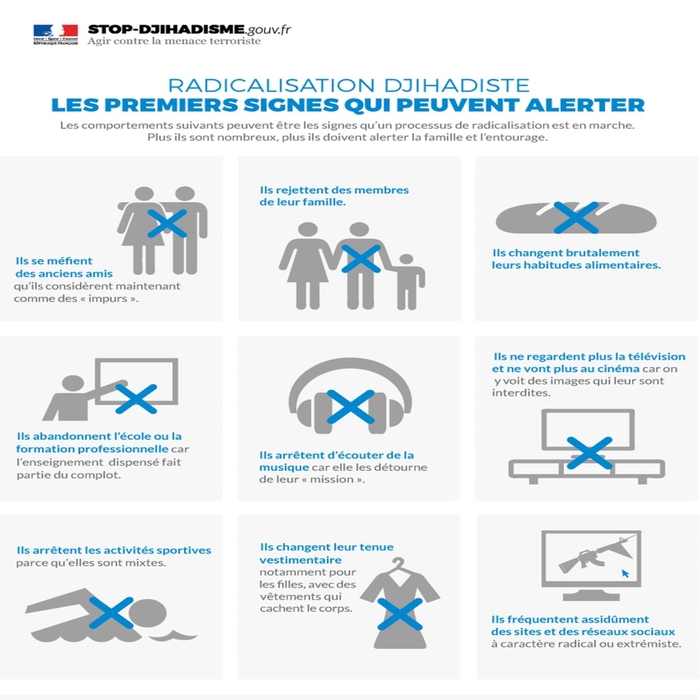 The French government's take on catching sleepers. |
May 24, 2015 update: Scotland Yard commander Mak Chishty, Britain's most senior Muslim officer, points to several indicators of radicalization. These include:
- Opposition to marking Christmas, branding it as "haram" – forbidden by Islam.
- Shunning certain shops, such as Marks & Spencer, which is sometimes mistakenly perceived to be Jewish-owned.
- Sudden negative attitudes towards alcohol, social occasions, and Western clothing.
Chishty concluded: "All the ugly bits of the problem, which are uncomfortable, you have to ... deal with them properly, as a state, as a nation, as a community."
Comment: A decade and more after I published my chapter, the governments of Germany, France, and Great Britain are coming around to the same realization.
Oct. 12, 2018 update: Todd Bensman's three-part series focuses on Hezbollah's infrastructure in the United States.
July 16, 2019 update: The FBI, the National Counterterrorism Center, and the Department of Homeland Security have released the 28-page 2019 edition of a booklet, Homegrown Violent Extremist Mobilization Indicators, that lists 46 "observable behavioral signs that someone might be planning to commit an act of extremist violence." Two them concern Islamism:
35. Promoting violent extremist narratives (e.g., the West is waging war with Islam, it's "us" versus "them," violence is required to defend the identity group)
40. Dehumanizing people who are not in the identity group (e.g., non-believers, followers of other religions or ideologies, including other variants of Islam)
Two others reference Islamism:
17. Having an acknowledged or implied membership in or association with violent extremist groups (e.g., individuals declare they are ISIS on social media, post terrorist symbols—green birds, flags, lions)
39. Rejecting non-violent voices in favor of violent extremist ideologues (e.g., Anwar Awlaki)
Finally, graphics for #1 and #2 sneakily allude to Islamism:
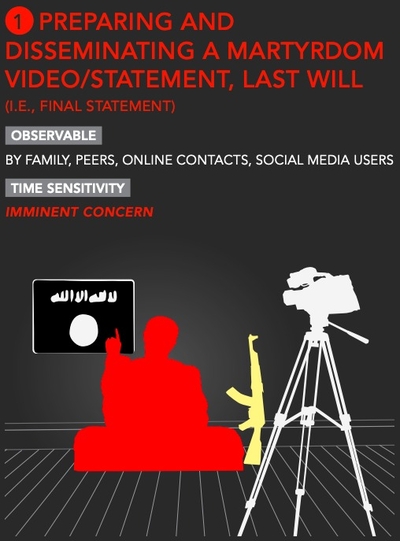 Note the ISIS banner. |
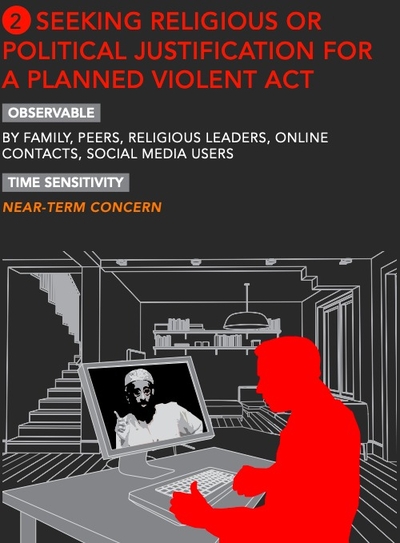 Note the picture of an Islamist, presumably Anwar Awlaki. |
Comments: 6 out of 46 is weak and disingenuous, but it could be worse.
Apr. 25, 2022 update: The trial of Alexei Saab, 45, a New Jersey software engineer lived accused of living a double life as a sleeper agent for Hezbollah unit, has begun. Federal prosecutors charged him with scouting terror targets, such as tunnels and bridges, in New York City while keeping up appearances as a normal law-abiding U.S. citizen.
Assistant US Attorney Sam Adelsberg: "He posed as a regular guy. In reality, he was a sleeper agent for Hezbollah ready to strike. He was sent by Hezbollah to set up a sleeper cell right here in this city." Saab faces a potentially long prison sentence.
June 22, 2025 update: U.S. forces struck Iranian nuclear facilities today but it prompted no sleeper activity.
Mar. 2, 2026 update: The even larger U.S. forces attack on Iran that began on Feb. 28 apparently prompted a murderous rampage in Austin, Texas by one Ndiaga Diagne. However, analyses such as this one in the Daily Mail, "Jihadis next door: As lone wolf attackers 'self-activate' across America... security expert's grave alert over missed warning signs," appear hyperbolic.
Mar. 3, 2026 update: More warnings keep coming in, as in "'Very grave' threat of Iranian sleeper cells in US, experts warn," in JNS.
Mar. 20, 2026 update: Steven Stalinsky, R. Sosnow, and Rachel Legow review the situation at "The Iran-Inspired And Orchestrated Violence And Terror Activity In The U.S.: Long Present, Now Exposed."
May 4, 2026 update: Adrian Shtuni writes for the Washington Institute for Near East Policy:
At the outset of the Iran war, many expected the regime to activate long-embedded sleeper cells abroad. Instead, a leaner, more disposable hybrid operational model has emerged, centered on the front entity Harakat Ashab al-Yamin al-Islamiyah (HAYI). This model relies on the recruitment of non-ideological local residents—mainly youths with petty criminal backgrounds—via casual, gig-economy channels on Snapchat and Telegram. Recruits are offered modest cash incentives for low-complexity acts of violence and intimidation against Jewish communities and symbolic targets in Europe, using readily available materials. Although no fatalities have resulted from these claimed incidents so far, they have achieved measurable psychological and media effects.
May 6, 2026 update: Matthew Levitt writes at War on the Rocks:
two months after the Revolutionary Guards' threat, [U.S.] authorities have yet to report a single homeland plot specifically tied to Iran. Lone offenders appear to have carried out attacks on their own, some clearly angered by the war, but authorities have yet to establish links between these plots and Iranian intelligence or security agencies, their terrorist proxies, or criminals hired as cutouts to carry out attacks.
This is surprising, not only because of the explicit Revolutionary Guard threat to target the homeland, but because Iranian-linked plots have been thwarted elsewhere around the world since the war began and because Iran has a track record of plotting attacks in the United States. Indeed, Iran and its proxies have spent years investing in what U.S. counterterrorism officials describe as a "homeland option" in the United States.
It stands out that there have been no reported plots in the United States while plenty have occurred elsewhere, despite Iranian threats.


