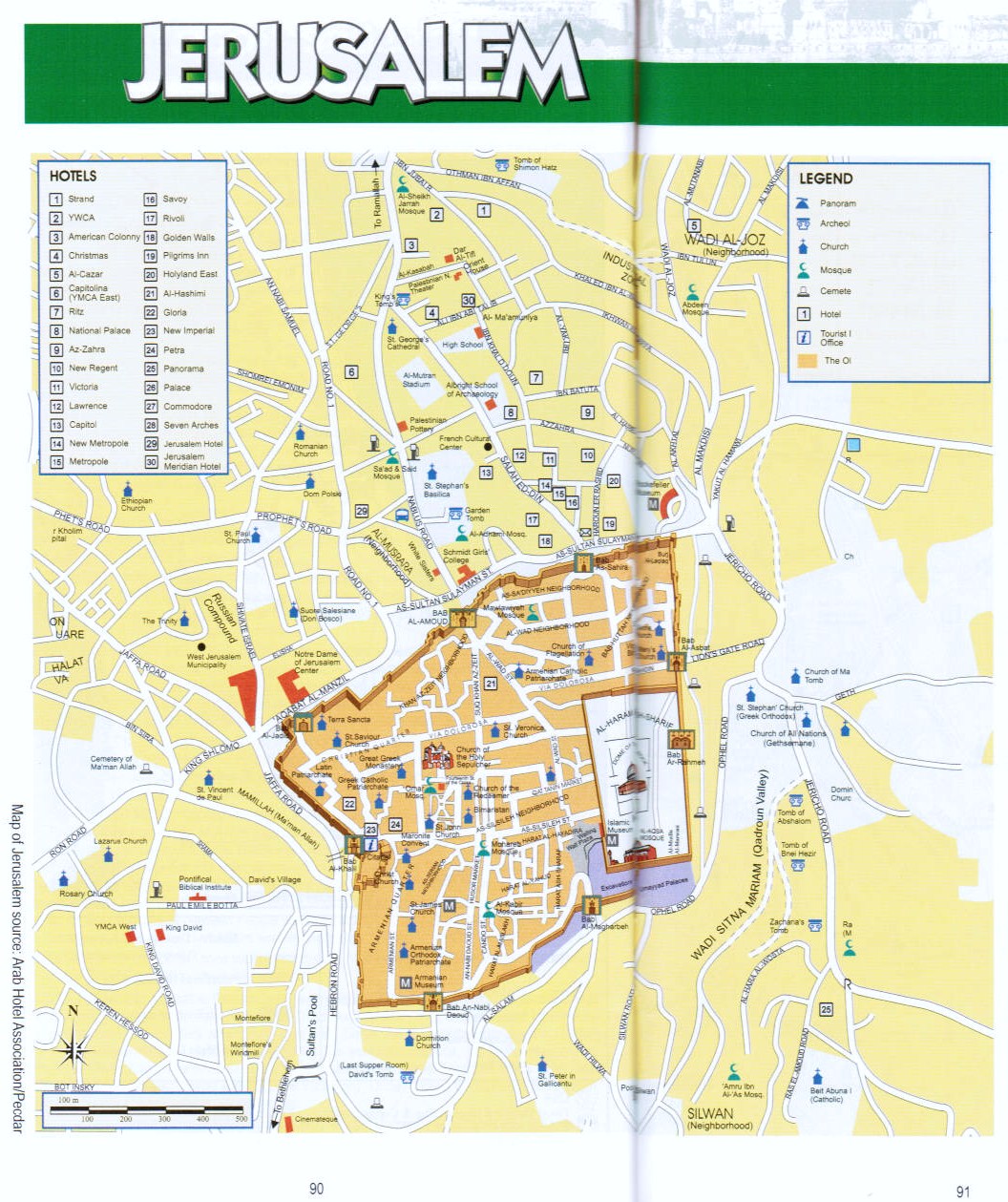
Shahin, described as journalist and author, has written a most curious guidebook. The genre normally aspires to help the traveler find his way, but this one has the grander aspiration to "search for all things Palestinian—past and present—in historic Palestine." In other words, its goal is political, not touristic. The guidebook dimension is nominal with no street addresses, much less opening and closing hours, evaluations of hotels and restaurants, or other practical advice.
 Perhaps the book's strangest aspect is the pretense that Israel does not exist—symbolically eliminating the Jewish state in anticipation of the PLO, Hamas, and Palestinian Islamic Jihad actually doing so. Thus, Jaffa fills up a chapter of twenty pages while the vastly larger city of Tel Aviv is barely mentioned, and then through gritted teeth. On the other hand, what Shahin refers to as the "massive and horrific" Wall (always with a capital "W") has a chapter of its own.
Conceptualized as a propaganda tool, the guidebook contains more than its share of inaccuracies. The first page falsely informs that "Palestine is a Holy Land to Muslims." The assertion that "archeologists have yet to verify the historic existence" of the Temple of Solomon is laughable nonsense. And Lord Balfour was hardly "of Jewish descent."
More surprising are the candid assertions that spring up between the tired anti-Zionist tropes. Palestinians are said to include Jews as well as Muslims and Christians, a rare inclusion. The comparison of Palestinians in Jordan to Jews in the United States got me thinking. "Many Lebanese blamed the PLO and its policies for the destruction of their country" must have slipped in when someone was not looking. And one sentence required three readings before I could believe my eyes, stating that the Arab population of Palestine grew in the 1930s partly because "the British and Jewish capital infusion to the country created jobs." That's a thesis, first articulated by Joan Peters (and forwarded in this journal by Fred Gottheil) that anti-Zionist elements vehemently deny.
As I say, it's a curiosity, an artifact unique to the Arab-Israeli conflict.
Oct. 1, 2007 update: This Week in Palestine offers a no less curious political version of a typically touristic artifact, though it does at least contain hotel & restaurant information, maps, and other practical information.
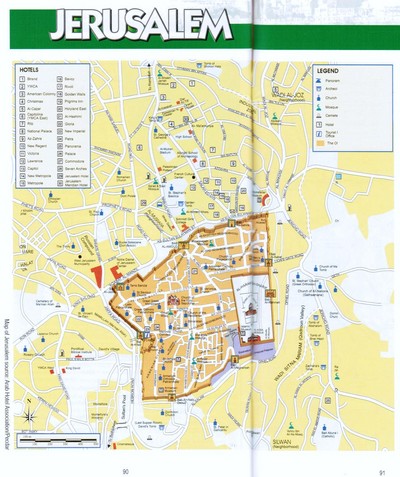 The map of Jerusalem (full-sized version here) typifies the contortions of this document. All the hotels listed in the box at the top left are Arab owned but the map shows just one Jewish-owned hotel, the King David. It recognizes a "Wailing Wall Plaza" (using an out-of-date term for what is now called the Western Wall) but marks only mosques and churches in the Old City, no synagogues. It does recognize the Jewish Quarter but disguises the name by referring to it only in Arabic ("Harat al-Yahud"). The Jewish site of Shimon HaTzadik is mangled into "Shimon Hatz"; plus, it is listed as an archeological site, not a religious one.
I imagine hours of debate produced each one of these compromises between politics and practicality.
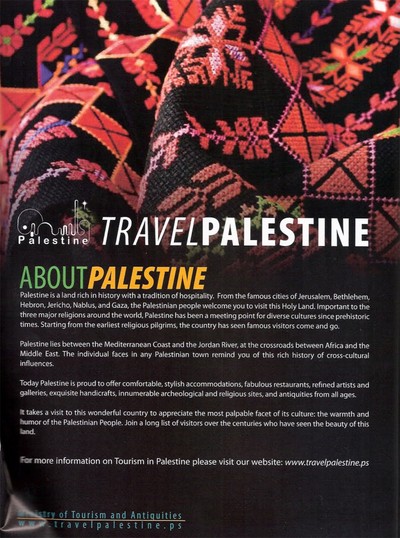
Jan. 1, 2011 update:The Palestinian Authority's so-called Ministry of Tourism and Antiquities has taken a leaf out of the guidebook reviewed here, producing an advertisement with a text that pretends no such place as Israel exists. Here is the text:
Palestine is a land rich in history with a tradition of hospitality. From the famous cities of Jerusalem, Bethlehem, Hebron, Jericho, Nablus, and Gaza, the Palestinian people welcome you to visit this Holy Land. Important to the three major religions around the world, Palestine has been a meeting point for diverse cultures since prehistoric times. Starting from the earliest religious pilgrims, the country has seen famous visitors come and go.
An ad for "Travel Palestine" that eliminates Israel through omission.
Palestine lies between the Mediterranean Coast and the Jordan River, at the crossroads between Africa and the Middle East. The individual faces in any Palestinian town remind you of this rich history of cross-cultural influences.
Today Palestine is proud to offer comfortable, stylish accommodations. fabulous restaurants, refined artists and galleries, exquisite handicrafts, innumerable archeological and religious sites, and antiquities from all ages.
It takes a visit to this wonderful country to appreciate the most palpable facet of its culture: the warmth and humor of the Palestinian People. Join a long list of visitors over the centuries who have seen the beauty of this land.
For more information on Tourism in Palestine please visit our website: www.travelpa/estine.ps
Comment: Something tells me that selling "the warmth and humor of the Palestinian People" might prove difficult.
May 13, 2015 update: The Palestinian Authority has published an undated six-page brochure titled Welcome to Palestine, Crossroads of Civilizations to encourage tourism. It does the same as the guidebook above - i.e., pretend Israel does not exist. For example, it shows Jaffa on a map but not Tel Aviv. It shows Bethlehem but not Ma'ale Adunim. It marks Egypt but not Israel. This pretense also goes back in time; the brochure mentions "the Persian, Hellenistic, Roman, Byzantine, and Arab civilisations" but does not mention the Jewish one.
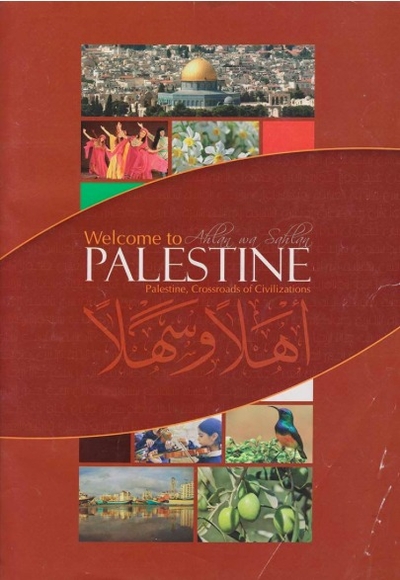
This brochure (which I learned about from IsraelBehindtheNews.com) stands out for having been produced with funding from the Government of Japan via the Japan International Cooperation Agency's "Project for Sustainable Tourism Development Through Public - Private Partnership In Palestine." Does the Japanese taxpayer really consent to this malign nonsense?
Feb. 28, 2021 update: Turkey's government has jumped in too. From an article by Dean Shmuel Elmas in today's Israel Hayom: it has
prepared a tourist guidebook about the history of Jerusalem and its tourist sites. The guidebook suggests visiting the Al-Aqsa Mosque and the Temple Mount, followed by Hebron and Jaffa – without any mention of Tel Aviv. In terms of other recommended sites in Jerusalem, the guidebook notes the Church of the Sepulchre of Saint Mary and King David's Tomb. It also recommends visiting Nebi Musa in Judea and Samaria (which Muslims believe to be the tomb of the Prophet Moses), and the clock tower in Jaffa, which was built by Sultan Abdul Hamid II. The Turkish guidebook, meanwhile, failed to note any of these sites' affiliation with Israel.
May 26, 2022 update: All this misinformation has reached at least one receptive audience, the "Palestine refugees," as Nan Jacques Zilberdik and Itamar Marcus show in "PLO, PA TV promote world without Israel - even in TV quizzes."
- Mount Meron in northern Israel is in "Palestine"
- The Sea of Galilee in northern Israel is "in Palestine"
- The Hula Lake in northern Israel is "in Palestine"
- The Red Sea at Israel's southern border is "in Palestine"
- "Palestine" is "27,000 sq. km." – i,e., includes all of Israel