Whispers are coming from Iraq that Saddam Hussein may be willing to withdraw from Kuwait or at least from part of it. This raises the tempting possibility that there will be no war and that most U.S. forces will soon return home, having achieved their goal without firing a shot. Many would cheer such an outcome. But close analysis shows that a peaceful resolution will only defer the fighting until later. What appears to be a nonviolent solution will surely lead to greater violence in the years ahead.
Saddam Hussein has many reasons to evacuate his troops. Most governments would be so relieved that they would quickly drop economic sanctions against Iraq. That Kuwait will have been left looted and despoiled, that many Kuwaitis will have been brutalized, raped and murdered—all this will be forgotten.
Withdrawing the troops would be embarrassing for Saddam Hussein at home, but Baghdad's spin doctors know how to portray retreat as victory. They can point to the financial gains made by the operation, the punishment of Kuwait or the unwillingness of the world's coalition to confront Iraqi forces. There would be much talk about preparing for the next battle—against Israel.
Mr. Hussein could survive this reversal as he survived previous ones. And if he did, the Iraqi effort to build chemical, biological and nuclear arms would surely resume, as would the missile program, which eventually may include intercontinental missiles. It is equally safe to predict that Mr. Hussein would be tempted to use his arsenal. His dream is to gain hegemony over the Persian Gulf region and thereby become the greatest Arab leader of the 20th century and a leading power on the world stage.
In other words, a withdrawal from Kuwait prepares the way for new aggression. If not stopped now, Mr. Hussein will have to be stopped later.
Even if a U.S. expeditionary force remains in Saudi Arabia for years (a questionable assumption), confronting Mr. Hussein will be far more difficult in the future than it is now. When he subverts or invades a country in 1995, we will no longer have today's option of knocking out the Iraqi military-industrial complex or of taking out Mr. Hussein himself. Rather, the response will have to be cautious and indirect, as it was when the Soviets invaded Afghanistan.
Should the American-led coalition go to war now, the easiest part would come first. A plausible casus belli would not be hard to find: Iraqi barbarism in Kuwait or the holding of Western hostages already provide this. Once war began, our forces would quickly gain control of the air and could devastate Iraq's military-industrial complex.
If the offensive ended with aerial bombing, Mr. Hussein would most likely remain in power and his troops would still occupy Kuwait. If ground troops joined in the allied assault, they would face larger well-entrenched Iraqi forces defending their homeland. And if our side reached Baghdad and eliminated the regime, what next? The prospect of an American-fostered government in Baghdad would arouse tremendous hostility throughout the Middle East, and would probably backfire.
U.S. facilities and Americans might become targets of violence in the Middle East. The fragile international coalition would splinter once violence was used, and with it most of the economic sanctions against Iraq. In the U.S., critics on the left and right would lobby to bring the troops home.
All these concerns are real and worrisome. But they are secondary. In the end, it is a matter of dealing with a relatively weak Iraq now or expecting to deal with a much more powerful one in a few years. Bluntly put: War now or war later.
The Kuwaitis, Saudis and Israelis have made their choice clear; they greatly prefer to deal with Mr. Hussein now, when he cannot keep control of Iraqi airspace or deploy nuclear missiles. They are right.
But President Bush seems to be unsure of what he wants to do. He seems genuinely to believe in a "diplomatic outcome." Such indecisiveness is welcome, for it indicates just how worried he is about making the most awesome decision a President faces: committing troops to war. But he must make up his mind, and that moment is drawing very near.
Daniel Pipes, author of The Rushdie Affair, is director of the Foreign Policy Research Institute.
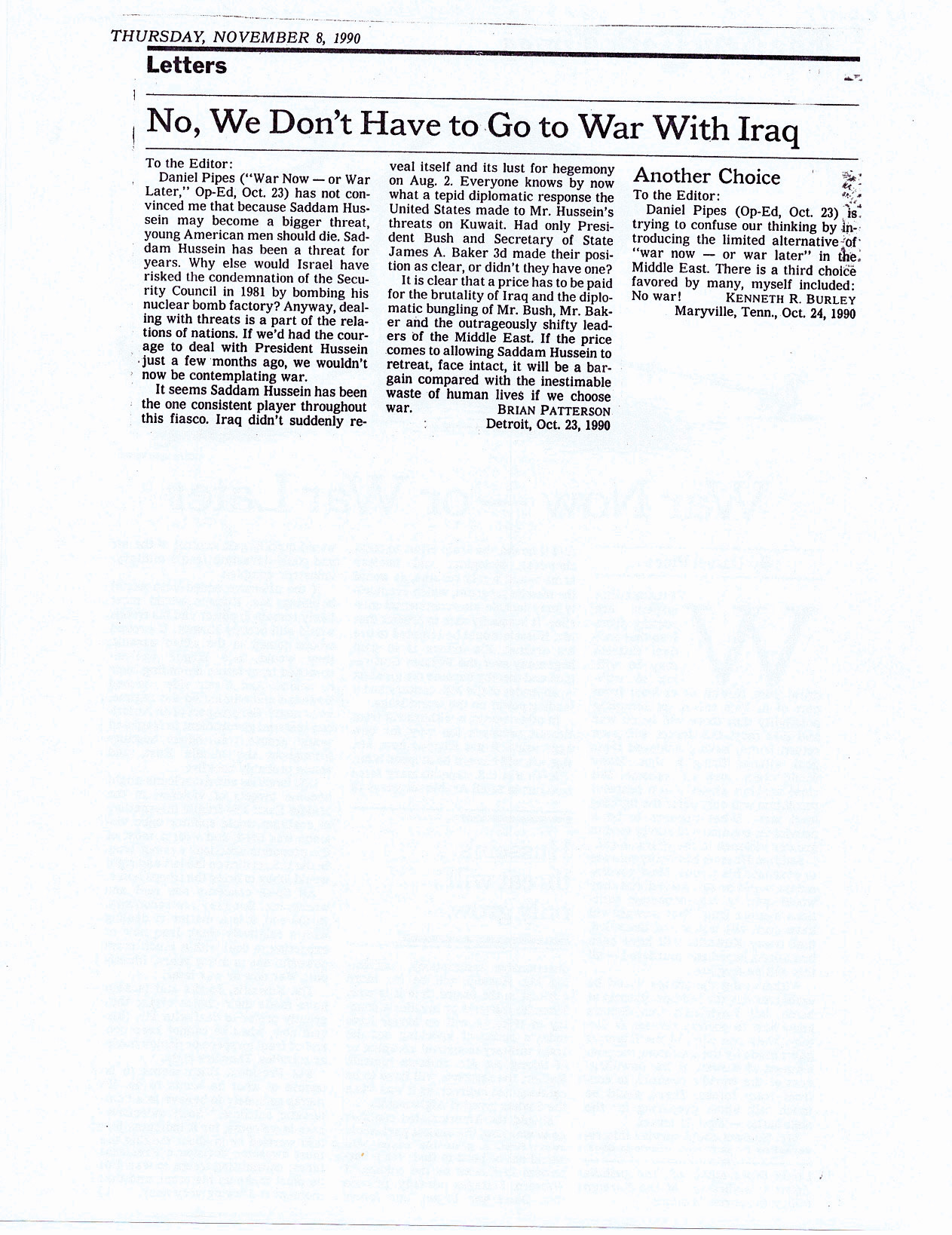
Nov. 8, 1990 update: For a published reply to to this article, click here.