A donor conference for Afghanistan convened in Tokyo last week had every appearance of being humane, moral, and sensible. Representatives from sixty governments pledged to help rebuild Afghanistan by committing at least $1.7 billion in 2002 and $10.2 billion over the next decade. On behalf of the United States, Secretary of State Colin L. Powell pledged $297 million, approximately one-fifth of the first year's monies.
This, the largest amount from any single country, is meant to help put what Powell dubbed a "startup country" back on its feet. He explained the basis of the largess: "The United States will not abandon the people of Afghanistan."
The lofty sum of $297 million catapults Afghanistan into the big leagues of American generosity, making it the fourth-largest recipient of America's foreign aid for 2002 (behind Israel, Egypt, and Colombia). This is remarkable for four reasons:
- Afghanistan will get more U.S. aid than many poor states that are truly vital to U.S. security, such as Russia ($177 million), Indonesia ($120 million), the Philippines ($75 million), India ($67 million), Mexico ($35 million), and Turkey ($3 million).
- Afghanistan will receive more aid than many countries more destitute than it. Afghans are not a wealthy people, but their per-capita income of $280 (according to the World Bank) places them well above some other countries. Per-capita income of Tajikistan is estimated at just $170 but it gets $11 million from Washington this year. The same goes for other basket cases. Ethiopia's per capita is $100 and it receives $42 million. Democratic Republic of Congo has $100 per capita and it gets $18 million.
- Unlike all these other countries, Afghanistan is costing the United States a fortune. Operation Enduring Freedom costs about $1 billion per month, or about $5 billion so far. And that pales compared to the estimated $105 billion lost directly and indirectly from the Afghanistan-based assault on Sept. 11.
- The 2002 allocation for Afghanistan planned a full year ago was for less than $3 million. In other words, the Afghanistan-based attack on the United States on Sept. 11 had the ironic effect of increasing U.S. aid to that country a hundred-fold.
Why then is Afghanistan rewarded with an outpouring of aid? The reason is simple: U.S. forces defeated Afghanistan's regime and Americans now feel responsible for fixing the country.
Sound strange? It shouldn't. It fits an established pattern. A few years ago, American forces were engaged in the former Yugoslavia; today that cluster of countries receives a whopping $358 million in U.S. aid. Similarly, Germany, Italy, and Japan benefited from massive U.S. aid after losing to America in World War II.
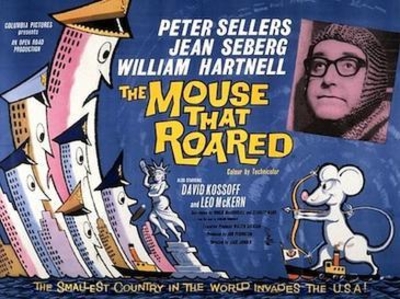 More broadly and humorously, this reflects the "mouse that roared" syndrome, named after the 1959 movie starring Peter Sellers in no less than three roles. It told the story of a tiny Europe duchy, Grand Fenwick, which finds itself on the verge of bankruptcy and decides to declare war on America in order to lose, then profit from the resulting aid.
"There isn't a more profitable undertaking for any country than to declare war on the U.S. and to be defeated," intones the duchy's prime minister. "No sooner is the aggressor defeated than the Americans bring in food, machinery, clothing, technical aid and lots and lots of money for the relief of its former enemies."
So the world's smallest country attacks America and when, at the film's end, the State Department comes to settle up, Grand Fenwick demands $1 million in aid. It is rebuffed: "You can't expect us to give you a measly million," the U.S. diplomat scowls, knowing his superiors won't permit his spending such a trivial amount.
The Mouse that Roared may be entertainment but it has a sobering message. As Grand Fenwick's prime minister sagely put it: "The Americans are strange people. Whereas other countries rarely forgive anything, the Americans forgive everything."
His point is particularly salient today: Washington should allot its foreign aid on the basis of strategic, humanitarian, or other considered reasons. Americans should feel less guilty, forgive less quickly, and be less swayed by headlines of the moment. They should pay more attention to self-interest. And they should not blindly pay out to mice that roar.


