
 In preparing "A Muslim Aliyah Paralleled the Jewish Aliyah," I overlooked the important history by Johann Büssow, Hamidian Palestine: Politics and Society in the District of Jerusalem 1872-1908 (Leiden: Brill, 2011). Here follow some excerpts from his book relevant to my article.
Immigrants from outside Palestine living in the Sa'diya quarter of Jerusalem in 1905, according to the Ottoman census (derived from information on p. 147):
Middle East and North Africa: Beirut (9), Sidon (8), Lebanese Tripoli (6), Damascus (9), Cyprus (2), Antakya (2), Circassia (4), Jeddah (1), Egypt (6), Libyan Tripoli (2), Fes (1).
Africa: Borno (17), Sudan (17), Darfur (11), Ethiopia (1).
South Asia: India (2), Afghanistan (1).
Total outside Palestine: 50+46+3 = 99 out of 1,465 persons, or 6.8 percent
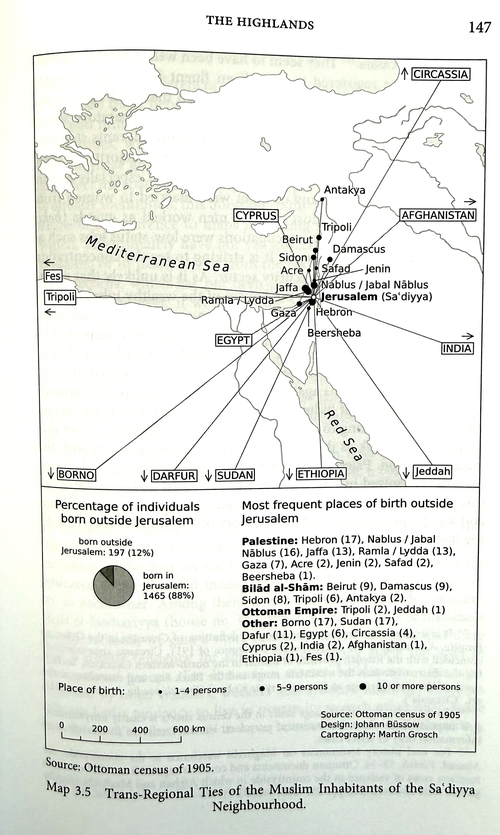 Büssow, p. 147. |
More information on early immigrants from Egypt:
The earliest group of settlers around Jaffa and Gaza were Egyptians, who came in growing numbers from the 1820s, and it was indeed the refusal of the Ottoman governor Abdallah Paşa to send back 6,000 fugitive Egyptian military conscripts who had allegedly settled in Palestine that served as a pretext for Muhammad 'Ali to invade the Levant in 1831. Egyptian immigration increased in the wake of that invasion and they were the largest immigrant group before the onset of large-scale Jewish immigration in 1882. A number of the Egyptian immigrants integrated into the city populations, and some even ascended to the ranks of the local urban elite. Most of them, however, were poor peasants and they settled in newly constructed mudbrick villages commonly identified by the Arabic term sakināt ('settlements'). What brought them to the Palestinian coast was most likely a combination of 'push' and 'pull' factors, especially the attraction of the sparsely settled but fertile land and the desire to flee the harsh rule of Muhammad 'Ali's regime. Not much is known about the life of the Egyptian settlers in the sakināt, but it is striking that their mudbrick villages are never actually referred to as villages but are called 'settlements'. This is still reflected in Walid Khalidi's survey of the Palestinian villages, where the sakināt are mentioned only in passing, as if they were not true Palestinian villages. We may surmise that most of their inhabitants were not peasants living on their own land, but agricultural labourers employed around Jaffa. There are reports that many of them worked only on short-term contracts and migrated between several agricultural regions during the year, following the different harvest seasons. During the winter, they typically worked in the citrus orchards and packing houses of Jaffa, in spring they were employed for the grain harvest around Gaza, and in summer they harvested grapes in the vineyards north of Jaffa.
(pp. 213-14)
"According to Ruth Kark, who inspected some of the few remaining Ottoman census registers for Jaffa, ... birthplaces of Muslim immigrants included Tripoli (Tarābulus al-Shām), Beirut and Sidon in the Province of Beirut; Port Said, Tanta, Suez, al-Minya and Damietta in Egypt; Tripoli (Tarābulus al-Gharb), Misurata and Benghazi in Libya, in addition to Latakia, Aleppo, Mersin, Jerash, Morocco, Algiers and Afghanistan."
(pp. 224-25:)
"The precarious situation of young Muslim immigrants not only erupted in inter-confessional brawls but also increasingly fuelled class-related tensions. In this case, the leading group were wardens (Ar: nāwāțīr), who were employed by landowners and who in some places also oversaw the collection of the tithe ('ushr). These private guards were mostly recruited from three groups: locals, among them apparently many former black slaves, and Afghans and Maghrebis, who had arrived in Palestine as migrant workers or as pilgrims en route to and from the holy cities of the Hijaz. In 1911, the German consul estimated that 1,000 to 1,500 armed guards were employed in Jaffa alone. The huge numbers of poor Muslim immigrants in the city provided a large reservoir of cheap labour from which they could be recruited."
(pp. 236-37)
In 1878, "Several hundred Muslim refugees arrive in District of Jerusalem; far more are settled in Northern Palestine and Transjordan." (p. 522)


