Do you have advice for European leaders? Daniel Pipes, founder of the Middle East Forum think tank, tells La Ragione, "Stay sober and serious, keep reminding Europeans and Americans of the principles that have shaped and sustained the Atlantic Alliance for eighty years."
A key figure of neoconservatism, he collaborated with the U.S. Department of State and then-President George W. Bush appointed him as member of the United States Institute of Peace. "Pick your battles wisely. Do not get provoked by Trump nor enter foolish arguments with him. Wait for this nasty, aberrant moment to reach its end in disrepute," he says referring to the current presidency.
Pipes hopes to reduce fears concerning Trump's actions that damage the American system and ties to historical allies. On the subject: "Donald Trump speaks with a carelessness perhaps unique among elected leaders, saying whatever comes to mind. Often, he does not follow through, leading to the much-bruited TACO meme ('Trump always chickens out')."
Pipes also believes that a government interference in the conduct of the midterm elections is not feasible: "I see him possibly pushing for federal oversight of all elections but law courts and other institutions obstructing his way to the point that he gives up this scheme." The president even threatened to cancel the election, but will likely meet opposition making that plan unworkable: "When it comes to constitutional issues, Trump's bark is far worse than his bite," Pipes concludes.
What about U.S. aggression towards its allies, dictated by imperial revanchism – such as the annexation of Greenland? The Middle East Forum founder cautions: "I cannot imagine this happening. Only the most steadfast Trump acolytes, and their numbers diminish daily, would support such a move. Near-universal domestic opposition alone would prompt him to back off."
When it comes to the Middle East (on which Pipes is a leading expert), in particular the future of relations between the United States and Israel: "From the outside, the U.S.-Israel relationship tends to look static: they are the closest of allies, full stop. Of course, from the inside, it brims over with tensions, resolutions, and endless changes. Large, learned books deal with this topic. Disputes between leaders and even waves of isolationism are routine."
However, it is the disaffection of liberals that could mark the long-term end to the pro-Israeli consensus. Were that to happen, "policy toward Israel will swing back and forth, depending on whether Republicans or Democrats are in charge. In that case U.S.-Israel ties will substantially weaken."
This awareness pushes Jerusalem to pursue a profound change in security doctrine, as announced by Prime Minister Benjamin Netanyahu, according to which the Jewish state must obtain strategic autonomy from Washington within a few years, implementing a military autarchy program. Pipes observes that the challenge requires the acquisition of defense necessities from new sources: "In part, it will require Israel to manufacture more of its own supplies. In part too, it will increase Israeli purchase from other arms suppliers, notably India and South Korea."
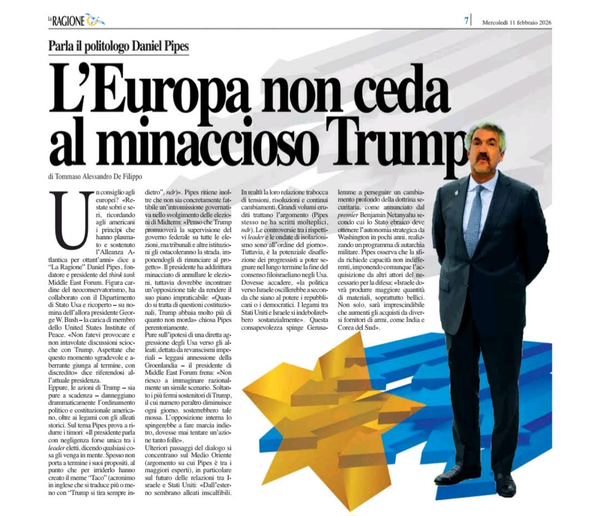 Note: The graphic in this newspaper article is not a picture of Daniel Pipes but an (inaccurate) AI rendition of him. |


