
My September 1998 article, "You Need Beethoven to Modernize," proposes that proficiency at Western classical music can, surprisingly, serve as an index for how well non-Westerners modernize. This weblog follows the theme by looking at the continuing difficulties between music and Muslims.
Sep. 21, 1998 addendum: Khalid Kishtainy interestingly projects Muslim views onto the Japanese:
Music stands out as probably the most effective indication of one's nationality, for the good reason that it is the earliest form of self expression and communication for the child. A Japanese conductor may spend his life studying western music in Moscow or Paris, but in the hours of a shattering emotional experience, he finds himself humming his national Hagoromo songs.
From Whither Israel? A Study of Zionist Expansionism (Beirut: Palestine Liberation Organization Research Center, July 1970), p. 10.
Dec. 9, 2003 update: For the fate and symbolism of classical music in post-Saddam Iraq, see "'Iraqi Symphony Performs for Bush'."
Dec. 19, 2005 update: "The Erratic Career of Western Music in Iran" reviews a bumpy career under the Islamic Republic.
Aug. 3, 2007 update: With the Hamas takeover in Gaza, music, even indigenous, is nearly banned, according to a musician named Salaheddin:
I lead a group of 26 musicians - we play traditional Palestinian music. But for the last two months we haven't been able to work. This group, Hamas, believe they are the leaders of Islam. The violin, piano, flute, all these instruments are banned. Only the drum is allowed. They say any other instrument is not mentioned in the Koran. ... Hamas have already beaten one of my singers for singing for Fatah. He was attacked at the wedding where he went to perform. We had to send him to Israel for hospital treatment. We have to keep our traditional music because it is Palestinian. People without traditions are not civilised, they are nothing.
May 5, 2008 update: If music is threatened in Iran and Gaza, it has a new opening in Saudi Arabia, reports Donna Abu-Nasr of the Associated Press:
A German-based quartet staged Saudi Arabia's first-ever performance of European classical music in a public venue before a mixed-gender audience. The concert, held at a government-run cultural center, broke many taboos in a country where public music is banned and the sexes are segregated even in lines at fast-food outlets.
The Friday night performance could be yet another indication that this strict Muslim kingdom is looking to open up to the rest of the world. A few weeks ago, King Abdullah made an unprecedented call for interfaith dialogue with Christians and Jews — the first such proposal from a nation that forbids non-Muslim religious services and symbols. "The concert is a sign that things are changing rapidly here," said German Ambassador Juergen Krieghoff, whose embassy sponsored the concert as part of the first-ever German Cultural Weeks in Saudi Arabia. ...
Friday's concert of works by Mozart, Brahms and Paul Juon was the first classical performance held in public in Saudi Arabia, said German press attache Georg Klussmann. It was advertised on the embassy's Web site with free tickets that could be downloaded and printed.
The excitement in the 500-seat hall was palpable as the largely expatriate audience walked in. "We have not done a concert like this before," German diplomat Tobias Krause told the audience at the start of a performance by the Artis Piano Quartet. Those gathered applauded enthusiastically after each piece and were treated to an encore.
Sebastian Bischoff, the German cultural attaché, said the mission had received permission for the event from the Ministry of Information and Culture, which runs the King Fahd Cultural Center, where the concert took place.
Japanese pianist Hiroko Atsumi, the quartet's only woman, said there was some debate before the concert about whether she should perform in an abaya, the enveloping black cloak all women must wear in public. She settled on a long green top and black trousers. ...
For the expatriates, the evening was an opportunity to have a normal evening out in Riyadh, a city with no movie theaters and where women are not allowed in outdoor cafes. One foreign couple held hands, while another husband put his arm around his wife's shoulders — rare public displays of affection in the kingdom. The mutawwa, the dreaded religious police tasked with enforcing public morality, were nowhere to be seen for a change.
Comment: Note that this concert took place in the long-shuttered King Fahd Cultural Center, which I discussed at some length in my 1998 article.
Dec. 2, 2008 update: The erudite David P. Goldman, writing as "Spengler," looks at the Chinese cultivation of Western classical music in a way complementary to my assessment of Japan and the Muslim world in "China's six-to-one advantage over the US." Whereas I focused on the cultural dimension, he looks at the mental benefits of mastering this music. Some excerpts:
The world's largest country is well along the way to forming an intellectual elite on a scale that the world has never seen, and against which nothing in today's world - surely not the inbred products of the Ivy League puppy mills - can compete. Few of its piano students will earn a living at the keyboard, to be sure, but many of the 36 million will become much better scientists, engineers, physicians, businessmen and military officers. ...
There is little doubt that classical music produces better minds, and promotes success in other fields. Academic studies show that music lessons raise the IQs of six-year-olds. Elite American families still nudge their children toward musical study. ...
Any activity that requires discipline and deferred gratification benefits children, but classical music does more than sports or crafts. Playing tennis at a high level requires great concentration, but nothing like the concentration required to perform the major repertoire of classical music. Perhaps the only pursuit with comparable benefits is the study of classical languages. It is not just concentration as such, but its content that makes classical music such a formative tool. ...
Something more than the mental mechanics of classical music makes this decisive for China. In classical music, China has embraced the least Chinese, and the most explicitly Western, of all art forms. Even the best Chinese musicians still depend on Western mentors. Lang Lang may be a star, but in some respects he remains an apprentice in the pantheon of Western musicians. The Chinese, in some ways the most arrogant of peoples, can elicit a deadly kind of humility in matters of learning. Their eclecticism befits an empire that is determined to succeed, as opposed to a mere nation that needs to console itself by sticking to its supposed cultural roots. Great empires transcend national culture and naturalize the culture they require.
China's commitment to classical music will have effects that are at once too subtle and too powerful to categorize easily. It is not that classical music helps to train good scientists, for example. ... Until now, the West has tended to dismiss China's scientists as imitators rather than originators. As a practical matter, China had little incentive to innovate; an emerging economy does not have to re-invent the wheel, or the Volkswagen, for that matter. ...
When it comes time to develop the next generation of anti-missile radar, or electric car batteries, Chinese originality may assert itself once again. Chinese who have mastered the most elevated as well as the most characteristically Western forms of high culture will also think with originality. Anyone who doubts this should watch Lang Lang's performance of the Mozart C Minor Concerto once again.
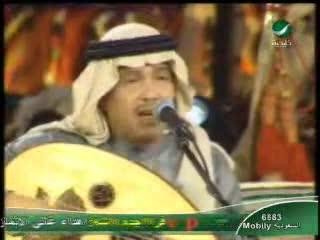 The Saudi oud player, Mohammed Abdo. |
The ulema, however, do not win every round:
In May a French embassy-sponsored concert by operatic soprano Isabelle Poulenard, performing with a female accompanist to a women-only audience in Riyadh, was forbidden just two days before the date after gaining full permission. The concert finally went ahead following an apparent high-level skirmish between religious and other officials, said a person associated with the event.
The former Cat Stevens, now Yusuf Islam.
July 26, 2009 update: An interviewer says this about the former rock musician Cat Stevens, now the Islamist called Yusuf Islam:
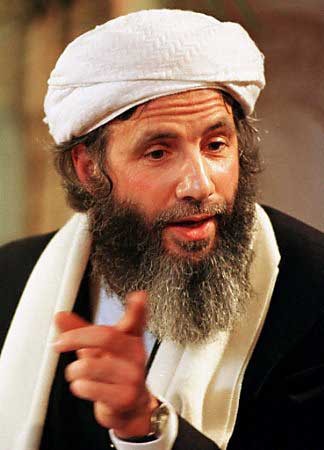
With the rigour of the zealous convert, he stopped playing music. The first guitar to re-enter his life was brought into his home in Dubai (where he also runs Jamal Records) by his son Muhammad. "He awoke within me my deep conviction that there was nothing wrong with this. Music has never been forbidden in the Muslim world."
Aug. 26, 2009 update: Some Saudis are trying to develop artistic festivals that include musical performances but the Mutaween, the religious police, are having none of it.
Jeddah's summer film festival was cancelled this year despite the support of local governor Prince Khaled al-Faisal. King Abdullah, who ascended the throne in 2005, is seen as backing the reformers but he must balance the opposing forces. "Unfortunately such actions carried on by religious police do not adhere to the official political will and they sabotage the government efforts to improve and maintain the internal tourism industry," said Mahmoud Sabbagh, a newspaper columnist. This month music concerts were also banned from the Abha tourism festival, in the mountainous southwest of the kingdom.
Apr. 14, 2010 update: The Somali Islamist group Hizbul Islam has just enforced a ban on all music, reports Agence France-Presse, and the fourteen independent radio stations operating in Mogadishu have no choice but to obey.
Mogadishu-based radio stations stopped playing music Tuesday in compliance with an ultimatum issued by hardline Islamists 10 days ago, officials and journalists said. "Today we see an official crackdown on the independent media. ... The local radio stations stopped playing any kind of music or songs after the deadline given by the Islamists came to an end," said Mohamed Ibrahim, an official of the National Union of Somali Journalists. ... All radio stations in both government and Islamist controlled areas of Mogadishu were affected by the ban imposed by the Hezb al-Islam militants, Ibrahim said. Journalists and radio executives said they had complied with the ban for fear of reprisal. The Hezb al-Islam and the Al Qaeda-linked Shebab groups control much of war-wracked Mogadishu.
AFP also quotes reactions from unhappy radio station staff:
Mohamed Haji Bare, director general of Danan Radio: "We abide by their rules by abstaining from broadcasting music and songs and instead we are using traditional poems from today on."
Osman Gure, director of Radio Shabelle: "No one dares disobey the orders otherwise you put your life in danger."
Abdiaziz Mohamed Dirie, an editor at Simba radio: "This morning I broadcast my program without the music sound bites. Everything is falling apart in this country and if we ignore what they [the Islamists] say, we ignore our safety."
Apr. 16, 2010 update: The Shabab, the most powerful Islamist group in Somalia, have gone a step further and banned school bells in Jowhar, some 55 miles north of the capital Mogadishu.
School principals in the town ... had been summoned to a meeting and informed that the bells could no longer be used because they sounded like church bells, according to one principal. "There was no bell rung in our school today," said Hamdi, a student at the Kulmis Primary and Secondary School, who asked that her full name not be used out of fear for her safety. "Some teachers were hitting the doors as the period finished. It is really confusing."
The news report also updates the predicament of the Mogadishu radio stations that stopped playing music: "The ultimatum left broadcasters scrambling to find creative ways around the ban, leading them to play recordings of horses galloping, roosters crowing, engines roaring or guns being fired — a common sound in the capital — to signal the start of various broadcasts."
Apr. 20, 2010 update: Music on the radio has become a hot potato in Somali politics, Mohammed Ibrahim of the The New York Times explains today in "Somalia: Off Again, on Again Radio":
Two radio stations in Somalia were shut down by the transitional government on Tuesday because they had stopped broadcasting music after threats from Islamist insurgents, but the stations were allowed back on the air hours later. The quick turnaround appeared to expose a difference of opinion in the government, which had earlier warned of shutdowns. Security agents had ordered the stations closed Tuesday, but the Information Ministry, citing the freedom of the press, countermanded the orders. Islamic insurgents had demanded the stations stop playing music because they deemed it un-Islamic.
June 28, 2010 update: This is off topic – no Muslims involved – but it adds a useful perspective on Western classical music. From a review of The Ninth: Beethoven and the World of 1824 by Harvey Sachs (Random House) in The Weekly Standard by Lawrence Klepp:
Toward the end of the Chinese Cultural Revolution, in the mid-1970s, the routine attacks on revisionists and running dogs of imperialism were briefly interrupted by a strident anti-Beethoven campaign. A friend of mine who was a schoolgirl in Shanghai at the time remembers that the reeducation sessions demanded particularly resolute striving against the Fifth Symphony, because the dramatic opening chords had been interpreted as fate knocking on the door, and the bourgeois concept of fate was obsolete. The revolutionary will of the people, reinforced by the collective recital of Chairman Mao's thoughts, overcame all inevitability and could accomplish anything.
But, Klepp continues, "It couldn't accomplish making Beethoven sound bad."
July 21, 2010 update: Again off topic but what a contrast: David P. Goldman reviews the Israeli music scene in "Pioneers: A mix of passion and tradition makes Israel a classical-musical superpower." Israelis would seem to have a classical musical role comparable to their high-tech role:
Improbably, Israel has become a pocket superpower in the arts, most visibly in classical music. ... Israel's contribution to classical music, that most distinctly Western of art forms, has never been more visible. And Israelis take to classical music—the art form that most clearly creates a sense of the future—like no other people on earth, to the point that music has become part of Israel's character, an embodiment of the national genius for balancing hope and fear.
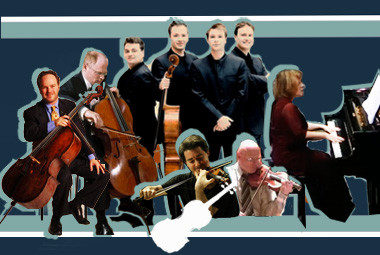
Israeli musicians, clockwise from the far left: Zvi Plesser, Hillel Zori, The Jerusalem String Quartet, Michal Tal, Nitai Zori, Nagai Shaham
The distinctly Israeli take on the European classical tradition has become the country's most notable cultural export, and it has been nurtured by a reverse flow of Israeli performers who are coming back from Europe and the United States to teach at home. In a country where daily life has an intensity that arises from risk, classical music offers an irreplaceable spiritual outlet. And young Israelis bring to it a unique blend of discipline and fervor.
Goldman concludes his moving tribute with an explanation for the outstanding Israeli role in classical music:
The sense of a future in Western classical music evokes the basic emotions with which human beings regard the future, namely hope and fear. When Israeli musicians speak of performing with a sense of risk, they mean the capacity to sustain hope in the presence of fear. It takes a certain kind of personality to do this on the concert stage, with all the attendant artistic and technical demands. Israel, whose existential premise is the triumph of hope over fear, incubates a disproportionately large number of musicians with this sort of personality.
Western conservatories, by contrast, tend to penalize risk-taking. Their graduates are taught to launch careers by winning competitions, and the default strategy for taking a competition prize is to make the fewest mistakes. The conservatory-and-competition circuit tends to manufacture risk-averse savants who play with the spiritual equivalent of surgical gloves.
Comment: The Israeli achievement strikingly confirms the point I argue that "fully reaping the benefits of Western creativity requires an immersion into the Western culture that produced it."
Jan. 18, 2013 update: The Al-Qaeda-affiliated thugs who now rule much of northern Mali, according to Deutsche Welle, "have banned most types of music and forced local musicians to flee for their lives." Confusingly, the article goes on to say that "The Islamists banned music of any kind there - even cell phone ringtones." In all likelihood, the latter is correct. Jan. 28, 2013 update: The French-led victory over the Islamists means some music has returned to northern Mali.
May 20, 2013 update: Sujatha Fernandes of Queens College reviews musical developments in Mali post-Islamist conquest:
It has been almost nine months since Islamic militants in northern Mali announced that they were effectively banning all music. It's hard to imagine, in a country that produced such internationally renowned music as Ali Farka Touré's blues, Rokia Traoré's soulful vocals and the Afro-pop traditions of Salif Keita.
The armed militants sent death threats to local musicians; many were forced into exile. Live music venues were shut down, and militants set fire to guitars and drum kits. The world famous Festival in the Desert was moved to Burkina Faso, and then postponed because of the security risk.
While French and Malian forces largely swept the militants from Timbuktu and other northern towns early this year, the region is still a battleground. Cultural venues remain shuttered. Even more musicians in the north are now leaving the country because they fear vengeful acts by the Malian Army, whom they accuse of discriminating against northern peoples. The music has not returned to what it once was.
July 30, 2013 update: An analysis of Al Maghrib Institute, a Wahhabi organization founded in Texas in 2002 and with many branches, will in late August 2013 run
a seminar entitled, "Fiqh of Chillin'."[1]As part of the seminar, there is a discussion on "how to advise someone to stop listening to music." Somewhat of a tradition exists among Islamic groups with respect to banning or restricting music. The Qur'an, they argue, suggests, for instance, that the playing of musical instruments is as corrupting as wine drinking[2]. There is also objection to the uncontrollable effects that music can have on individuals and the themes that are contained within modern music.[3]
Aug. 13, 2013 update: Sam Westrop wrestles intelligently at "Art as Humanity: Islamism and Music" with the question why "some Islamists choose to use music as propaganda while others ban it completely." His response:
The answer might lie in examining different Islamist groups' approaches to modernity – that is, to what extent can Western methods by adopted and exploited in order to promote the Islamic ideal? One might also ask, for example, why Turkey's Erdogan wears a tie while Iran's Ahmadinejad did not; or why some Western Islamist groups will use the democratic processes, such as libel laws, to attack their critics while others regard such means as sinful.
He then observes:
Ultimately, perhaps, there is little difference between absolute proscription and selective censorship – both, essentially, are systems of control. Truly free expression only serves to embolden and liberate the individual, at great risk to the all-consuming higher ideal.
Jan. 12, 2014 update: The fate of music in Iraq since its peak in the 1970s again points to a utilitarian approach. Ali Abdulameer, an Iraqi journalist in exile, notes that Saddam Hussein saw music as a mechanism to mobilize the masses, and so – to a lesser degree, to be sure – does the Maliki regime today.
in Iraq, particularly since the former regime of Saddam Hussein took over the cultural and artistic institutions and used them for war propaganda and internal and external incitement, the quality of music and songs has declined from being a social product that expresses natural human feelings to merely a government-affiliated sector. ...
Just as propaganda via songs was dominant when the former Iraqi regime controlled the country's cultural institutions, that phenomenon is back today. Nationalist songs have become propaganda tools glorifying the "victories" of the Iraqi forces against terrorism, as in the song "The Golden Team" by the duo Hussam al-Rassam and Mohammed Abdul-Jabbar. There are songs praising the "heroic acts" of the Iraqi army commander and Prime Minister Nouri al-Maliki.
The songs have lousy melodies and no artistic value. They are frequently broadcast on state television and other pro-government outlets. Also, the singer Qassem Sultan used to make songs praising the former Iraqi leader and now makes terrible songs glorifying Maliki.
In the old days, Iraqi songs expressed "deep feelings, including passion." Now, "a song is expected to provide the listeners instant gratification, satisfy their feelings and satisfy their simple awareness patterns."
Jan. 20, 2014 update: How much things have changed in Saudi Arabia in a few years. Arab News carries a story by Habib Shaikh titled "Italian pianist mesmerizes audience in Jeddah." Excerpts:
It was a sheer magical evening at the Italian Consulate when gifted Italian pianist Orazio Sciortio set poetry in motion from the moment his nimble fingers descended on the keys. Just 29, Orazio, is already considered an icon among the new generation musicians from Italy, and this was evident from the standing ovation and cries for encore from the audience after every rendition. ...
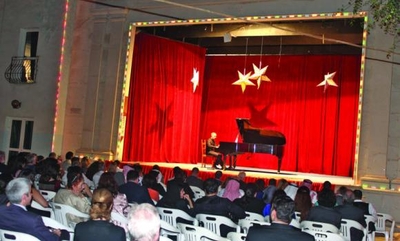 Italian pianist Orazio Sciortio playing at the Italian consulate in Jeddah. |
Consul General Simone Petroni, speaking to Arab News, said the concert was part of the initiative to deepen and strengthen relations between the two countries. "It was planned as a small gathering, but requests flooded us and we tried to accommodate all." Petroni said the consulate was working on organizing three to four programs in future focusing on arts, design, and fashion. ...
Sahar Abujadail, a Saudi, said it was the first time she attended a piano recital. "I am happy I did. It was amazing. I loved it," she added.
Comment: This recital took place, it bears noting, in a consulate, not a public hall, and was planned as only "a small gathering" but demand made it something larger, perhaps in part from Saudi nationals wanting to participate.
Jan. 21, 2014 update: The Islamic State of Iraq and al-Sham (ISIS) conquered the province of Raqqa in the northeast of Syria on Jan. 14 and six days later issued commands banning music and taking other steps (no smoking, burqas on women, public quiet for women, stores closed during prayers). It specifically
"banned music and songs in cars, at parties, in shops and in public, as well as photographs of people in shop windows." The organization urged shop owners to remove photographs of men and women from their shop windows, warning that "whoever violates these rules will subject themselves to the necessary Sharia punishment." "Songs and music are forbidden in Islam, as they prevent one from the remembrance of God and the Koran and are a temptation and corruption of the heart," the statement added.
Jan. 26, 2014 update: An article at Al-Monitor by Mehrnaz Shamimi points out that music is one thing and showing the music being made another. Surprisingly, the Islamic Republic of Iran Broadcasting has allowed some musical instruments to be shown as they are played.
Feb. 9, 2014 update: In January, for the first time since the Islamic revolution of 1979, Iranian television showed music being played on instruments.First came a traditional Persian music band, Avaye Parsian, followed a few hours later by The Pallett, a contemporary music band, which pantomimed playing instruments.
Reactions to the TV appearances reflected the hopes many Iranians feel after the election of a new president, Hasan Rouhani, in June. ... In subtle ways, Iranians said Mr. Rouhani's government has tried to ease the most zealous enforcement of Islamic codes and create space for more personal expression in public.
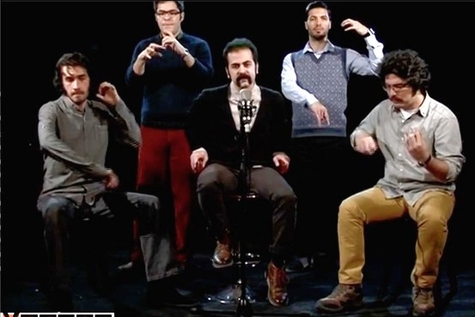 The Pallett pantomined playing on instruments during its unprecedented television appearance last month. |
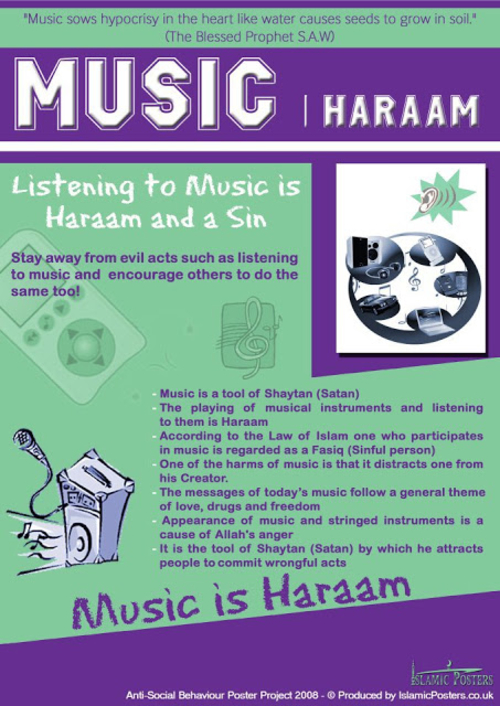
Apr. 19, 2014 update: The Madani Schools Federation in Leicester, England, a state-funded Islamic school, has placed a poster "Music is Haraam" on its official noticeboard. The poster declares:
- "Stay away from evil acts such as listening to music and encourage others to do the same too."
- "Music is a tool of Shaytan (Satan)."
- "Music sows hypocrisy in the heart like water causes seeds to grow in soil" (a hadith)
Feb. 18, 2015 update: ISIS in Libya released pictures of its militiamen burning musical instruments, especially drums, near Derna. These, apparently, were confiscated by its religious police.
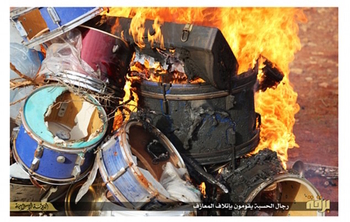 Drums burning near Derna, Libya. |
Aug. 3, 2015 update: Writing for the Indian website New Age Islam, Naseer Ahmed asks "Is Music Prohibited In Islam?" No, he concludes:
Self-prohibition of music, when musical ability and talent is clearly a gift from God, and the Quran does not prohibit it, amounts to ascribing falsehood to God and makes one a zalim (wrong-doer), and therefore someone who will never prosper.
Sep. 24, 2015 update: A video shows Rachid Houdeyfa, the imam of the mosque in Brest, telling his congregants in a sermon that "Whoever enjoys music will be turned into a monkey or a pig" ("Celui qui aime la musique sera transformé en singe ou en porc").
Dec. 3, 2015 update: Steven Stalinsky today published a survey of "ISIS's Jihad against Music."
Mar. 14, 2016 update: In a mildly surprising development, Hamas has permitted a female singer, Rawan Okasha, to perform in public in Gaza City. But she had to stand still, cover all but her face and hands, and limit herself to "patriotic music."
Sep. 5, 2016 update: The Islamist have imported the music wars to Toronto, as Colin Freeze and Mahnoor Yawar recount in the Globe and Mail:
When music class begins this week at Toronto's Donwood Park elementary school, Mohammad Nouman Dasu will send a family member to collect his three young children. They will go home for an hour rather than sing and play instruments – a mandatory part of the Ontario curriculum he believes violates his Muslim faith.
The Scarborough school and the Toronto District School Board originally had offered an accommodation – suggesting students could just clap their hands in place of playing instruments or listen to acapella versions of O Canada – but not a full exemption from the class. After a bitter three-year fight, however, Mr. Dasu felt he had no other opton but to bring his kids home.
Dasu, works as a Koran teacher at Scarborough's Jame Abu Bakr Siddique mosque, whose imam, Kasim Ingar, agrees with Dasu: "We here believe that music is haram. We can neither listen to it, nor can we play a role in it. ... We do not compromise with anyone on the clear-cut orders and principles conveyed by the Prophet."
The school tried a range of compromises.
Records show one idea was to have the children "research the role of nashid" – or the Islamic tradition of oral music. Another was to have the children clap out quarter notes, half notes and full notes. "Your children will not be required to play a musical instrument or sing in their music class," read a formal note to at least one family.
Comment: Another Islamist vs. the West battleground has opened up. It's dizzying to keep up with them all.
Oct. 20, 2016 update: Music performances have emerged as a central issue in Iran's culture wars, where hardliners eying the 2017 elections use these to attack Hassan Rouhani's presidency. Shahir Shahidsaless explains:
ever since Rouhani's election in 2013, conservatives have been gradually increasing their attacks on music concerts despite Rouhani and his team's resistance. They have pushed for the cancellation of concerts in various cities, enlisting the support of like-minded local authorities and, in many cases, physically attacking the concert-goers.
In a recent turn of events, the police and judiciary have also intervened to prevent concerts based on what they have vaguely described as "morality issues" despite the fact that the country's Culture and Islamic Guidance Ministry has given permission to concert organisers.
Matters have worsened of late:
The confrontations between the moderates and the religious hardliners over concerts have intensified since July. In a head-on clash and reacting to an order from the Rouhani administration that the police had no authority to stop the concerts, hardliner Sayed Masoud Jazayeri, deputy chief of the joint armed forces, called on the police to confront "moral and cultural maladies ... throughout society in regards to concerts."
On 5 August, despite the permission of the ministry for a concert of the popular Iranian singer Salar Aghili to be staged as planned the judiciary intervened. The prosecutor of the Khorasan Razavi Province in the country's northeast announced the concert's cancellation. "Due to moral issues in past performances, until the issue is looked at again and a framework set by the province's cultural council all concerts are suspended," he said.
In response, Interior Minister Abdolreza Rahmani Fazli decried the judiciary's suspension of the music concerts in the Khorasan Razavi Province. In a letter to the Conservative Judiciary Chief Ayatollah Sadeq Amoli Larijani, Fazli wrote that "we cannot prejudge the intentions of musicians and base decisions on the possibility that something could go wrong during concerts."
On 12 August, Ahmad Alamolhoda, a conservative and the outspoken Friday prayer leader of the city of Mashhad, said in a Friday sermon that "Mashhad [the seat of the shrine of Imam Reza, the eighth Shia imam] is a pilgrimage destination... If you want a concert, you should go somewhere else." Mashhad is the second-largest city in Iran after the capital Tehran.
By late August, under pressure from the Students' Basij Organisation, part of the Iranian paramilitary volunteer militia, music concerts were banned in all of Iran's universities.
Early October saw Ayatollah Mohamed Yazdi, chairman of the Society of Seminary Teachers of Qom, stoke even greater tensions with Rouhani.
Until last May, Yazdi was head of the country's Assembly of Experts, the body tasked with the supervision and election of Iran's supreme leader. As a leading hardliner, he faced an unexpected and perhaps humiliating defeat when he lost his seat on the body during the elections in February.
In a press conference on 2 October, Yazdi fiercely attacked the Minister of Culture and Islamic Guidance Ali Jannati, an advocate of moderation and the son of ultra-conservative Ayatollah Ahmad Jannati, chairman of the powerful Guardian Council. "It is not your business to say whether [having] music in Qom is appropriate or not. You have no right to interfere in religious matters," Yazdi told the minister.
He also addressed Rouhani, reminding him that as a cleric he should not tolerate events perceived as sinful. "You say you are the follower of the supreme leader. He has given permission for certain genres of musical activity, but [from the religious point of view] he considers the promotion of music impermissible," Yazdi said.
Nov. 19 2016 update: Off topic, but on the relevant topic of China and classical music, from the Economist:
Once, classical music generally travelled from the West to the rest. Now China is reversing the exchange, not merely performing Western classical music in China, but exporting it. ...
Fifty years after Mao's Cultural Revolution in effect banned Western music, a real cultural revolution is taking place. The government is setting up opera houses, concert halls and symphony orchestras at speed. Some 40m children now play the piano—once dismissed by Mao as bourgeois—and additional millions play the violin. The "Lang Lang effect" helps too: the country's most famous pianist has inspired millions of eager young musicians.
But it is in bringing orchestras, opera performances and top individual performers to the West that China is showing its real clout. Jindong Cai of Stanford University, who conducts in both China and the United States, describes the push in soft-power terms: "A product manufactured in China is not as important for China's international profile. Cultural power is much more important." ...
Measured in musical quality, the CPO is not yet the Berlin Philharmonic. "No Chinese orchestra I have heard comes close to beginning to match the world's best in power, beauty and precision," says Norman Lebrecht, a British music critic. ...
Mr Wu acknowledges the quality gap. "We have a couple of good orchestras, but they're not the Vienna Phil," he admits. "But our tours are a way of showing our orchestras' standards, to show our colleagues in Europe that we're getting better and better." Mr Lebrecht agrees: "Longer-established Chinese orchestras have improved beyond recognition."
Apr. 20, 2017 update: David Ignatius reports:
A recent Saudi poll found that ... 82 percent [of the Saudi public] favored music performances at public gatherings attended by men and women. Though these aren't independently verified numbers, they do indicate the direction of popular feeling, which Saudis say is matched by anecdotal evidence. ...
"We want to change the culture," said Ahmed al-Khatib, a former investment banker who's chairman of the entertainment authority.
Dec. 8, 2017 update: Lebanese singer Hiba Tawaji has become the first female musician to perform a public concert in Saudi Arabia. At it, Newsweek reports,
Thousands of young women attended the sold-out event on Wednesday, removing their abayas (the floor-length robes women in Saudi Arabia are obligated to wear in public), shaking out their hair and dancing to covers of songs by Whitney Houston and Celine Dion. At one point, Tawaji looked out at the crowd and yelled, "Girl power!"
Apr. 26, 2018 update: Saudi Arabia's brand-new General Entertainment Authority, tasked with regulating the entertainment industry, has announced that 1,500 entertainment events will be held in 2018, including plays, jazz concerts, traditional and oriental music concerts, and children's performances. It also has a astounding $64 billion budget to build infrastructure over the next decade.
Comment: It looks like the Saudi music dearth is well and truly over.
Dec. 18, 2019 update: The Economist on the burgeoning on piano playing in China in an article titled "How China made the piano its own":
Of the 50m children learning the instrument worldwide, as many as 40m may be Chinese. Shanghai alone has over 2,700 music schools, by one estimate. The government lavishes money on orchestras, which now number over 80, and new concert halls
Feb. 11, 2020 update: Khaled Abu Toameh describes the convoluted music scene in Gaza, where Hamas only wants militaristic music and has come down on the Sol Band.
Mar. 1, 2020 update: "Who would have believed this only a few years ago?" asked Saudi novelist Latifa al-Shaalan. "A Saudi Music Authority and headed by a woman, too!" That woman is Gehad al-Khaldi and the authority's mission is to develop the music sector in Saudi Arabia. Khaldi has a bachelor's degree in violin and music theory from the Higher Institute of Music in Cairo and played for eight years in the Egyptian Orchestra.
Sep. 20, 2021 update: Howard Fishman, a devoted fan of Cat Stevens' music, totes up some of the singer's more outrageous Islamist statements, starting with his statements about Salman Rushdie:
Tracking the history of the controversy, I went back to the 1989 appearance that Stevens made on the British TV show "Hypotheticals." Earlier that year, after Rushdie had officially been targeted because of his portrayal of the prophet Muhammad in his novel "The Satanic Verses," Stevens had matter-of-factly confirmed that the Koran prescribes death as the punishment for blasphemy. Now, on "Hypotheticals," Stevens was asked directly whether Rushdie deserved to die. "Yes, yes," he replied, without much hesitation. Were Rushdie, a marked man, to come to him for help, how would he respond? With what he subsequently insisted was nothing more than an ill-advised attempt at dry humor, a straight-faced Stevens said: "I might ring somebody who might do more damage to him than he would like. I'd try to phone the Ayatollah Khomeini and tell him exactly where this man is." When asked whether he would participate in the burning of an effigy of the author, he replied that he would instead hope it were "the real thing."
When the program aired, a furor ensued, compelling Stevens to issue a press release indicating that his comments had been manipulated in the editing room and taken out of context (this, despite the fact that the New York Times reported that Stevens had "watched a preview of the program today and said in an interview that he stood by his comments"). But the damage had been done. Radio stations boycotted Stevens's music, and copies of his records were destroyed in public demonstrations.
"For many years, Yusuf Islam has been pretending he didn't say the things he said in 1989, when he enthusiastically supported the Iranian terrorist edict against me and others," Rushdie wrote to me in an email. "However, his words are on the record, in print interviews and on television programs. ... I'm afraid Cat Stevens got off the peace train a long time ago."
Stevens has said he never agreed with the fatwa, and that he wishes people would simply "move on" from this decades-old issue. But the fatwa was not some historical footnote. There were bombings of bookstores; people associated with the book were killed or attacked.
I also learned that the incident was not an isolated example of Stevens making public statements at odds with the gentle, liberal-minded nature of his music. In a 1987 appearance at the University of Houston, he described the Jewish faith as "a distortion of monotheism," and questioned basic concepts of modern science, including the theory of evolution. In a 1993 lecture, he called those who would hurry to Rushdie's defense hypocrites for giving America a pass for the bombings of Hiroshima and Nagasaki. In another appearance archived on YouTube (removed since the time I began writing this piece), he defended the punishment of amputation for thievery, and in a 1997 interview with Andrew Anthony for the U.K. newspaper the Observer, he played down reports of deaths by stoning of adulterous women in Afghanistan — arguing that this penalty has value as a deterrent. ...
Stevens's publicist referred me to the FAQ section of his website, in which Stevens bemoans the way he has been written about in the press. Parts of the site deal directly with Rushdie, with headings that read: "Did Cat Stevens Say, 'Kill Rushdie!'?" and "Yusuf Islam Wants to See Salman Rushdie Burnt, Right?" The site says: "I never called for the death of Salman Rushdie; nor backed the Fatwa issued by the Ayatollah Khomeini — and still don't."
Dec. 21, 2021 update: Rubbing eyes in disbelief at how far the music scene has changed in Saudi Arabia. From a report titled "Giant Rave In Saudi Desert Pushes Kingdom's Changing Boundaries":
The party in the Saudi desert looked like any other rave until the music stopped for the Islamic call to prayer, leaving attendees in ripped skinny jeans and combat boots to stand in silence.
Fifteen minutes later—religious duties completed—thousands of party-goers got back to business. Men and women danced with abandon in a country where that would have been unthinkable five years ago. ...
the four-day festival called MDL Beast Soundstorm was endorsed by the government and included performances by global DJs like Tiesto and Armin van Buuren. Organizers say more than 180,000 people attended the opening night, pushing boundaries as the kingdom transforms.
"Allow us progress, allow us to represent ourselves in the way that we feel fit," said Prince Fahad Al Saud, a royal family member and entrepreneur who attended in a psychedelic-patterned jacket and sparkling eyeliner. "We are very eager to be part of the international community, but we can't be stifled every time we try to make progress because it doesn't look like what you want to see." ...
Women flaunted their style, wearing everything from skintight pants to full-length robes and face veils. Inebriated men stumbled through crowds perfumed with the distinct scent of marijuana, alongside a limited but notable display of local queer culture. Alcohol and homosexuality are still illegal in Saudi Arabia, but the event created a carnival-like atmosphere, opening the space to test limits. ...
to Ibrahim Fahad, a 21-year-old tourism and hospitality student, the festival was a long-awaited dream. "I can't even describe my feelings," he said, posing for pictures as bass pounded in the background. "Before music opened up in Saudi Arabia, I used to travel to see artists like The Chainsmokers. Now I can stay at home, because they're here."
Jan.11, 2022 update: As Saudi Arabia opens up, Iraq closes down, notes Saadoun Mohsen Damad, a television presenter. Case in point: music. For details, see Mustafa Saadoun, "Conservative groups seek to shut down concerts in Iraq."
Jan. 15, 2022 update: A tweeted video clip showing the Taliban burning musical instruments and insulting two musicians standing near the flames has spread wide on social media in Afghanistan.
Video : Taliban burn musician's musical instrument as local musicians weeps. This incident happened in #ZazaiArub District #Paktia Province #Afghanistan . pic.twitter.com/zzCp0POeKl
— Abdulhaq Omeri (@AbdulhaqOmeri) January 15, 2022
May 21, 2022 update: The Saudi Music Commission (yes, such a body exists) is working to introduce music classes in the general school art curriculum.
رئيس هيئة الموسيقى: نعمل على خطة لإدراج الفنون في مناهج #التعليم العامhttps://t.co/jGskON5WZQ#صحيفة_المدينة pic.twitter.com/eQVOUHapYL
— صحيفة المدينة (@Almadinanews) May 21, 2022
Dec. 11, 2024 update: News from Hujjat al-Islam wal-Muslimeen Sayed Esa Hussaini Mazari in Kabul:
Recently, images from Saudi Arabia have been circulating on social media, showing that at a vulgar music concert in Riyadh called "Riyadh Season" a symbol resembling the sacred House of the Kaaba has been placed among singers and dancers, who are seen circling around it, which has hurt the feelings of Muslims all over the world.
Mazari goes on to blame the incident on Israel.
Oct. 20, 2025 update: Thikra: Night of Remembering, by Akram Khan, with an all-female cast and had its world premiere in Saudi Arabia, the first contemporary dance production to be showcased there.


