
Since chaos in the Palestinian Authority areas became acute in February 2004, I have been following it in a weblog entry titled "The Growing Palestinian Anarchy." But the out-of-control funeral for Yasir Arafat on Nov. 12 and then today the shooting up of his pretend-successor, Mahmoud Abbas, suggest that a new era has begun. I mark that with the start of a new blog. Here are some details, provided by Charles A. Radin of the Boston Globe:
Armed men from the radical Al Aqsa Martyrs' Brigades shot up a mourning tent for the late Palestinian leader Yasser Arafat in Gaza City last night, killing two people, injuring at least 10, and sending thousands of mourners fleeing in panic. Mahmoud Abbas, the leading candidate to succeed Arafat, and Mohammed Dahlan, the man many hope will be able to calm the potentially violent power struggle now brewing among Palestinian factions in the Gaza Strip, both were inside the tent at the time.
A Palestinian at the scene, near a seaside presidential compound, said Abbas, who is general secretary of the Palestine Liberation Organization and currently the most powerful man in Palestinian politics, was pushed to the ground and covered by security guards until he and Dahlan, a powerful local commander who was often at odds with Arafat, could be evacuated safely. A few hours earlier, Abbas had been nominated by the central committee of the PLO's dominant Fatah movement to succeed Arafat as president of the Palestinian Authority. Elections were scheduled for Jan. 9.
With an estimated 100 armed men from the Brigades, Fatah, and various Palestinian security agencies involved in the clash, the toll could have been much higher.
Abbas told reporters in his local office, where he was taken after the incident, that "it was not an assassination attempt. Emotions were high. There was random gunfire and pushing in the crowd. . . . The shooting was not political, it was not personal; it was not against anybody."
But the boiling emotions, which seemed to reflect only grief at Arafat's passing when they got out of hand at the leader's funeral on Friday, last night seemed aimed at Abbas, even if the attackers did not try to kill him.
Witnesses said heavily armed, masked members of Al Aqsa Martyrs Brigades, who are changing the name of their organization to Al Yasser Brigades in memory of Arafat, paraded to the mourning tent around 3 yesterday afternoon. … They chanted: "Abu Mazen [Abbas] does not represent us. . . . Neither Dahlan, nor Abu Mazen represents us."
The marchers were led by a masked man who identified himself only by the nom de guerre Abu Mohammed, and who told the crowd at the tent that the militants "will not allow anyone to surrender the rights of refugees or Jerusalem." … The marchers dispersed, but another group—members of the Brigades and of Fatah—showed up while Abbas was shaking hands with mourners outside the entrance to the tent. Some of them shouted "No to Abbas," and began firing their weapons in the air. Guards took Abbas into the tent. …
Al Aqsa Brigades units in both the West Bank and the Gaza Strip rejected Abbas's nomination as Fatah's candidate to succeed Arafat. "We have only one representative," said a member of the Brigades, who refused to give his name. "He is Marwan Barghouthi. We asked the minister of justice and he said that Barghouthi can legally be a candidate even if he is in jail." The Fatah central committee, which nominated Abbas, "does not represent us. It has no backing from the street and from the Fatah base," he said. "Barghouthi has the backing of everybody except the central committee."
The shooting incident in Gaza was an ominous sign for senior officials who have formed an interim leadership to manage Palestinian affairs until the election is held. They have been trying hard to maintain calm and arrange a smooth transition to the post-Arafat era, but the chaos at Arafat's funeral and again last night showed just how shaky the peace is.
Comment: I have been predicting since Arafat took ill that his death will deepen the anarchy that has been brewing the past year. This remains a distinctly minority position but events such as the one described here may begin changing minds. (November 14, 2004)
Nov. 15, 2004 update: Arutz Sheva reports that two other clashes have taken place:
[On Nov. 11,] rival factions in PA-controlled Jericho were involved in street battles, with an unspecified number of persons taken to the hospital. Today, the PA city of Kalkilye was the scene of gun battles between rival terrorist groups. Preliminary reports indicated that a number of people were wounded in the clashes.
Arutz Sheva sees these three incidents as possibly "the first signs that previously sporadic battles are set to take a much more violent."
Nov. 17, 2004 update: "Militants threaten to hang PA men suspected of corruption" reads the Ha'aretz headline, reporting on an open letter from the Al-Aqsa Martyrs Brigades to Palestinian Authority and Fatah figures suspected of venality – Mahmoud Abbas, Salim Al-Za'anun and Rouhi Fattouh. The Brigades sent an open letter that reads in part:
We are presenting you with our demands and hope that you will take them seriously. We are expecting substantive and quick results within one month. If this does not happen, the Brigades will use their rifles to put an end to all expressions of corruption. They will take the law into their own hands and will establish revolutionary public courts and hanging scaffolds in city squares.
Comment: The Palestinian night of the long knives grows closer and no one, perhaps not even tens of thousands of occupying troops, can stop it.
Nov. 18, 2004 update: Ahmed Qorei, the Palestinian Authority's pretend prime minister, declared today that "Armed chaos must cease, armed demonstrations must cease. Everybody must respect law and order. The current chaos is in no one's interest, except for those who benefit from it personally." He added that Fatah party is examining ways "to put an end to armed chaos, maintain order and impose the rule of law." (For the French original translation of these remarks, click here.)
Nov. 22, 2004 update: My friend and fellow historian Robert Satloff, with whom I normally agree, disagrees with me on the matter of Palestinian chaos, as he writes in the Weekly Standard. "If history is any guide, worst-case fears about a descent to anarchy in the immediate aftermath of Arafat's death are unwarranted." He reaches this conclusion by observing that although the Palestinian Authority is not legally a state, it has enough state-like attributes so that comparisons with states are valid. And Arab governments, he continues, have been undone by coups d'état and assassinations but rarely revolutions or civil wars because elites prefer to hang together than hang separately. "The counter-case does not exist," he concludes in a flourish: "there is no example of an Arab state disintegrating when the leader, even the paramount leader, leaves the scene."
To which I respond that there is always a first time, that anarchy in the Palestinian territories predates Arafat's demise (as I have been documenting), and that anarchy is an increasing pattern in the region, with large parts of Sudan, Lebanon, Iraq, and Afghanistan falling under its sway, meaning that the Palestinian case is not entirely an aberration.
In any case, we shall soon enough see whether or not the PA areas are governable.
Jan. 23, 2005 update: The Los Angeles Times has a major article today by Laura King, "Palestinian Police Face the Enemy Within," that documents the continued anarchy within the Palestinian security forces. As King puts it,
Although violence ebbed after Abbas sent his officers into the streets last week, enormous obstacles stand in the way of his plan to harness a security force that has little real sense of its priorities, let alone its loyalties. Made up of no fewer than 13 branches, the Palestinian security services are riddled with internal rivalries and beset by disorganization. …
Feuds among rival security chiefs, who often command loyalty based on patronage or clan ties, regularly spill over into shootouts and abductions, particularly in the Gaza Strip. Some branches of the service so loathe one another that straying into the wrong patch of territory without a full complement of armed escorts would be deadly. Particularly at odds are the preventive security and militant intelligence branches, which have attacked one another with grenades and gunfire.
I fail to see how Abbas, who lacks anything like Arafat's authority, will tame this monster.
April 1, 2005 update: A group of fifteen Palestinians belonging to Al Aksa Martyrs' Brigades went on a shooting rampage in Ramallah. Most dramatically, the terrorists fired on Mahmoud Abbas' West Bank headquarters, the Mukata, even as he was inside it. As the Jerusalem Post describes the episode:
The attack started shortly after 11 p.m. when scores of gunmen arrived at the Mukata and demanded to meet face-to-face with Abbas. When the guards refused to let them in, the gunmen opened fire at one of the buildings inside the Mukata, but no one was hurt. Abbas, who was holding a meeting with top security officials in his office, later left the compound under heavy security. According to a senior Abbas adviser, the PA chairman was "enraged" by the behavior of the gunmen and ordered the security forces to arrest all those involved in the incident. The gunmen then marched towards the city center, shooting into the air and beating several passersby and merchants.
In addition, the terrorists damaged five restaurants and cafes.
Dozens of Fatah gunmen went on a shooting rampage in the city, beating passersby and smashing furniture inside some of the city's prestigious restaurants, including Darna and Bardouni. The gunmen also beat some diners and waiters, forcing them to flee. … "They behaved like a mafia," a waiter at one of the restaurants said. "They destroyed everything inside the restaurant and attacked some of the men and women who were there. You see such things only in cowboy movies." The waiter and several eyewitnesses said PA policemen who arrived at the scene failed to interfere to stop the attack. "They were clearly afraid of the gunmen."
[Aug. 22, 2005 update: I received a letter today from Adel Boulos, chairman of Albardauni's Restaurants Company, who states that "The Bardouni Restaurant mentioned in this article was NOT attacked" by dozens of Fatah gunmen. He goes on to state that "Our restaurant respects the will of the Palestinian Street and was not involved in any attack since the beginning of the intifada."]
The owner of one restaurant used another analogy: "We are living in a jungle. These men think they are above the law and everyone is afraid of them."
A Palestinian security official, commented on condition of anonymity, saying the group "crossed a red line. They attacked the presidential headquarters. They are defying the Palestinian Authority and now we have to take harsh steps against them, otherwise they will control the city and spread chaos." As for Israel's minister of defense, Shaul Mofaz, he noted how "This act shows that Abbas must act swiftly against the terror groups."
June 23, 2005 update: "I'm weak," Mahmoud Abbas said to Ariel Sharon at one point during their summit on June 21. "Help me." To which Sharon replied, "Don't say that. People might believe it."
July 3, 2005 update: Efraim Inbar, director of the Begin-Sadat (BESA) Center for Strategic Studies at Bar-Ilan University, wrote the political obituary for Mahmoud Abbas today in "Heading for a failed state." Excerpts include:
It is incredible to see foreign officials, diplomats and the media simply refusing to come to terms with the current harsh reality in the Palestinian Authority. They seem unprepared to digest the bad news that Abbas has failed to achieve his commendable mission [of putting an end to Palestinian violence, reforming Palestinian society and making the necessary compromises to reach an agreement with Israel]. Moreover, the Israeli withdrawal from Gaza will actually strengthen the divisive trends in Palestinian society, making it poorer, more violence-prone and less willing to reach a deal with Israel.
Unfortunately, Abbas cannot transcend Yasser Arafat's political legacy. Arafat's PA was a Byzantine, corrupt system in which he ruled by divide-and-conquer tactics, allowing competition between leaders and agencies, and even militias which left him the ultimate arbiter and dispenser of jobs and remuneration. This decentralized system eventually degenerated into chaos and lack of law and order (fawdah).
Abbas, a man with far less political standing than Arafat among the Palestinians, was elected in January 2005 to head the PA after promising to reform the security organs and enforce law and order. He preferred the incorporation of the armed men into the official security organs over confrontation with the armed gangs, achieving only partial success so far. He has failed miserably in centralizing the security services and in appointing new and loyal officers. Indeed, the fawdah is continuing unabated as the recent armed attacks on PA officials, civilians and other gangs clearly demonstrate. …
The continuing economic crisis in the PA is further weakening Abbas's regime. The lack of law and order is inimical to a climate that encourages regular economic activity and growth. The chaos in the PA also hinders the efforts of the international community to deliver aid to the Palestinians.
The PA is further weakened by the ascendance of Hamas in Palestinian politics. Hamas has succeeded in filling the vacuum left by an inept PA by developing a system of services to the population and an image of an uncorrupt Hamas leadership dedicated to the needs of the people. Abbas's domestic failures are fertile ground for the growing appeal of the Islamists. …
The first five months of Abbas's rule have been disappointing, and marked improvement any time soon is unlikely. Therefore the withdrawal from Gaza will probably accentuate the current trends in Palestinian society, making the PA a candidate for the title of "a failed state."
July 15, 2005 update: For the first time since 1998, open combat and a public exchange of accusations has taken place today between Hamas and the Palestinian Authority, reports Michael Widlanski. The PA responded by declaring a state of emergency and his broadcast media blamed Hamas for starting a period of fitna ("civil strife"). Voice of Palestine radio announced 25 PA staff had been wounded and PA television added that two police cars had been burned.
July 17, 2005 update: Khaled Abu Toameh writes in the Jerusalem Post about the worsening anarchy in Gaza:
some Palestinians believe the events in the Gaza Strip over the weekend carry the signs of a "mini-intifada" against the PA. In scenes reminiscent of confrontations with the IDF, hundreds of civilians took to the streets in the neighborhoods of Sabra and Zeitun on Friday morning to face Palestinian policemen searching for Hamas gunmen. The two neighborhoods are known as Hamas strongholds where the Palestinian security forces often hesitate to operate. Moreover, scenes of children climbing on torched police vehicles and sifting through the rubbles of damaged police stations look as if they were taken from Al Jazeera footage from Baghdad or Fallujah.
July 20, 2005 update (1): "Palestinian police and Hamas militants clashed in gunbattles in the northern Gaza Strip yesterday, leaving at least 13 wounded in the worst internal fighting since before the outbreak of the Palestinian uprising five years ago," writes Joshua Mitnick in the Washington Times. "The fighting marks the first time that Mr. Abbas has used force against the Islamic militants to enforce a calm with Israel after months of trying to negotiate with Hamas."
July 20, 2005 update (2): If you can't control the bad news, at least control its distribution. "Fatah bans press on PA-Hamas clashes" reads the Jerusalem Post headline. Khaled Abu Toameh reports that the Palestinian Journalists Syndicate instructed local reporters and photographers to refrain from covering the clashes between Hamas and the Palestinian Authority. Pictures that some journalists take "do not benefit the struggle of the Palestinian people for liberation and independence." Anyone who violates these strictures will bear the consequences.
July 25, 2005 update: Anat Kurz of Tel Aviv University writes (in an unposted Tel Aviv Note) that "The recent outburst of [intra-Palestinian] violence was not simply another stage in the ongoing Israeli-Palestinian confrontation. … There is nothing new about the initiation and suspension of violence by Palestinian actors to enhance their organizational standing. But in the past few weeks, intra-Palestinian politics have become the primary engine of violence and left the Israeli-Palestinian conflict as little more than a pretext."
July 27, 2005 update: Strategic Assessments Initiative, a Washington think tank, has published a study, Planning Considerations for International Involvement in the Palestinian Security Sector, that "paints a picture of complete disarray among the soldiers and police working for the Palestinian Authority," as summarized by Tim Butcher of the Daily Telegraph. "Only one in four possesses a weapon, there is a critical shortage of ammunition, and senior positions are handed out along clan lines rather than on merit. This is in contrast to groups such as Hamas and Islamic Jihad, which are well armed and organised." SAI finds no improvement since the bad old days of Yasir Arafat. "The report predicts potential anarchy when Israeli settlements in Gaza are withdrawn next month, with the land grabbed by the first armed Palestinian group to reach any vacated property."
Sep. 12, 2005 update: To surely no one's surprise, Palestinian anarchy has increased with the complete withdrawal of the Israeli presence in Gaza. In an article titled simply "Anarchy in Gaza Strip," Yedi`ot Aharonot reports today on "an orgy of looting and vandalism," explaining that
Palestinian security forces at first attempted to resist the masses, but in most cases were overwhelmed by the mobs and gave up. What was supposed to be an orderly process of assuming control over the area turned into a huge scene of chaos mostly controlled by armed terrorists.
Oct. 6, 2005 update: "Palestinian Vigilante Killings on the Rise" reads the Associated Press news item by Mohammed Daraghmeh:
The number of Palestinians slain in vigilante killings and other internal violence has nearly quadrupled in four years, from 43 in 2002 to 151 so far in 2005, according to statistics presented Thursday. A top security official said more Palestinians were killed in internal violence this year than by Israeli troops.
"The security situation is deteriorating in a very dangerous way, with no one putting a stop to it," said Hassan Khreisheh, deputy speaker of the Palestinian legislative council. "Chaos is the most dangerous threat Mahmoud Abbas and the Palestinian Authority are facing now," said an analyst, Hani al-Masri. "If the Palestinian Authority doesn't take hard steps to protect us from chaos, it will collapse."
Oct. 9, 2005 update: In an article from Rafah on Jamal Abu Samhadana, dubbed one of "Gaza's New Strongmen," Time magazine's Matt Rees writes that he
is emerging as the most powerful figure in this flash-point town on the border between Gaza and Egypt, where the intifadeh was at its most murderous. As the founder of an armed militia called the Salah ed-Din Brigades, he commands 2,000 gunmen who since 2001 have fought deadly battles with Israeli forces patrolling the border. But now that Israel has pulled its troops and civilians out of Gaza and turned over responsibility for the area to the Palestinian Authority, Abu Samhadana and his troops have a new target: Palestinian President Mahmoud Abbas and his security services, who are struggling to impose order in Gaza, home to 1.5 million Palestinians. Abbas' predecessor, Yasser Arafat, used to send Abu Samhadana $10,000 a month, but Abbas ended those payments in February. Without such support, Abu Samhadana's army is filled with jobless (and armed) men who have been expressing their frustration by going on a spree of kidnappings and assassinations. "Gaza is in security chaos," says Abu Samhadana. "Every Palestinian citizen is in danger.
Oct. 13, 2005 update: Khaled Abu Toameh reports on the latest developments, concerning Al-Azhar University in Gaza City, which
has been shut down after gunmen belonging to the ruling Fatah party beat the institution's president and some of his aides. The attack took place on Wednesday [Oct. 12] when some 20 gunmen stormed the offices of university president Dr. Adnan al-Khaldi and forced him to flee after assaulting him. Eyewitnesses said the attackers also dragged an employee from the university's public relations department and dumped him outside the campus. The attack was not the first of its kind on the university. Earlier this year another Fatah group stormed the campus and threatened to lynch the university president, who managed to escape unharmed. …
Denouncing that attack on al-Azhar University as a "crime against education," the university administration decided to suspend studies until the PA security forces put an end to the anarchy. The university also appealed to Palestinian Authority Chairman Mahmoud Abbas to interfere to halt the recurring attacks on its staff by members of his Fatah party. Sources in Gaza City said the latest attack was apparently in response to the university's decision to expel six Fatah-affiliated students for their involvement in previous cases of violence on campus.
Oct. 21, 2005 update: The anarchy develops in new directions, reports the Associated Press, with gunmen
increasingly resorting to kidnappings to get jobs, break relatives out of jail or settle personal scores. Gaza and the West Bank suffered 31 abductions in August and 44 in September, according to official statistics. … The kidnappers usually don't have political motives. … Family feuds, street brawls, drugs, and personal vendettas have all been used as reasons for kidnapping.
Nov. 6, 2005 update: "Since the assassination of senior Islamic Jihad member Loai Saadi in Tul Qarem last month," reports the Israeli daily Yedi`ot Aharonot, "40 rockets were launched in Israel's direction, only 7 of which exploded in Israeli territory. The rest exploded in Palestinian areas, at time causing damages and injuries." More broadly, the IDF estimates that four out of five Qassam rockets intended for Israel actually land in Gaza.
Nov. 10, 2005 update: "The Palestinian Authority security forces are on the verge of collapse because of rampant corruption and growing anarchy, according to a letter sent by a large group of PA security officers to PA Chairman Mahmoud Abbas." For details, see the full article by Khaled Abu Toameh in the Jerusalem Post.
Nov. 19, 2005 update: Here's a dimension I had not until now considered – clan-based anarchy – as reported by Ha'aretz:
One Palestinian was killed and ten others were wounded in an exchange of fire between Palestinian Authority police and members of the Al-Astli clan in the Gaza Strip town of Khan Yunis on Friday night [Nov. 18]. According to Palestinian sources, heavy exchanges of fire broke out between PA police officers and members of the clan, which is one of the largest in Khan Yunis, during which a police station and a police car went up in flames.
Clashes between PA police officers and local gunmen have been on the rise, giving cause for concern for many politicians and observers. Since Israel's withdrawal more Palestinians have been killed in violence between different Palestinian factions than in fighting with Israel Defense Forces.
Nov. 27, 2005 update: Khaled Abu Toameh reports in the Jerusalem Post that "A group of gunmen on Sunday went on a rampage inside the offices of the online newspaper Donia al-Watan in Gaza City, destroying furniture and equipment and threatening to kill the editor-in-chief, Abdallah Issa." The newspaper has focused on corruption and lawlessness in the Palestinian Authority and newspaper sources said the attackers were members of a Palestinian faction sent following a recent critical report.
Dec. 13, 2005 update: About 100 al-Aqsa Martyrs Brigades gunmen stormed election offices in Gaza, smashing desks and computers, and provoked a shoot-out with the police and forcing the closure of all election offices in the West Bank and Gaza Strip. One Abu Eyad, said to be a spokesman for the gunmen, called the assault "a peaceful step to protest the policy of [candidate] appointments within Fatah" said warned it was just a first step.
In a separate incident, members of a Gaza clan attacked the main Palestinian security complex in Gaza to kill an inmate they blame for the death of one of their relatives. The security forces returned fire and prevented the break-in.
Dec. 28, 2005 update: Mixing an election campaign with anarchy leads to strange results, specifically masked gunmen taking over election offices and demanding spots on the ticket for their armed group in the Fatah party's list of candidates in the January polling.
- In Gaza City, more than 60 gunmen stormed the main election office, exchanging fire with policemen.
- In Rafah, gunmen surrounded the election office, but police prevented them from entering it.
- In Khan Younis and Deir el-Balah, gunmen stormed the buildings housing election offices.
Dec. 29, 2005 update: Writing from Cairo, Eli Lake concludes in the New York Sun that recent developments in Gaza suggest that Mahmoud Abbas "was barely in control and that he could not deliver on promises to curb terror." This does not come as a total surprise to me. I wrote in "Arafat's Last Threat to Israel?" just before Arafat's death in November 2004, that
There will be no successor to Mr. Arafat - he made sure of that through his endless manipulations, tricks, and schemes. Instead, this is the moment of the gunmen. Whether they fight for criminal gangs, warlords, security services, or ideological groups like Hamas, militiamen grasping for land and treasure will dominate the Palestinian scene for months or years ahead. The sort of persons familiar from past diplomacy or from TV commentaries - Mahmoud Abbas, Ahmed Qurei, et al. - lack gunmen, and so will have limited relevance going forward. The Palestinian territories have already descended into a hellish anarchy and circumstances will probably worsen as the strongmen struggle for power.
Dec. 30, 2005 update: Anarchy in Gaza has prompted all but a few dozen foreigners to flee the area, and 25 of the remaining ones work for the United Nations, which provides heavy security – living under a curfew, their apartments patrolled, and moving about escorted in convoys.
Dec. 31, 2005 update: On Dec. 29, a Palestinian family attacked a Gaza police station in an attempt to free a relative detained on drug charges, sparking a shootout outside the station between itself and a rival family that led to the deaths of a police officer and a civilian. Angry over the killing, some hundred 100 Palestinian policemen early yesterday stormed the Rafah crossing point between Gaza and Egypt, firing in the air and taking up positions, thereby forcing its closure for much of the day. "The unarmed European Union observers — responsible for enforcing the terms of the Israeli-Palestinian agreement that opened the border last month — fled to a nearby Israeli military base." The police only left the crossing in the evening. Several hours later, the Europeans reopened it. Oh, and "Members of the incarcerated man's family stormed the police station again yesterday, sparking another deadly shootout. A 14-year-old boy passing through the area was mistakenly shot in the head and died instantly."

The United Nations club after the bombing. (Photo by Xinhua) |
|
Jan. 2, 2006 update: For fifty years, the United Nations has operated the UNRWA Beach Club in Gaza City for its personnel. In recent times, it has had the distinction of being the only place in Gaza one could order an alcoholic drink. At 2 a.m. on Jan. 1, masked gunmen stormed the club during a New Year's revelry, pushed the guests out, tied up and struck the security guard with gun butts, placed two explosives by the bar, unrolled a detonator cable, and blew up the charges. The result was destroyed furnishings, a roof partially brought down, broken windows, and damage to the neighboring Palestinian Civil Defense building. It bears noting that the United Nations, with its many agencies, is the second-largest employer in Gaza.
Jan. 4, 2006 update: As they say, you couldn't make this up. Three items from Gaza:
(1) Melbourne's Age reports that "dozens of police stormed government offices in the southern Gaza Strip town of Rafah to protest at the failure of the Palestinian Authority to fight growing lawlessness. The police raided government offices, courthouses and the municipality building in Rafah. They smashed windows at the Interior Ministry building and forced the staff to leave."
(2) The Times (London) reports that Palestinian police arrested a suspect in connection with last week's kidnapping in Gaza of three Britons, Kate Burton and her parents. "The suspect, named as Alaa al-Hams, a faction leader of the al-Aqsa Martyrs' Brigade, the armed wing of the ruling Fatah party, was bundled into an unmarked car by unidentified men in the Rafah refugee camp south of Gaza City last night. … About 20 gunmen later stormed a Palestinian Interior ministry building in Rafah, demanding the release of their comrade. All were armed with assault rifles, and some brandished rocket-propelled grenade launchers. Palestinian sources said that officials were in contact with the gunmen by telephone and were trying to persuade them to leave."
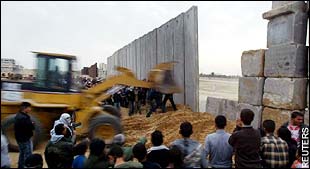
The gunmen then stole two bulldozers, Ha'aretz continues, and rammed through a massive wall near the border "as a show of force against the Palestinian Authority. After seizing a bulldozer to cheers from onlookers, gunmen smashed through concrete blocks lining the border near the Palestinian refugee camp of Yibna, witnesses said. The gunmen fired into the air in celebration." Then things really got out of hand, as the Associated Press recounts:
Hundreds of angry Palestinians streamed into Egypt on Wednesday after militants with stolen bulldozers broke through a border wall, and two Egyptian troops were killed and 30 were wounded by gunfire in the rampage. About 3,000 Egyptian Interior Ministry troops who initially had no orders to fire swarmed the border but were forced to withdraw about a half-mile, said security forces Lt. Sameh el-Antablyan, who announced the casualties. Gen. Essam el-Sheikh said Egyptian forces later began firing back. The scene was one of utter chaos. An Egyptian armored vehicle was burning and hundreds of Palestinians could be seen crouched in farm fields just inside Egypt.
(3) The Palestinian Centre for Human Rights tells about a family feud started by school children that escalated to hand grenades and led to two dead, several injured.
on Monday morning, 2 January 2006, a quarrel broke out between school children from the al-Masri and Taha families at a school in Khan Yunis. The quarrel developed into an exchange of fire between the two sides after school had finished and members of the two families became involved in the quarrel. Three children from the al-Masri family were injured by live bullets.
On Tuesday morning, 3 January 2006, armed clashes between the two families were renewed. As a result, Suleiman Mohammed al-Masri, 24, was killed by a live bullet to the neck, and a member of the Abu Taha family was injured in the back. At approximately 20:00 on the same day, clashes broke out between the two families again. The families used hand grenades and firearms in these clashes. The clashes which continued until the following morning left Jihad Ibrahim al-Masri, aged 18, dead. He was hit by a live bullet to the chest.
On Wednesday morning, 4 January 2006, clashes broke out between the two families in the Jourat al-Lout area, where the families live. Two children were injured by live bullets. Tension has spread and the Palestinian police have not yet intervened to end the clashes.
The Christian Science Monitor sums up the situation in Gaza thus:
As the first year devoid of an Israeli presence since 1967 dawns in the Gaza Strip, armed militias roam the streets freely, foreigners are kidnapped with regularity, and the measure of a man in this coastal territory is not his political title, or even the size of his house, but the number of AK-47-wielding bodyguards he employs. When Israel left Gaza four months ago, full control over the 1.3 million people was ostensibly transferred to the Palestinian Authority (PA). But its authority in this coastal territory has deteriorated to such a state of anarchy, that the best-armed gangs or families are effectively the law now.
Jan. 5, 2006 update: Writing in the Daily Telegraph, Harry de Quetteville deems that the border incident described immediately above "marked the total collapse of law and order in Gaza." As though intending to confirm this assessment, the Palestinian Authority released Alaa al-Hams, the member of Al-Aqsa Martyrs' Brigades whose imprisonment prompted the riots and border wall breach. was released as a result of the agreement reached between Fatah and the [Palestinian] Authority yesterday. This will calm all types of protests from our side," al-Hams told The Associated Press by telephone.
Jan. 8, 2006 update: Steven Erlanger of the New York Times reads the situation this way: "There is spreading chaos, a sense of deterioration and growing concern among both Palestinians and Israelis that the Palestinian Authority, nearly bankrupt and facing a huge budget deficit, may look like a failed state even before it becomes one."
Jan. 26, 2006 update: I am closing this entry here, for with the electoral triumph of Hamas I expect a new order in the Palestinian Authority, a far less anarchic one, where the "one gun" that Arafat boasted of really does take charge. And if I am wrong, well there is always the prospect of a new blog, "Palestinian Anarchy Continues under Hamas."
Aug. 24, 2006 update: Well, I called that one wrong, so go to "Palestinian Anarchy Continues under Hamas" for the continuation of this saga.


