
Today's news includes this item:
Sami Ibrahim Isa Abdel Hadi, 39, was stopped for tailgating on Route 46 in Ridgefield Park, New Jersey. When a Bergen County police officer called in Abdel Hadi's North Carolina license plates, he learned that Abdel Hadi had been ordered deported to Brazil in December 2001 and is listed in the FBI's National Crime Information Center database. Even more interestingly, Abdel Hadi has a valid temporary I.D. from L & L Painting to paint the George Washington Bridge (a high-profile potential terrorist target).
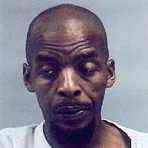 Michael Wagner |
|
Abdel Hadi is hardly the first actual or potential terrorist stopped due to a routine traffic infringement.
In July 2004, Michael Wagner's not wearing a seat belt got him stopped in a SUV near Council Bluffs, Iowa, that had in it "flight training manuals and a simulator, documents in Arabic, bulletproof vests and night-vision goggles, a night-vision scope for a rifle, a telescope, a 9mm semiautomatic pistol and hundreds of rounds of ammunition."
Timothy McVeigh was stopped in April 1995 as he sped away from Oklahoma City bombing that killed 168 people and injured more than 500 because his car lacked a license plate.
A New Jersey state trooper noticed Yu Kikumura's odd behavior at a New Jersey Turnpike rest stop in April 1988 and thoroughly searched his vehicle, finding three powerful homemade bombs. Kikumura, a member of the Japanese Red Army, was sentenced to thirty years in jail followed by deportation to Japan.
Three members of the Syrian Social Nationalist Party (Walid Nicolas Kabbani, Georges Fouad Nicolas Younan, and Walid Majib Mourad) were stopped by Richford, Vermont's only policeman in October 1987, because he was suspicious of their movements. Indeed, they were smuggling a bomb from Canada to the United States.
Comments: (1) It is remarkable how many criminals, terrorist and otherwise, make elementary traffic mistakes. (2) There is no substitute for law enforcement on the ground. (3) If good luck brings in so many terrorist-related individuals, one has to wonder how many of them don't tailgate and do wear seatbelts. (4) I shall record other examples here as I become aware of them. (May 4, 2005)
Semi Osman was driving to Bly, Oregon, on Sep. 30, 1999, when the Oregon State Police stopped him because his car lights were not working, then cited him three more times for other infractions. One of these stops caught the attention of the FBI, which had lost track of Osman. He was subsequently arrested in 2002, accused of "material support for terrorists," plea-bargained, pleaded guilty to a weapons violation, and served his jail sentence. (October 4, 2005)
"On a damp, gray day in March 2004, the Dutch traffic police stopped a Belgian driver for a broken headlight and accidentally stumbled onto a major investigation of Islamic radicals," write Elaine Sciolino and Hélène Fouquet in the New York Times, telling the story of Khalid Bouloudo, whose name "turned up on an Interpol watchlist, for an international arrest warrant from Morocco charging him with links to a Moroccan-based terrorist organization and involvement in suicide bombings in Casablanca in 2003. The random arrest set into motion a cascade of events that underscores the extent of the radicalization of young Muslims throughout Europe - and a rapidly expanding and home-grown terrorist threat." (October 9, 2005)
Nov. 12, 2005 update: Apparently, not everyone shares my appreciation for the benefits of routine traffic stops. The Staten Island Advance reports on a meeting between the borough's Muslim community and its police commander, Albert Girimonte, in which the former complained that in four incidents during the past 11 months,
cops investigating minor auto accidents or traffic infractions allegedly asked mosque members inappropriate questions about their citizenship status. "The typical question has been: 'Where are you from, where were you born?' ... Two questions that are totally irrelevant at an accident scene."
In one of the incidents near the Staten Island Mall at Christmastime last year, a female Pakistani wearing a Muslim shawl repeatedly was asked where she came from, he said. "This is an educated woman," [the Muslim leader] said. "When a policeman first asked her where she was from, she told him Staten Island. Then he asked her where she was born. She told him Pakistan." There were other incidents in the spring, he said, including the case of a girl caught crossing against a traffic light in New Springville being questioned.
For his part, Girimonte agreed that the interrogation was improper: "Asking a person at an accident scene where they're from is not necessary. Once your proper ID is confirmed, all you want to find out is what happened." He acknowledged being "surprised" by the incidents and promised that traffic stops would not lead to questions about citizenship status. "This is basically a training issue. And we'll address it. The police should not be concerned with the citizenship status of motorists. That's not our bailiwick."
Tragic proof that Albert Girimonte is wrong and I am right came yesterday, when Naveed Afzal Haq was driving to the Jewish Federation of Greater Seattle building, where he proceeded to murder one person and severely injure five others. According to Seattle Police Chief Gil Kerlikowske, as paraphrased by the Associated Press, Haq had been "stopped shortly before the shootings in Seattle for a minor traffic infraction, and was cited and released. ... Haq had a valid driver's license and his actions did not raise any suspicion." That traffic violation was driving down a buses-only lane. Comment: How many more murders will it take for the police to wake up to the danger of Sudden Jihad Syndrome? (July 30, 2006) Apr. 16, 2008 update: Police Officer Glen Cook gave testimony in Haq's trial, providing more details: Haq drove his white Mazda pickup north on Third Avenue at 3:37 p.m., a bus lane at that time of day, Cook pulled him over, took down Haq's license and proof of insurance, ticketed him, and let him go.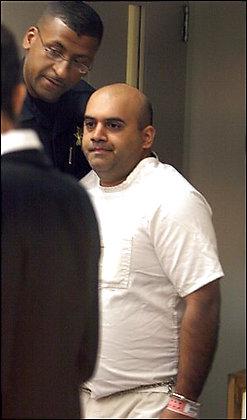
Naveed Haq under arrest.
July 1, 2007 update: The July/August issue of the magazine Crime & Justice International features an article on pp. 4-12 by Dean C. Alexander and Terry Mors, "Best Practices in Identifying Terrorists During Traffic Stops and On Calls for Service." It discusses "how patrol officers can assist in identifying and capturing domestic and international terrorists while undertaking traditional duties, with particular emphasis on traffic stops and calls for service." The author's advice is summed up in a few words: "Police should go on the offensive and aggressively look for signs of terrorist activity or involvement."
The newspaper account does not tell why New Castle County, Delaware, police Officer Thomas Bruhn stopped the car of Amir Al-Kaabah, 21, and a female passenger shortly before 3 p.m. on Court Street near Brandywine Avenue in Claymont, but he stumbled on a minor treasury of criminality: 10 grams of marijuana, a large buck knife, fictitious registration tags, no title to the car, and an identity theft ring. The last became clear when he found expensive jewelry, clothing and shoes, all in their original wrapping in the trunk, all purchased with credit cards belonging to recent customers at the Comfort Inn in Birmingham Township, where the female passenger happened to work. Further inquiry found that Al-Kaabah is a fugitive from Georgia for violating his probation for a conviction of armed robbery, kidnapping and weapons violations. Al-Kaabah was charged with carrying a concealed deadly weapon, possession of a deadly weapon by a person prohibited, possession of marijuana, and driving while suspended. The woman was turned over to Pennsylvania authorities to face criminal charges. (December 18, 2007)
Four men (Pratheepan Thambu, 22, Lojanand Srianandan, 27, both of Toronto, Sethukavalar Saravanabavan, 35, and Kirubakaran Selvanayagam Pillai, 38, both of London, U.K.) were riding in a rented van in Scarborough, Ont., on Jan. 28, when Constables Scott Aikman and Patrick Pelo watched them run a stop sign and pulled the van over. On looking inside, the officers noticed one of the four desperately hiding something. They also observed that the driver had been drinking, plus the presence of open liquor in the vehicle, giving them the right to search the vehicle, which they did. They found a number of plastic gift cards worth an estimated $250,000, with debit card information on the magnetic strip which police believe was stolen from UK bank customers.
Police later searched a hotel and a home and found another 88 cards, all with debit card data from British banks on their magnetic strips, as well as $25,000 in Canadian $20 bills, laptop computers and memory sticks, receipts for money transfers to the U.K., travel documents and passports and what detectives described as "Tamil Tiger paraphernalia."
The routine traffic stop quickly exposed an international debit card fraud ring, led to 373 criminal charges, and possibly broke up a Tamil Tiger terrorist fundraising and money laundering operation. Running a light is "not too smart a thing to do when you're driving a van full of stolen bank cards," Detective. Peter Trimble sagely observed. "And they had been drinking and had open liquor in the car, which also isn't very smart." (January 31, 2008)
Police in Matthews, N.C. stopped Sasan Ghazal, 21, of Bristol Ford Place in Charlotte, on suspicion of drunken driving on Feb. 9, and found an explosive device his vehicle. Under state law, Ghazal was charged with possession of a weapon of mass destruction, as well as possession of marijuana and drug paraphernalia. A U.S. Attorney will decide if federal charges are warranted. Ghazal is now in the Mecklenburg County Jail on a $101,500 bond. In 2006, he pleaded guilty of carrying a concealed gun and felony possession of drugs. (February 14, 2008)
According to CBS News, the sequence of events that ended in the arrest of Najibullah Zazi on terrorism charges began with his being stopped for an unspecified "routine traffic violation" on his way into New York: "While entering the city, he was stopped by police for a routine traffic violation on the George Washington Bridge, which connects New Jersey and New York. Suspicious police allowed him to go free but kept a close watch on his movements." The same account, however, goes on to state that "Zazi told authorities he disposed of the explosives once arriving in New York," raising the possibility that the traffic stop may have backfired by alerting Zazi to the fact that he was already being watched by the FBI before this trip to New York. The full story is not clear here. (February 22, 2010)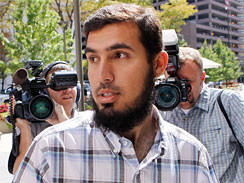
Najibullah Zazi.
Swiss police report that a routine traffic-stop (for unspecified reasons) on April 15 at Langnau thwarted three eco-terrorists of Il Silvestre from blowing up the site of the £55 million nano-technology headquarters of IBM in Europe at Rueschlikon, near Zurich. The police stopped the two men and a woman a few miles from the target with an explosive device primed and ready to go off. (April 26, 2010)
Pre-Olympic U.K. terror arrests: Police stopped a car on June 30 on a highway in Yorkshire, impounded it, suspecting it was uninsured. They discovered two firearms, ammunition, and other materiel, leading to the arrest of the driver, the passenger and five other male suspects between 22 and 43. (July 6, 2012)
Jared Loughner killed six people and wounded 13 others, including Rep. Gabrielle Giffords, in Tucson, Arizona, on Jan. 8, 2011; it turns out, according to information buried in thousands of pages of just-released documents, that hours before his shooting rampage, he was stopped on a routine traffic matter. Arizona Game and Fish Officer Alen Forney saw Loughner driving in northern Tucson about 7:30 a.m. that day and stopped him for driving erratically and running a red light. Michael Mello recounts what happened for the Los Angeles Times:
When the officer approached the car, Loughner's hand was already thrust through the window, holding his license and registration. Forney said Loughner took off the black bandanna he was wearing. The officer saw that Loughner had a shaved head, something he thought was peculiar. He asked Loughner whether he knew why he had been stopped. He replied, yes, he did.
During the traffic stop, another Game and Fish officer drove by, asking whether Forney needed any help. "I gave her the thumbs up at that point," Forney told investigators. "I had no reason to believe anything suspicious was going on."
Forney said he didn't notice anything unusual inside the car, but had checked to make sure "the trunk was secure" on Loughner's '69 Chevrolet Nova. "I made the decision not to write a citation. Game and Fish doesn't write a lot of traffic citations ... I was also in kind of a hurry" to join [a meeting with] other officers for their patrol at Florence Junction, east of the Phoenix metro area.
"I told him, 'I'm not going to write you a citation for this.' When I said that to him, his face got kind of screwed up and he started to cry.... That struck me as a little odd," Forney told investigators. "I asked him if he was OK. He said, 'Yeah, I'm OK. I've had a rough time and I really thought I was going to get a ticket and I'm really glad that you're not ... going to give me a ticket."
Forney again asked Loughner whether he was OK, worried he would be driving with his emotions out of control, possibly leading to an accident. Loughner then immediately composed himself, he said. "He actually looked up at me and said, 'Can I thank you?' I said, 'Yeah, you can thank me.' He asked what my name was, and he stuck out his right hand."

(March 28, 2013)
- An improperly filled out a car insurance form led to the discovery of an arsenal of sawn-off shotguns, machetes, knives, samurai swords, elements for pipe bombs, and a nail bomb in a car in Dewsbury, UK. (April 30, 2013)
- A report from Paris in the Wall Street Journal concerns a cathedral built between A.D. 1163 and 1345: "French authorities have opened a terror investigation after a car loaded with cooking gas canisters was found near Notre Dame Cathedral on Sunday morning, [Sep. 4,] a spokeswoman for the Paris prosecutor said. The vehicle's two owners, one of whom is on a national-security watchlist, were detained for questioning on Tuesday on the highway near Orange, a French city hundreds of miles south of Paris, the spokeswoman said. ... Police discovered the car with its hazard lights blinking and no license plate, according to a police officer familiar with the matter. One gas canister was found on the front seat of the car while six others were recovered from its trunk, the officer said, adding that no detonator was found." (September 7, 2016)
- Ali Kourani, 35 and an immigrant from Lebanon, ended up with a 40-year sentence for his connections to Hezbollah after a New York City policeman stopped him for running a stop sign in Queens. (December 4, 2019)
June 17, 2020 update: Patrick Dunleavy adds some additional cases to this list at "Abolishing the Police – A Terrorist's Dream Come True."
- A group called Rise of the Moors was apprehended when "Massachusetts police in the town of Wakefield saw two cars parked on the shoulder of Interstate 95. Men, heavily armed and wearing military-style tactical clothing, were refueling their vehicles. When police asked to see registration for the weapons, The Washington Post reported, the men indicated that they were not carrying gun licenses, and that their group did not recognize state laws. What followed was a standoff lasting almost nine hours, with surrounding neighborhoods being ordered to shelter in place as many of the armed men moved into nearby woods." (July 4, 2021)


