
[This weblog entry complements two others by the author: (1) "Hating Valentine's Day" reviews Muslim attitudes toward the day of romance up to 2004; (2) "Valentine's Day in Mecca" focuses on that special day in Saudi Arabia. The information below covers the topic of Valentine's Day updates outside of Saudi Arabia.]
Bangladesh: Outrage over Valentine's Day led to 12 people injured at Dhaka University. (February 14, 2005)
Egypt: How does "The Prophet Mohammed's Day" sound to you? Al-Watan newspaper reports that some Islamists in Egypt have suggested that Valentine's Day should be thus renamed, in a defensive measure as Valentine's gains in popularity. They would divest Valentine's of its eroticism and consumerism, turning turn it instead into a broader love of humankind. It might include such activities as collecting toys for orphans. In this spirit, Al-Masri al-Yawm newspaper published a special issue called "Beautiful Egypt" that told of altruism and kindheartedness by Egyptians. That said, red Valentine's Day roses and "I love You" teddy-bears filled the stores Egyptian today. Also, the traditional women's accessories in turquoise, black, green and pastel shades were supplanted temporarily by shades of red. (February 14, 2007)
Pakistan: Javeed Akhter, a Chicago-based physician, tells his surprise on going to Lahore, Pakistan on the evening of Valentine's Day, 2006.
The night was alive. Street vendors were selling heart-shaped balloons and roses in singles and dozens. Many of the shops were having Valentine's Day sales. Restaurants were announcing Valentine's Day parties. The Gymkhana Club, where my family was staying, had a Valentine's Day dinner where "enthusiastic couples" could win "fabulous prizes." The extent and level of the Valentine's Day celebration I witnessed that evening knocked my socks off! The celebrations were so huge they were like the Islamic holiday Eid.
He finds it remarkable "how fast Valentine's Day has gained popularity and how large it has grown." (February 18, 2007)
Jordan: Reformist intellectual Shaker Al-Nabulsi, puts in a rare good word for Valentine's in an article entitled "Happy Valentine's Day." Of particular interest is his recalling the Arabs' prowess at romance:
We are a nation whose men and women have loved as no other nation in history has loved. We are the nation that gave birth to the world's greatest love poets, to the extent that 70% of Arabic poetry consists of love poems. And in spite of this, our nation is forbidden to love, Valentine's Day is [considered] impure, love roses are cursed, and kisses of love are despised. The hostility towards love in the Arab world has grown so intense that it is forbidden to import red roses for this holiday, and [it is forbidden] to wear a red dress or kafiyeh, or to drive a red car on this day. The color red is despised on [Valentine's Day], even more than it was despised as the symbol of communism and the Soviet Union.
(March 1, 2007)
Kuwait: Supermarkets may sell Valentine's Day paraphernalia but the head of the National Assembly's Committee Monitoring Negative Alien Practices, an Islamist politician named Waleed Al-Tabtabae, seeks to censor all public displays concerning Valentine's Day. "We want to discuss measures that should be taken by these ministries to prevent such alien events from impacting Kuwaiti society and spreading corruption among the Kuwaiti youth." Another committee member, Jamaan Al-Harbash, contends that the holiday "spreads moral corruption." (February 11, 2008)
Gaza: Valentine's Day is forbidden but allowed in Gaza, according to Karin Laub:
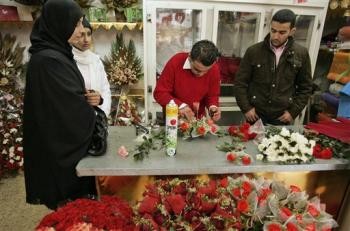
The odds are stacked against Valentine's Day in Hamas-ruled Gaza: The holiday is considered "haram," or forbidden by Islam, most residents don't have money for frills and the requisite red roses are grown only beyond a closed border with Israel. Yet even Gazans managed to mark "Eid el Hob," or the Feast of Love, with a few splashes of red Thursday. Flower shops in Gaza City's better neighborhoods, displaying rows of flower-filled buckets and heart-shaped decorations, sold homegrown carnations to women in Islamic head scarves and dutiful husbands.
Mohammed Abdo, center, arranges flowers for Valentine's Day at a shop in Gaza City on Feb. 14, 2008.
Hamas police looked the other way despite the religious taboo, reflecting the Islamic militants' policy of not going against popular consensus when it comes to social norms. ... Valentine's Day was introduced to Gaza about a decade ago by Palestinian exiles returning from more cosmopolitan places such as Beirut and Tunis, following interim peace deals with Israel. The Internet and Arab satellite TV helped spread the idea, mostly among the young, educated and secular. Yet in Gaza, the holiday of love remains a relatively modest affair, in part because few Gazans can afford to spend on extras, such as candy and flowers.
At a flower shop in Gaza City's Rimal neighborhood, 24-year-old Mohammed al-Wakid bought a rainbow-colored bouquet of carnations for his wife for $1.30. That's a steal, even for Gaza, mainly because the territory is flooded with carnations that had been grown for export to Europe. ... Al-Wakid, a policeman who's stayed off the job since the Hamas takeover, said he began buying flowers for Valentine's Day four years ago, when he was engaged. Since then, his wife has come to expect the gesture, he said.
Across the street at the Rose Flower Shop, two young women, one dressed in a black Islamic robe and head scarf, bought a bouquet of roses, a rare sight in Gaza. The shop had managed to bring in 500 roses from Israel, using Gaza medical patients treated in the Jewish state as "mules," and had about 50 roses left. Salesman Mohammed Sussi, 30, said he hadn't received any complaints about his business. "They didn't tell us anything, whether from the government or anyone else, that it is haram," he said.
But at a third flower shop, a TV crew earned angry glares from salespeople, and shoppers adamantly refused to be interviewed on camera. Asked why the reluctance, one salesman said his customers didn't want to be filmed doing something haram.
(February 14, 2008)
United Kingdom: Anjem Choudary, a high-profile extreme Islamist, has penned an article, "Valentine's Day Of Fornication." that announces:
- Valentine's Day is "a futile and evil festival, used to justify sinful actions such as free-mixing, promiscuity, vain sexual talk and even fornication".
- Whoever celebrates it will rot in Hell.
- Exchanging cards, sending roses or enjoying romantic candlelit dinners are "sordid acts influenced by the Devil."
- It is a "Pagan festival" that "diverts" people away from "the submission and worship of Allah."
Instead, he suggests, "People should not succumb. Instead we should endeavour to attain the best form of love, which is exclusive love for Allah." (February 3, 2009)
Egypt: A religious leader named Hazem Shuman offered his views on Al-Rahma Television on February 6; MEMRI makes it available today in video form or transcript:
In a few days' time, Planet Earth will turn red. We will become the reddest planet in the universe. Everything red will become more expensive. Red teddy bears, red candles, red pens – they will all become more expensive. Only one red thing will become cheaper: The blood of Muslims. All this is the result of the sins committed by Muslim youth. In a few days time, a very dangerous virus will attack the body of the nation. ... I am talking about the Valentine virus, people. I have come tonight to warn all boys and girls about an extremely dangerous virus, which is about to attack the hearts of the nation's youth, and to destroy our relations with God. We must confront this Valentine virus! ...
The more you celebrate Valentine's Day, the more the Jews and Christians are happy, and the more the Prophet Muhammad is sad. The more you do this, the more the Jews and the Christians gloat at us, while tears flow from the Prophet's eyes. Do you want to make the Prophet sad and the Jews and Christians happy?! ... You can't tell the difference between a Fatima and a Mary [i.e., a Muslim and a Christian] anymore. Fatima wears the same clothes as Mary, listens to the same songs, she loves the same singers, and she watches the same TV channels. How long will we go on living this lie?"
(February 10, 2009)
Middle East: Walid Phares surveys changes underway at "Jihad against Love: Valentine's Day Enflames the Middle East," a reprint from 2005. Phares discerns a "revolution is rising."
The "love guerrillas" are spreading on the street and on the internet. In liberated Afghanistan, transistor radios air love songs. In Iran, boys and girls have waged the revolt of "kissing in public." Tracked by the militia, the teenagers perform the kiss-and-run tactic. In Kuwait, tactics are evolving. In this oil-rich state, young Arabs buy two cell phones, and as they see their beloved driving by, they throw one of the mobiles in her car; then the telephonic romance can begin.
In West Jerusalem, young Palestinians who want to stroll freely with their girlfriends, walk up the Yehuda street speaking Hebrew. In Egypt, soap operas compete with their Mexican counterparts. Love warfare has become the boldest threat that can roll back jihad. On the internet, Arab, Persian, Kurdish, Aramaic, and other love and music chat rooms attract ten times the al-Ansar-crowded rooms. There, you read and hear discussions of love; they seek not decadence, but the early stages of a romantic revolution.
Lebanon's TV has taken the freedom for love to sophisticated artistic expressions. With shows seen by millions, the LBCI has been shaking off the fundamentalist quarters of the region. On al Jazeera, clerics are horrified by the scenes. Their deepest nightmare is to see young Saudi men singing the beauty of human love, while their jihadist counterparts are assassinating young Iraqi women for not wearing the hijab.
(February 14, 2009)
Russia: A council of Muslim leaders in Russia's Nizhny Novgorod region wants "all believers and sensible people" to ban celebrations of Valentine's Day because the holiday "preaches universal permissiveness, amorality, and nihilism." Say no, it advises, "to celebrating this day, since it contradicts not only the norms of Islam, but also recognised human morality." (February 11, 2009)
Muslims and communists: In "Hating Valentine's," FrontPageMag.com's editor, Jamie Glazov, looks at the parallel hatred for the day of love among Muslims and communists, concluding that "Islam and the radical Left both revile the notion of private love, a non-tangible and divine entity that draws individuals to each other and, therefore, distracts them from submitting themselves to a secular deity." I basically agree but wish he would limit his comments to Islamists and Islamism. (February 12, 2010)
Iran: In the run up to Valentine's Day, the Iranian regime has banned the production of Valentine's Day gifts and any promotion of the day. Reuters reports:
The printing works owners' union issued an instruction on the ban, imposed by Iranian authorities, covering gifts such as cards, boxes with the symbols of hearts and red roses. "Honoring foreign celebrations is the spread of Western culture," said the union's head, Ali Nikou Sokhan, ILNA news agency reported. "Our country has an ancient civilization and various days to honor kindness, love and affection." ...
"Printing and producing any products related to Valentine's Day, including posters, brochures, advertising cards, boxes with the symbols of hearts, half-hearts, red roses and any activities promoting this day are banned," read the instruction. "Authorities will take legal action against those who ignore the ban."
In an amusing coda, some Iranians suggest replacing Valentine's Day with "Mehregan," an ancient Iranian festival celebrated, where mehr means "friendship," "affection," or "love." (January 18, 2011)
Bangladesh: Zahidul Islam Biswas looks at the "Dynamics of Valentine's Day Celebrations in Bangladesh" and finds that it "has gained huge popularity among the younger generation" while the government has left the holiday alone. (February 1, 2013)
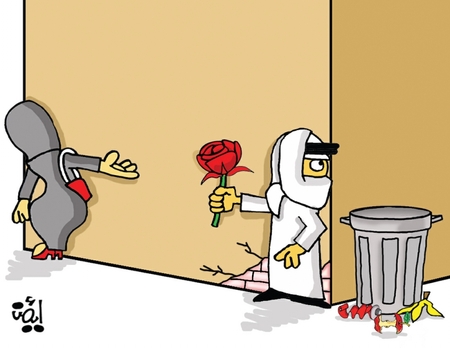
Saudi Arabia: Cartoonist Aymann al-Ghamdi offers a pictoral summary of Valentine's Day in Saudi Arabia. (February 17, 2013)
United States: TazzyStar started selling humorous Muslim Valentine's Day cards at her Etsy store today. It contains three choices of six cards, selling for $10 each for the six; here is the panel titled "This Burka is Built for Two":
 One of TazzyStar's three panels of Muslim-themed Valentine Day's cards. |
(January 15, 2014)
Turkey: Tulin Daloğlu notes in "The irony of Valentine's Day in Turkey" that
Valentine's Day has somehow entered the social fabric of Turkish society. Even Sadik Yakut, deputy parliament spokesman, opened the session today by celebrating the parliamentarians' Valentine's Day, and hoping for a day of affection for the day's agenda.
(February 14, 2014)
Gaza: As a Salafi imam railed and Salafis rallied against Valentine's Day, Gazans went about buying and giving red flowers and other romantic gifts, reports Asmaa al-Ghoul. The Salafis also encountered direct push-back.
A march by a group of Salafist sheikhs belonging to the Ibn Baaz Islamic Charitable Association had started on the evening of Feb. 13 in the Garden of the Unknown Solider. It was part of a campaign against Valentine's Day. Al-Monitor spoke to Abu Islam, a man wearing the typical Salafist dress that includes a short galabiyya over pants and a white skull cap. He said, "I think that young people celebrate this holiday because of unemployment, or a lack of religious restraint, or someone advising them. Youth should stop imitating the West and focus on the most important things in life. ... Muslims only have two holidays, Eid al-Adha and Eid al-Fitr."
Every now and then, the voices of the youth in the crowd surpassed those of Abu Islam, as the microphones the Salafists had brought with them were not working. Some of the young people agreed with them, while others were cynical. Mohammed Qadih, 22, said, "If we aren't working, we haven't gotten married, our future is lost and everything in the country is pushing us [to smoke], how can we not smoke? If love is haram, then they should make the costs of the wedding and the dowries cheap so that we can marry." ...
Mohammed, who works at the Safir al-Hub flower shop, told Al-Monitor that a group of Salafists visited the shop on the first day of the campaign. He said, "They entered the shop and said that Valentine's Day is haram, and that we must remove the decorations. While this was a form of advice, they also said they would come back to confirm that we had removed it. But of course we didn't remove it."
The report ends by noting that the Salafi
call for boycotting the holiday did not prevent Ramadan, 23, and his veiled fiancee Haniyah, 18, from sitting together at the Log In Cafe, with its exterior decorated in red, located across from the Garden of the Unknown Soldier. They came to celebrate love and joy together, and they described for Al-Monitor the red gifts they gave each other.
(February 14, 2014)
Iraq: In 2011, Valentine's Day began its transmutation in Iraq from a day of romance and sex to one of hope and national pride, reports Ali Mamouri.
On Feb. 14, 2011, in Liberation Square in Baghdad, a campaign titled "Love Iraq" started. It was attended by hundreds of young people carrying red hearts and dressed in black to express their grief for the homeland and the will to change. The demonstration has taken place every year since. ... the campaign's goal has two parts. First, to spread a culture of love in the face of violence, terrorism and sectarianism, in a peaceful and civilized way and by means of change, which depend on a culture of peaceful protest. And second, to try to involve the civil current, intellectuals and democracy advocates in the process to reform the system. ... Various youth groups looked for orphaned children and poor persons in Baghdad and other cities, grouped them into categories and took them to shopping malls to buy them what they needed, then took them to public parks to spend an entire day playing in an atmosphere of love.
This year, the activities spread to other cities; in Hilla, for example, young people distributed red roses to symbolize love for Iraq and their rejection of hate, violence, and sectarianism. (February 28, 2014)
Malaysia: "Islamic religious leaders and officials have warned Muslims against celebrating Valentine's Day, linking it with vice activities and unsuitable for Muslims." (February 12, 2015)
Central Asia: "Several universities [in Uzbekistan] have asked students to sign contracts affirming they will not celebrate the holiday on February 14. Islamic clerics in Tashkent told RFE/RL that sermons against Valentine's Day will be included in Friday Prayers. ... In the southern Kyrgyz city of Osh, meanwhile, education officials imposed a Valentine's ban on all schools to avert the holiday's "negative influence on the mental health of children." (February 13, 2015)
Egypt: Valentine's Day is quite the occasion in Cairo, Mada Masr explains:
A weekend where the capital turns red, helium balloons fly and teenage girls walk around with giant-sized teddy bears, Valentine's Day in Cairo can be exhausting for singles and couples alike. Restaurants are usually over-booked and over-priced, it's crowded and Facebook is full of love proclamations that make most people cringe.
Luckily, she goes on, "some venues and artists in Cairo are staging somewhat anti-Valentine's nights — in a club, an artist-run space, a theater and online." In other words, Valentine's is so established, it has its own antibodies, such as the Vent Lonely Hearts Club where, "Unlike the usually rather strict couples-only policy Vent has on weekends and during events, on Valentine's Day singles will be allowed and tickets waived." (February 13, 2015)
Pakistan: Following orders from Minister for Interior Chaudhry Nisar Ali Khan, the district administration of Islamabad, banned all celebrations for Valentine's Day. "Strict action" will be taken against those violating the order. (February 11, 2016)

United Arab Emirates: Not only are Valentine celebrations just fine for ex-pats in Abu Dhabi but also for Arabic-speakers, as evidenced by these ads for "the holiday of love" in a local give-away magazine Abu Dhabi Week in Arabic. The top one announces a week of Valentine festivities at a large mall, the bottom one dinner at the most expensive (and state-owned) hotel in the city, the Emirates Palace. (February 14, 2016)
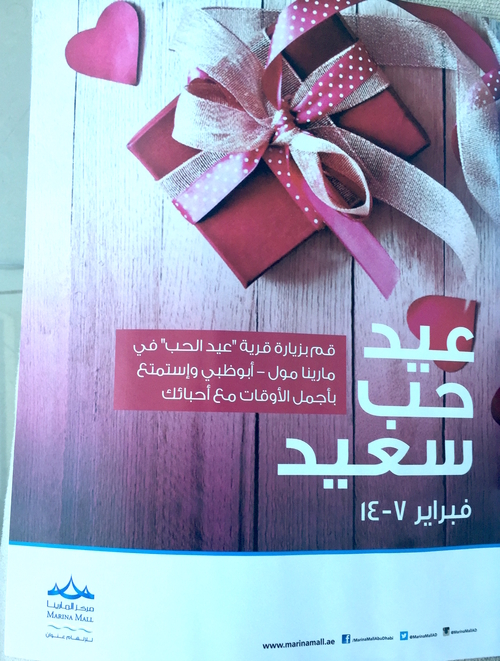 Marina Mall festivities go from Feb. 7 to 14, 2016. |
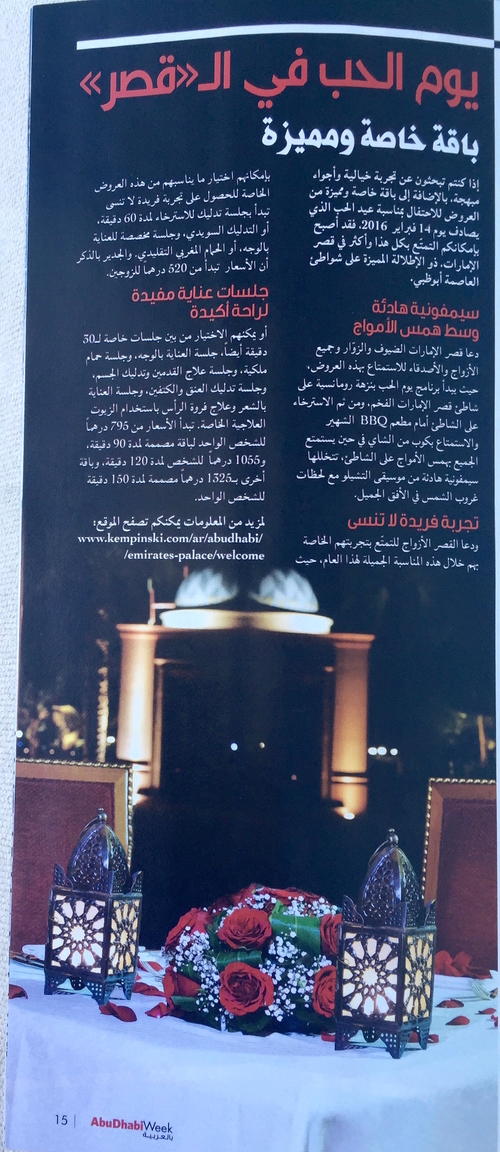 Abu Dhabi's #1 hotel announces its Valentine dinner. |
Pakistan: Tufail Ahmad reports on President Mamnoon Hussain's vehemently argument against Valentine's Day:
"Valentine's Day is part of the Western culture. There is no room for it to be celebrated in Islam and Pakistani culture." Mamnoon Hussain, who holds the ceremonial post of the president and is not seen as outspoken on various issues, noted that the Valentine's Day is "not a part of Muslim tradition" and that "we must maintain our religious and national identity." ...
Nor was he alone:
In the run-up to Valentine's Day, the administration in the Kohat district of Khyber Pakhtunkhwa province "banned the sale of greeting cards and all goods associated with the day." Maulana Niaz Muhammad, an elected district official, said: "Valentine's Day has no legal basis and is against shari'a." However, the district government's order to ban the February 14 holiday was dismissed by the police officials, because it was perceived as a violation of human rights.
Similar directives against Valentine's Day were issued by the local administration in Peshawar, and in Punjab province, in order to ensure that terrorists did not take advantage of the festivities to carry out terror attacks. Osama Naseer, a Lahore-based leader of Islami Jamiat Tulaba, the student wing of Jamaat-e-Islami Pakistan, said: "Valentine's Day is not a tenet of Muslims."
The president's statement stirred a debate regarding Valentine's Day. (February 28, 2016)
Egypt: 'Ala Al-Sa'dani, a columnist in Al-Ahram newspaper calls for the celebration of Valentine's Day. (February 16, 2017)
Saudi Arabia: The columnist Ralph Peters calls the "Love revolution: the real force for Mideast change." He explains:
Something momentous happened in the Middle East last week and it didn't involve war or fanaticism: Saudi Arabia let its citizens celebrate Valentine's Day. ... This is the first truly telling sign that — against all odds — positive change may be possible in the Kingdom. ... it's a simple display of affection — of loving respect between two human beings — that could shift history. ... this slight liberalization of human interactions in the most repressive society on Earth is a glimmer of hope.
(February 18, 2018)
Pakistan: Gearing up for Valentine's Day in a month, someone at the University of Agriculture in Faisalabad came up with the bright idea of replacing it with "Sister's Day," celebrated by handing out headscarves, shawls, and gowns to the female students. The goal, intoned UAF vice chancellor Zafar Iqbal, is to promote "eastern culture and Islamic traditions among the youth," noting that, "In our culture, women are more empowered and earn their due respect as sisters, mothers, daughters, and wives."
As for Islami Jamiat-e-Taleba, Pakistan largest Islamist student group, it has rebranded Valentine's Day "Modesty Day," though with modest success. (January 14, 2019)
Iran: In an article on the 40th anniversary of the Islamic Republic, Thomas Erdbrink gives examples of how Iran has moved away from Islamic strictures, one of which concerns Valentine's Day:
Now, with Valentine's Day approaching, young men are anxiously deliberating what to get their girlfriends. They can be seen running around with heart-shaped balloons or gigantic teddy bears, falling on their knees for their girlfriends in public spaces, and then posting the whole spectacle on social media, for all to see.
(February 11, 2019)
Kill Valentine's Day: That is the title of a column by Ibtisam Aal Sa'd in a Qatari newspaper on the occasion of the holiday. (February 14, 2019)
Arabic-speaking countries: There's a new, more tolerant spirit reports Samar Kadi from Beirut:
Valentine's Day, the Feast of Love marked by the exchange of heart-shaped balloons, red roses and teddy bears between couples, has gained acceptability in the mainly Muslim Arab world, with many people openly celebrating the centuries-old tradition.
Residents of conservative Muslim countries such as Saudi Arabia, where public manifestations of the February 14 holiday were previously considered taboo, can purchase red roses, which used to be confiscated from flower shops by the religious police.
This year's more open celebration of Valentine's Day was boosted by high-profile religious figures issuing statements of tolerance, a sign the Arab world is moving against the flow of Islamist pronouncements.
(February 18, 2019)
Iraq: Valentine's Day has transcended its roots in Iraq, becoming a deeper event, notes Gilgamesh Nabeel in Al-Monitor.
With red teddy bears, heart-shaped balloons, roses and Iraqi flags, Baghdad's streets embraced Valentine's Day in a festive atmosphere despite the four-month-long unrest and civil protests.
Early in the morning, hundreds of Iraqis of all ages flocked to Tahrir Square, Baghdad's iconic protest hub, to celebrate the Love Revolution Festival that was announced days ago on social media. The festival aimed to emphasize "unity among people" despite the death toll of over 600 ever since Iraqis took to the streets Oct. 1 to demand governmental change.
The festival included a large bazaar to sell paintings, artwork and handcrafts. It also hosted a common lunch where people sat down and lunched along a 1.5-kilometer-long path right in the middle of graffiti and murals in al-Saadoun tunnel and al-Khullani Square.
"This event symbolizes our patriotism, love for peace and desire to live in dignity," Caesar al-Wardi, a 28-year-old protester and photographer from Baghdad, told Al-Monitor.
Others think love itself is resistance and revolution. "This is a revolution of love, awareness and peace. It aims to eliminate poverty, wars and sectarianism," Ali al-Mikdam, a journalist and one of the protesters from Baghdad, told Al-Monitor. "Today is a day of beauty. This [Tahrir Square] might be the biggest place to celebrate our love for Iraq. We are all united, both men and women, to enjoy many artistic activities under the Freedom Monument," he said.
This remarkable celebration came despite the negative views of the powerful Islamic leader Muqtada al-Sadr:
"Before, there were voices calling for militancy, killing, slitting throats and booby-trapping in the name of religion," said Sadr in a tweet Feb. 13, "Today, we hear calls for liberation, nudity, promiscuity, drunkenness and immorality." Sadr continued his condemnation of the voices calling for infidelity and infringement of the divine as well as against religious principles, prophets and infallible imams.
Referring to the slogan "Baghdad will never be another Kandahar" used by secular activists in Baghdad in 2010, Sadr said these groups want to turn Baghdad into Chicago.
"All that we asked for is a homeland. We took to the streets to restore our homeland that has been stolen by politicians and militias," said Mikdam. "Even if these protests end, the love revolution has succeeded. Apart from the political gains we achieved legislating the individual electoral system and the prime minister's resignation, we have achieved much more. We have renovated the spirit of patriotism, the ability to rebel against the unjust. We are afraid of nobody now, for our only master is our homeland — not tweets," he added.
Sadr's followers ended up getting chased out of Tahrir Square. (February 14, 2020)
Qatar: Two articles in the Sharq newspaper attack Valentine's as Qatar appears increasingly isolated in its anti-Valentine stance. (February 16, 2021)
Arab world: Maghreb Observateur rightly notes that "Valentine's Day is Growing in Popularity in the Arab World." (February 13, 2022)
Pakistan: MEMRI reports that "Columns In Pakistan's Urdu Daily Reject Valentine's Day: 'There Is No Possibility For Valentine's Day In Our Civilized Country; It Is A Festival Of Uncivilized Nations'." (March 6, 2024)


