
[This weblog entry follows the Valentine's Day saga in the Kingdom of Saudi Arabia; for a weblog entry on all other countries, see "Valentine's Day in the Muslim World."]
"Hating Valentine's Day" was the title of my article documenting the heavy-handed efforts of Muslim authorities to repress the holiday of love (as it is known in Arabic, 'Id al-Hubb). But the really spectacular example came to light after my article appeared.
"200 Arrested in Mina for Celebrating Valentine's Day" is the title of an article in today's Arab News, a Saudi newspaper. And, boy, does it have a tale to tell.
 A box of Valentine's Day chocolates. |
The dreaded religious police arrested the lot of them, including 16 it accused of being drunk. Some 100 participants were later released for lack of evidence.
Implied but left unsaid by the Arab News article are two peculiar facts about the celebrants at this post-Valentine's Day party: that all of them were men (only in Saudi Arabia could one imagine such a sad version of a Valentine's Day celebration) and all of them Muslim (Mina is part of the sacred territory prohibited to non-Muslims). In all, this offers a perfect symbol of Islamist repression. (February 18, 2004)
Stores with heart signs are a rare sight in Riyadh because Saudi Arabia has banned Valentine's Day.
Feb. 13, 2005 update: A year later, Donna Abu-Nasr reports from Riyadh that "In gift and flower shops across Saudi Arabia, the flush of red has started to fade." That's because, "Each year shortly before Feb. 14, the country's religious police mobilize, heading out to hunt for - and confiscate - red roses, red teddy bears and any signs of a heart." Sheikh Abdullah al-Dakhil, head of the Muttawa religious police in Thumama, a town outside Riyadh, told Al-Iqtisadiya newspaper that "despite awareness campaigns and the confiscation of flowers, chocolate and other items, there were 15 infractions" for Valentine's Day indiscretions in 2004. He also explained how girls lining up for their daily morning prayer at school on Feb. 14 were closely inspected by teachers on the look-out for anyone wearing or carrying red items that day: "Ribbons, boots, jackets, bags and pen holders with a hint, stripe or pattern in red, burgundy and hot pink were thrown into a heap, and the school called the girls' mothers to pick up the offensive items."

As a result of these prohibitions, Valentine's items go underground, to the black market, "where their price triples and quadruples," Abu-Nasr finds. But they do exist.
Shoppers who know where to look can find plenty of Valentine gifts: hearts that make kissing sounds and say "I love you" when squeezed, white teddy bears sitting on a red heart, lips touching, elaborate gift arrangements with "beating" hearts fitted with blinking lights and baskets of plastic red fruits. Lingerie stores have rows of red, lacy lingerie, with one shop displaying a sheer negligee and the picture of a heart next to it.
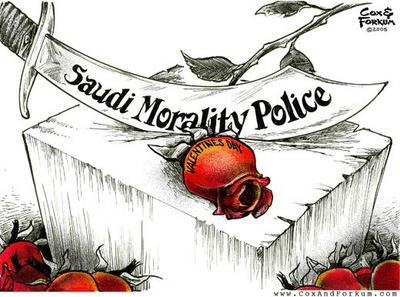 Fox & Corkum on the Saudi response to Valentine's Day. |
But a reporter found some stores willing to take the risk of stocking up the banned commodities. In which case, shopkeepers hide their roses and place heart-shaped cards under stacks of "To my grandmother" and "Happy retirement!" greeting cards.
Also today, I began a new weblog entry to complement this one: "Valentine's Day in the Muslim World." It deals with everywhere but Saudi Arabia.
Feb. 14, 2007 update: For an undated Islamist attack on Muslims paying attention to Valentine's Day, see Mission Islam's "Celebrating Valentine's Day." Key sentence:
In recent years, a new phenomenon has spread among the Muslim youth – males and females alike – which does not bode well. This is manifested in their imitation of the Christians in their celebration of the Valentine's Day, which has led the scholars and daa'iyahs to explain the rulings of sharee'ah [Shari'a] concerning that, out of sincerity towards Allah, His Messenger, the leaders of the Muslims and their common folk, so that Muslims may have a clear understanding of this issue and so that they will not fall into that which will undermine the belief ('aqeedah) with which Allah has blessed them.
Other interesting extracts:
One of the bad effects of imitating [the kuffar, spelled here kuffaar] is that this makes it look as if there are more of them, as if they have more supporters and followers. ...
[The Muslim] should not help the kuffaar in their celebrations, because it is one of the rituals of kufr, so helping them and approving of what they do is helping them to manifest kufr and make it prevail, and approving of it. ...
He should not help any Muslims who celebrate it. Rather it is obligatory to denounce them, because for the Muslims to celebrate the festivals of the kuffaar is an evil action which must be denounced. ...
Valentine's Day has come to a number of Arab and Muslim countries, and has even reached the heartland of Islam (the Arabian Peninsula). It has reached societies which we had thought far removed from this insanity. In Riyadh the price of roses has risen in a crazy manner, so that a single rose costs 36 riyals (10 dollars), whereas before this day it cost 5 riyals. Gift shops and card shops compete in designing cards and gifts for this occasion, and some families hang up red roses in the windows of their homes on this day. In some of the Gulf countries, shopping centres and hotels have organized special celebrations of Valentine's Day. Most of the stores and business places are covered with red.
An acceptable Saudi version of a non-Valentine.
One of the finest Gulf hotels was full of balloons and dolls. Following the customs of the Feast of Love and the pagan myths, the restaurant put on a dramatic production with "Cupid", the idol of love in the Roman myths, nearly naked and carrying a bow and arrow. He and his cohorts were looking to select "Mr. & Mrs. Valentine" from among the people present. Less expensive restaurants also celebrated this day in their own way. Some stores replaced their regular plates with heart-shaped plates, used red tablecloths and linens, and put a red rose on each table for the man to present to his beloved. The latest Valentine's Day craze was started by the owner of a gift-shop in Kuwait. He imports (live) French rabbits which are small and have red eyes. He puts a necktie around the neck of each rabbit, and puts it in a small box to be given as a gift! We must oppose these things by all possible means. The responsibility rests with us all.
We should not accept congratulations on Valentine's Day, because it is not a holiday or an Eid for the Muslims. If the Muslim is congratulated on this occasion, he should not return the congratulations. ...

Mar. 5, 2007 update: There may be change afoot in the Kingdom of Saudi Arabia, say Stephen Schwartz and Irfan al-Alawi. In "what may be the first faint signs of movement away from tyranny," there is a Valentine's Day angle:
Valentine's Day is a touchy subject in Saudi Arabia. Introduced by Saudis who had lived in the West, the custom of exchanging romantic gifts became popular, but met with official disapproval.
This year, the annual Valentine's Day "debate" began on Monday, February 12. The Riyadh newspaper al-Jazeera (unrelated to the television network of the same name, which means "the peninsula") reported in blazing red headlines that the Commission for the Promotion of Virtue and Prevention of Vice, the Wahhabi institution better known as the religious militia or mutawwa, would systematically inspect hotels, restaurants, coffeehouses, and gift shops to prevent Muslim couples from giving each other Valentines or other presents. Such items would be confiscated, and those selling them would be subject to prosecution. The mutawwa condemned Valentine's Day as a "pagan feast."
Nevertheless, this year's anti-Valentine offensive by the mutawwa was less draconian than usual. It included a stipulation: Non-Muslims in the kingdom—as much as 20 percent of the population (up to 6 million people) because of the immense influx of Western technicians and mostly Christian guest workers from east Asia—would not be molested by the mutawwa if they celebrated the holiday behind closed doors, although Muslims were cautioned against joining in foreign Valentine's Day events.
The mutawwa are notorious for bursting into the residences of foreigners to check whether they are consuming liquor, so this Valentine's Day concession to foreigners was more significant than outsiders might think. The privacy of one's home is, after all, foundational to civilized societies.
The next day, on February 13, the mutawwa forbade the sale of Valentine roses in the markets and malls. This seems especially perverse to Muslims, since roses have always been symbols of love, beauty, and inspiration in Islamic spirituality. The newspapers al-Jazeera and al-Watan (The Nation) stated that all red-colored items had been removed from shops.
Yet Saudi subjects report that the mutawwa harassment failed. Many ordinary Saudi Muslims favored their beloved with Valentine gifts, which were more popular than ever. The price of red roses shot up, and they were quickly sold out. What makes this significant is that it is one of several signs of waning mutawwa power.
Feb. 15, 2008 update: Deborah Weiss notes the West's general cluelessness about the Saudi government's serious hatred of Valentine's Day. First, by way of background, she notes that:
Buying, selling, wearing, or displaying anything red including red roses, clothes, wrapping paper, teddy bears and gift boxes were all illegal on this holiday for those in love. A few days prior to Valentine's Day, flower shops and other stores were warned that they must remove all red items from their shelves. The Religious Police made it clear that they were going to monitor the stores on Valentine's Day to ensure they were not shelving anything displaying the forbidden color.
The holiday is illegal because it is considered "un-Islamic". Government authorities let it be known that they were not going to tolerate any public displays of affection on February 14th. Though they claimed that Valentine's Day promotes prohibited relations between unmarried men and women, public expressions of affection between married couples on that date was equally prohibited. ... All of this caused the blooming of an underground black market of red roses. Roses that normally cost five Saudi riyal ($1.30) per rose, sold for up to thirty riyal ($8.00) each, on Valentine's Day. Some flower shops snuck their deliveries to customers in the dark of night, so as not to draw attention and arouse suspicion.
Then the clueless part:
Ahmed Al-Omran, who runs the blog "Saudi Jeans" and is a student at King Saud University in Riyadh, was interviewed on the radio about the Valentine's Day ban. A naïve NPR [National Public Radio] interviewer inquired if Saudis think the ban is a joke and laugh about it, as she seemed to. Not exactly. Ahmed explained that people take the ban very seriously because if they are caught wearing red or buying red roses they can be arrested and jailed. Stores that persist in shelving red products are raided and their items are seized.
Feb. 12, 2009 update: Here's an ambitious policy to ban the dread holiday: "Saudi Arabia bans all things red ahead of Valentine's Day." CNN provides details:
Saudi Arabia has asked florists and gift shops to remove all red items until after Valentine's Day, calling the celebration of such a holiday a sin, local media reported Monday. With a ban on red gift items over Valentine's Day in Saudi Arabia, a black market in red roses has flowered. ... Roses that normally go for five Saudi riyal ($1.30) fetch up to 30 riyal ($8) on February 14, the Saudi Gazette said. "Sometimes we deliver the bouquets in the middle of the night or early morning, to avoid suspicion," one florist told the paper.
Feb. 13, 2009 update: More on the ineffectual Saudi crackdown, from the local English-lanaguage press, the Arab News:
Arab News toured a number of shops selling flowers, chocolates and assorted gifts. All but one of the stores avoided any hint in their displays of merchandise that Valetine's Day is tomorrow. But money talks even if most shopkeepers don't: The price of red roses has gone up as much as 10 times the regular price, indicating a demand.
"We ordered thousands of these Indian red roses this morning," said a Filipino florist in Jeddah who only wanted to be named Armando. "By tonight, the roses will be sold out." The price of one red rose is typically SR5 [=US$1.30], he said. The price starts at SR10 running up to Valentine's Day. As the stock is depleted, the prices rise to as much as SR50. Armando says he sells full arrangements of 200 roses for SR2,000. "It is not even Saturday night yet and people are coming in and buying these items," he said. "This is a season of love and appreciation, so buyers come here to purchase these items for these reasons."
The religious authorities tend to look out for red items sold in these stores, viewed as an attempt by merchants to market the holiday. However, one shop in Jeddah was found to be openly selling red flowers and stuffed toy animals. "Red flowers are sold throughout the year," said the shopkeeper, who only went by the name Fadi. By tomorrow his roses will be selling for SR50, or 10 times his usual price.
Another flower shop owner said that from his perspective Valentine's Day is simply one of year's peak retail seasons. This shopkeeper, who didn't want his name published, said customers come to him with special requests, or they bring in their own stuffed animals or poems to deliver with the flowers.
In many cases florists keep and arrange bouquets behind the scenes or in separate, undisclosed locations.
Prices of chocolates, too, have risen at specialty shops. At one shop in Jeddah an assorted box of chocolates that normally sells for SR150 was selling for SR200. And though commission members are looking out for signs of Valentine's Day merchandising, it was possibly to find heart-shaped red boxes of chocolate.
Middle East Online adds:
It is the eve of Valentine's Day in Saudi Arabia—and as usual the florists are hiding away their red roses. Toy stores have cuddly red teddy bears and candy merchants have heart-shaped red boxes of bon bons in stock, but all are hidden out of sight. ... Meanwhile supermarkets and chocolate shops have tucked away red gift items.
Two days before the big day a florist in Riyadh's upmarket Suleimaniya district was shipping out wreaths of red roses and crimson apples in the middle of the afternoon, the time that everyone else, including the Muttawa, is at rest. "Every year they try to stop Valentine's Day," said a Pakistani deliveryman as he packed the wreaths into a van. "The Muttawa will come tonight. If they catch me they will take all of these and destroy them."
But the Muttawa—which go by the official name of the Commission for the Promotion of Virtue and Prevention of Vices—are only a nuisance, said a choclatier in front of his shop pmWednesday. His Valentine's assortments are mixed colours—red, blue, green etc—so that he doesn't attract undo attention. "Sales are still good," he said, not wanting to be identified to be on the safe side.
Feb. 11, 2010 update: It appears the Saudi authorities are becoming more desperate with each passing year to stem the Valentine's tide. This year, Abdullah Al-Shihri of the Associated Press reports from Riyath on a general ban on red gift products before the dread day, unbelievable as that sounds.
The Saudi religious police launched Thursday a nationwide crackdown on stores selling items that are red or in any other way allude to the banned celebrations of Valentine's Day, a Saudi official said. Members of the feared religious police were inspecting shops for red roses, heart-shaped products or gifts wrapped in red, and ordering storeowners to get rid of them, the official said. ... A statement by the religious police, informally known as the muttawa, was published in Saudi newspapers, warning shop owners against any violations. "Those who don't comply will be punished," the statement said, without spelling out what measures would befall the offenders.
Of course, those determined to celebrate "Love Holiday," as it is known in Arabic, do so despite the ban: "Red-colored or heart-shaped items are legal at other times of the year, but as Feb. 14 nears they become contraband in Saudi Arabia." Therefore, "Many Saudis, who still want to mark the popular Valentine's, do their shopping weeks before the holiday."
May 9, 2014 update: The Daily Mail reports on what may be about the heaviest fine for partying in history:
Five Saudi men have been sentenced to 32 years in prison and 4,500 lashes by a criminal court in Saudi Arabia - for holding a Valentine's Day party. The law breaking men were caught at a rented rest house in the Al-Farouq area of Buraidah Qassim province and accused of holding a party with women who were unrelated to them, drinking and dancing.
Police from the Commission for the Promotion of Virtue and Prevention of Vice (CPVPV) rounded up the men with the help of security patrols for their offences along with six women on February 14. The men have all admitted to the charges, which include illicit seclusion with unrelated women, dancing and drinking. A judge will decide the fate of the six women.
May 20, 2014 update: Criticisms of the Saudi government's crackdown on Valentine's Day, as collected by MEMRI and summarized by it thus:
Ahead of Valentine's Day, the Saudi government press published several articles that attacked the inflexible position of the religious police and other authorities on this issue, calling it petrified and rigid thinking and an attempt to suppress love, the most noble of human sentiments. The articles claimed further that the ban has transformed the marking of this holiday into an act of protest against the authorities. They pointed out that those who condemn Valentine's Day on the grounds of emulating the West do not hesitate to emulate the West in other matters.
Feb. 15, 2018 update: Ahmed Qasim Al-Ghamdi, the former president of Mecca's Commission for the Promotion of Virtue and Prevention of Vice (aka the Saudi morality police), says the day of romance is not haram.
Celebrating Valentine's Day does not contradict Islamic teachings as it is a worldly, social matter just like celebrating the National Day and Mother's Day. All these are common social matters shared by humanity and are not religious issues that require the existence of religious proof to permit it. There are many worldly things that we deal with morally that may be of interest to non-Muslim communities and became more common among Muslim communities because of their popularity. The Prophet dealt with many worldly things that came from non-Muslims. Even greeting peaceful non-Muslims in their special religious holidays is permitted without participating in a forbidden act that contradicts Islam.
Ghamdi called love a natural human feeling and Valentine's Day offers an opportunity to celebrate "a positive aspect of the human being."
Comment: Stunning statement for an ex-religious police head, in Mecca no less. An aberration or a sign of the times? I am inclined to think the latter.
Feb. 14, 2020 update: Symbolic of the massive changes taking place in Saudi Arabia, the Agence France-Presse story on Valentine's Day there, "Love, lust, heartache: Secret dating lives of young Saudis," barely mentions the holiday. Instead, as the headline suggests, it ponders the tensions surrounding romance, from a religious police force rendered "toothless" to a "control freak" brother who deployed government-issued spyware to track whether his sister was meeting men.


