
"Should law enforcement profile Muslims?" That was my lead question, answered in the affirmative, in "To Profile or Not to Profile?" In that article, I focused on the case of Abdullah al Kidd; elsewhere, in both article and blog, I have devoted considerable attention to the Brandon Mayfield case. In both cases, the authorities imprisoned a person, due to his profile, and then released him. But I also note plenty of other instances where profiling worked (notably that of Maher Hawash).
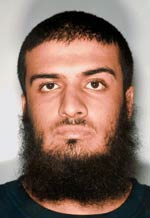
Mohammed Abu Baker Mansha (Metropolitan Police) | |
Another interesting case comes from London, where Mohammed Abu Baker Mansha, 21, was arrested on March 24 in a 4 a.m. raid that produced the following items:
- A range of outdoor equipment, some with possible military uses, including military binoculars, full-face balaclavas with eyeholes cut out, a radio scanner and a respirator, four sleeping bags, four pairs of gloves and four pairs of Wellington boots in different sizes;
- Correspondence that "appeared to suggest his involvement in what are described as missions abroad";
- A newspaper clipping referring to a decorated British soldier, with his details circled and his home address and personal details written down on a separate piece of paper;
- Ordnance Survey maps of the Snowdonia region and route planners for the area;
- A "quantity of material appearing to indicate that extremist leanings can be attributed to Mr Mansha."
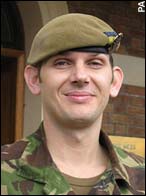
Corporal Mark Byles |
|
The circumstantial evidence looks damning; how will the legal process turn out? Will there be enough to put Mansha away or will he walk? This is one to watch.
Comment: Had the 9/11 hijackers been stopped before they carried out their crimes, the circumstantial evidence would have been about what it is for Mansha – dual use equipment, extremist literature, clippings, prayers, and the like. Presumably, under the more lax rules of that era, they would have walked and law enforcement would have had egg on its face. (March 30, 2005)
Dec. 7, 2005 update (with some information added from the Dec. 22 coverage of the conviction): Mansha's trial is now underway and it appears to rely heavily on circumstantial evidence. Consider, for example, the thesis that Mansha planned to attack Corporal Mark Byles, a hero in Iraq: During the raid on Mansha's residence in March 2005, his fingerprints were found on a newspaper. David Cocks, the Queen's Counsel, explained:
In a bag belonging to him found behind the sofa, officers found a number of documents, the first of those was the Sun newspaper dated 8 September 2004 and the headline on the front read "Lionheart Bayonet Charge Hero To Get Bravery Gong" and had subject matter about the corporal.
The article related how Byles had been awarded the Military Cross for showing "immense professionalism under fire" and for his strong leadership qualities. Mansha, however, focused on the passages relating to Iraqi deaths. Cocks continued:
One part read "Corporal Byles, of Portsmouth, Hants, thinks he killed between 15 and 20 Iraqi insurgents during the war." And someone circled this information. We say this is highly significant and someone has singled out the corporal's home town. Then on a sheet of paper found in his bag the defendant had written something down and this is in Mansha's handwriting. He had written "Hero Corporal Mark Byles, Portsmouth, Hants." Then followed his door number 31, house name Perth House, street name Australia Close, town Portsmouth and then his postcode. It wasn't an up to date address as he had left it some time before these events. But someone had done some research based on the Sun newspaper entry and turned up the fact Corporal Byles was on the electoral register for Portsmouth.
Other anti-Western materials, deemed "virulent" by Cocks, found in Mansha's residence included a picture of Osama Bin-Laden and others of the beheaded body of British engineer Kenneth Bigley. He had films that, in Cocks' description, "contained Arabic chanting and singing, praising the Holy War and Jihad, glorifying martyrdom, calling on Islam to take part in a Jihad, particularly after the Allied attack on Falujah."
A poem found read in part:
All you enemies who want to defeat Islam, well, the fact we all know is Islam can never be defeated. No dirty pigs like Blair or Bush could move this one bit.
Cocks concluded why Mansha had these materials:
We say that looking at it in the context of what was in the flat. He had the piece of paper with Corporal Byles' information in his possession either to kill him or do him really serious injury. To exact revenge no doubt with other people for what the corporal had achieved in Iraq and the part the corporal had played in killing Iraqi insurgents.
We say he was targeted for political purposes and there was other research to do as his address was out of date but that was the beginning. We say he has the piece of paper with Corp Byles' details in his possession so he could hunt him down and at the very least use very serious violence against him so British soldiers in particular and the British public in general might be intimidated and the Islamic cause might be advanced.
Cocks told jurors that other indications showed that Mansha sought information on a rich Jewish man and the Hindu owner of a cash and carry business. "It is plain that they were also being targeted. In their case, it is nothing to do with harm they may have done to the Muslim community. It was because of their religious beliefs."
All this makes perfect sense, of course, but it all rests on assumptions about Mansha's mindset. Were he seen as a patriotic Briton, the circling of the death information and the tracking down of Byles' address could be interpreted as celebrating Byle's achievement. That a terrorism case is premised on the defendant's Islamist perspective strikes me as breaking new ground.
Dec. 22, 2005 update: Jurors found Mohammed Abu Baker Mansha guilty today of one count of possessing information likely to be useful to a person committing or preparing an act of terrorism (Section 58 1b of the Terrorism Act 2000). In brief, jurors were convinced that Mansha intended to attack Corporal Byles as vengeance for his killing Iraqis. Mansha now faces up to 10 years in prison; his sentencing takes place January 26. It is also worth noting that Mansha has a previous conviction for threatening a white stallholder at Whitechapel Market with an iron bar while shouting ‘White bastard!'
In prepared statements, Mansha denied he had anything to do with terrorism, said he has no political views, is not a strictly practicing Muslim, bought the fake gun as a souvenir, and claimed friends with access to his residence placed some of the incriminating materials there. He did, however, admit owning some of the DVDs found there. He claimed that most of the items picked up by the police in his apartment were for research he was doing to help a journalist friend.
Comment: Conceptually, this is an important victory over terrorism. As David Cocks put it: by targeting Byles for political purposes, Mansha hoped "British soldiers in particular and the British public in general might be intimidated and the radical Islamic cause might be advanced." Mansha was effectively convicted on the basis of the Islamist ideas and planned actions in his head, nothing more. That is a crucial defense needed for the civilized world's security.
Jan. 26, 2006 update: Judge Nicholas Loraine-Smith imposed a six-year sentence on Mansha, four years less than the maximum allowed. In explaining his actions, the judge told the criminal that no attack having occurred was a mitigating factor, as was his lack of intelligence and the influence over him by others. "You have never faced a charge for conspiracy to kill or cause harm and I do not sentence you for that, but when that information [the soldier's address] came into your possession and was recorded by you, you crossed the boundary into terrorism."


